
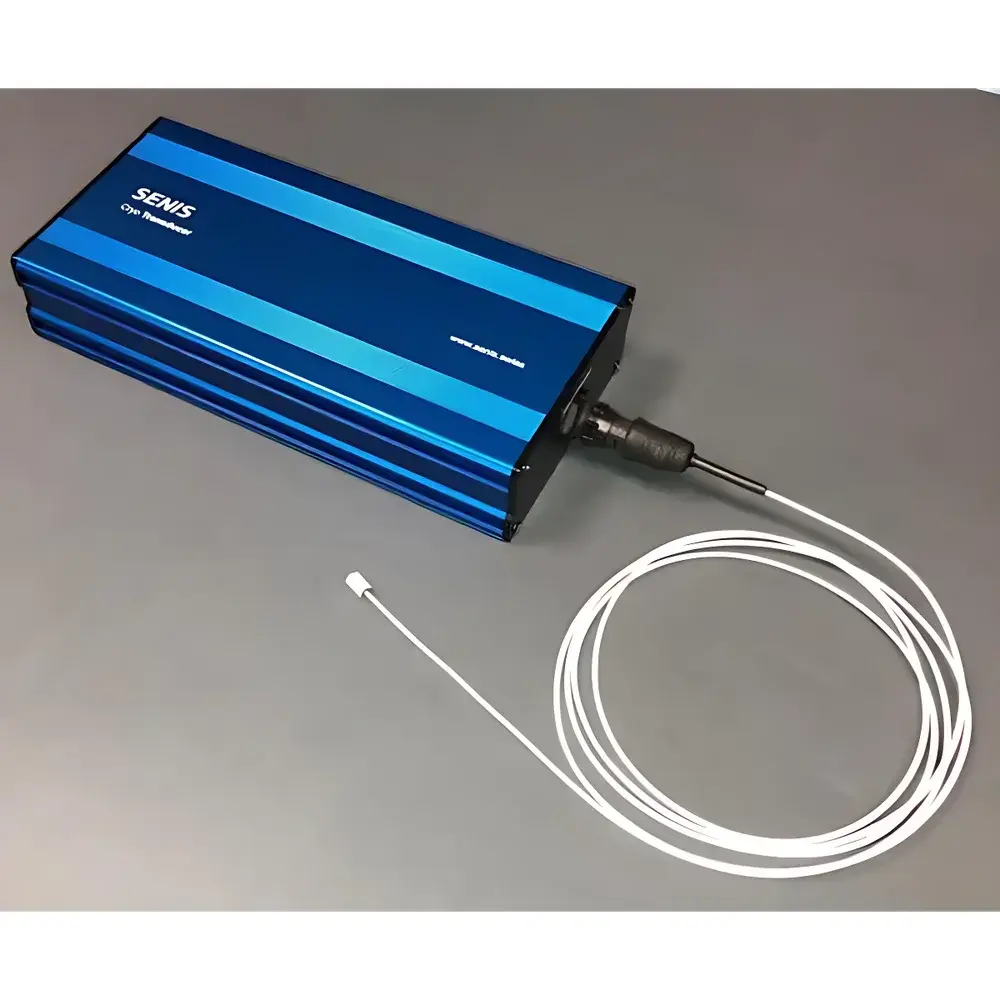
Auniontech K3A Cryogenic Low-Noise 3-Axis Hall Magnetometer / Tesla Meter
| Brand | Auniontech |
|---|---|
| Origin | Shanghai, China |
| Model | K3A |
| Measurement Principle | Semiconductor Hall Effect (3-axis orthogonal sensing) |
| Operating Temperature Range (Probe) | <1 K to 320 K |
| Full-Scale Ranges | ±2 T, ±5 T, ±9 T |
| Calibration Accuracy | 0.25% FS (optional cryogenic calibration down to 4 ± 2 K) |
| Noise Spectral Density (white noise) | <0.04 µT/Hz¹ᐟ² |
| Corner Frequency (1/f noise) | 10 Hz |
| Bandwidth | DC to 1 kHz |
| Field-Sensitive Volume | <0.6 mm³ |
| Probe Dimensions | 4.5 × 4.5 × 9 mm |
| Electronics Supply | 0–24 V DC |
| Interconnect Cable | 12 m |
| Electronic Box | 230 × 109 × 45 mm, 0.8 kg |
| Output | Differential ±10 V @ full scale |
| Offset Drift | <2 µT (<1 ppm FS) at room temperature |
| Long-Term Sensitivity Stability | <1% over 10 years |
| Temperature Coefficient | <25 ppm/K |
Overview
The Auniontech K3A Cryogenic Low-Noise 3-Axis Hall Magnetometer is a precision magnetic field measurement system engineered for quantitative vector characterization of static and quasi-static magnetic fields in extreme thermal environments—from sub-kelvin cryogenic stages up to ambient conditions. Based on monolithic, orthogonally aligned Hall sensor elements fabricated using high-mobility semiconductor technology, the K3A delivers true three-component (Bx, By, Bz) field resolution with minimal thermal cross-talk and negligible hysteresis. Its ultra-compact probe head—measuring only 4.5 × 4.5 × 9 mm—integrates active temperature compensation circuitry and low-thermal-conductance mechanical mounting interfaces, enabling direct integration into dilution refrigerators, superconducting magnet bores, and quantum device test cryostats without perturbing local thermal or magnetic environments. The sensor operates reliably below 1 K (verified in pumped 4He and dry 3He systems), with full electrical functionality maintained across its specified probe temperature range of <1 K to 320 K.
Key Features
- True 3-axis vector measurement with independent analog differential outputs (±10 V full-scale) for Bx, By, and Bz, enabling real-time field mapping and gradient estimation
- Field-sensitive volume <0.6 mm³—achieved via sub-millimeter active Hall element geometry (1.5 × 1.3 × 0.3 mm³)—minimizing spatial averaging artifacts in inhomogeneous fields
- Low-noise analog front-end with white-noise floor <0.04 µT/Hz1/2 above 10 Hz and 1/f corner frequency at 10 Hz, optimized for DC-stable cryogenic applications
- Cryogenic calibration traceable to NIST-traceable standards; optional high-accuracy calibration (0.25% FS) performed at user-specified temperatures down to 4 ± 2 K
- High-field capability up to ±9 T with linearity deviation <0.1% FS across full range, supported by comprehensive DC calibration tables for each probe
- Long-term stability: sensitivity drift <1% over 10 years; offset fluctuation <2 µT (<1 ppm of ±9 T full scale) at room temperature
- Robust mechanical design: hermetically sealed ceramic probe housing compatible with UHV, liquid helium, and inert-gas cryogenic environments
Sample Compatibility & Compliance
The K3A probe is compatible with standard cryogenic sample holders, radiation shields, and cold-finger-mounted platforms. It requires no external magnetic shielding beyond that provided by the host cryostat or magnet system. The electronics module complies with IEC 61000-6-3 (EMC emission limits) and IEC 61000-6-2 (immunity to electrostatic discharge and conducted RF disturbances). While not certified for medical or aerospace use, its performance parameters align with requirements for ISO/IEC 17025-accredited laboratories conducting magnetic field metrology under GLP conditions. Data acquisition workflows support audit-ready timestamping and metadata logging when interfaced with compliant DAQ systems (e.g., National Instruments PXI platforms configured per FDA 21 CFR Part 11 guidelines).
Software & Data Management
The K3A operates as a hardware-transparent analog transducer: output signals are fully compatible with third-party data acquisition systems supporting ±10 V differential inputs and 24-bit resolution. Aboard the electronics unit, no embedded firmware or proprietary drivers are required—eliminating software obsolescence risk. For standardized deployment, Auniontech provides a documented pinout specification, voltage-to-field conversion coefficients (including temperature-dependent correction polynomials), and MATLAB/Python reference scripts for batch calibration table interpolation and vector field reconstruction. Raw voltage streams may be archived in HDF5 or TDMS formats to ensure long-term readability and FAIR (Findable, Accessible, Interoperable, Reusable) data principles compliance.
Applications
- Mapping stray fields and homogeneity profiles inside superconducting magnets and hybrid cryo-electromagnets
- In situ characterization of persistent current decay and flux creep in NbTi/Nb3Sn coils during cooldown/warm-up cycles
- Quantitative validation of magnetic shielding effectiveness in quantum computing dilution refrigerator inserts
- Calibration transfer between primary standards (e.g., NMR teslameters) and secondary probes in cryogenic test benches
- Time-resolved monitoring of pulsed field decay in capacitor-driven magnet systems (bandwidth supports ≤1 kHz transients)
- Material science studies requiring concurrent magnetization and local field feedback, such as magneto-caloric effect measurements or spin ice characterization
FAQ
Is the K3A probe compatible with ultra-high vacuum (UHV) environments?
Yes—the probe housing uses ceramic-to-metal seals and contains no organic adhesives or outgassing polymers. Outgassing rates meet ASTM E595 specifications for space-qualified components.
Can the K3A be calibrated at arbitrary temperatures below 4 K?
Standard calibration is offered at 4 ± 2 K, 10 K, 20 K, 77 K, and 300 K. Custom calibrations below 4 K require coordination with Auniontech’s metrology lab and depend on available cryogenic infrastructure.
What is the maximum allowable thermal gradient across the probe body during operation?
To maintain specified accuracy, axial and transverse thermal gradients should remain below 0.5 K/mm. Mounting recommendations and thermal interface material guidance are included in the installation manual.
Does the electronics unit require cooling in cryogenic setups?
No—the electronics operate nominally from 10 °C to 35 °C and must be located outside the cryostat. The 12 m low-capacitance shielded cable ensures signal integrity without active cooling of the interconnect.
How is traceability ensured for cryogenic calibrations?
Each calibration certificate includes uncertainty budgets per ISO/IEC Guide 98-3 (GUM), referencing NIST-traceable NMR teslameter measurements performed in situ within the same cryostat configuration used for user testing.



