
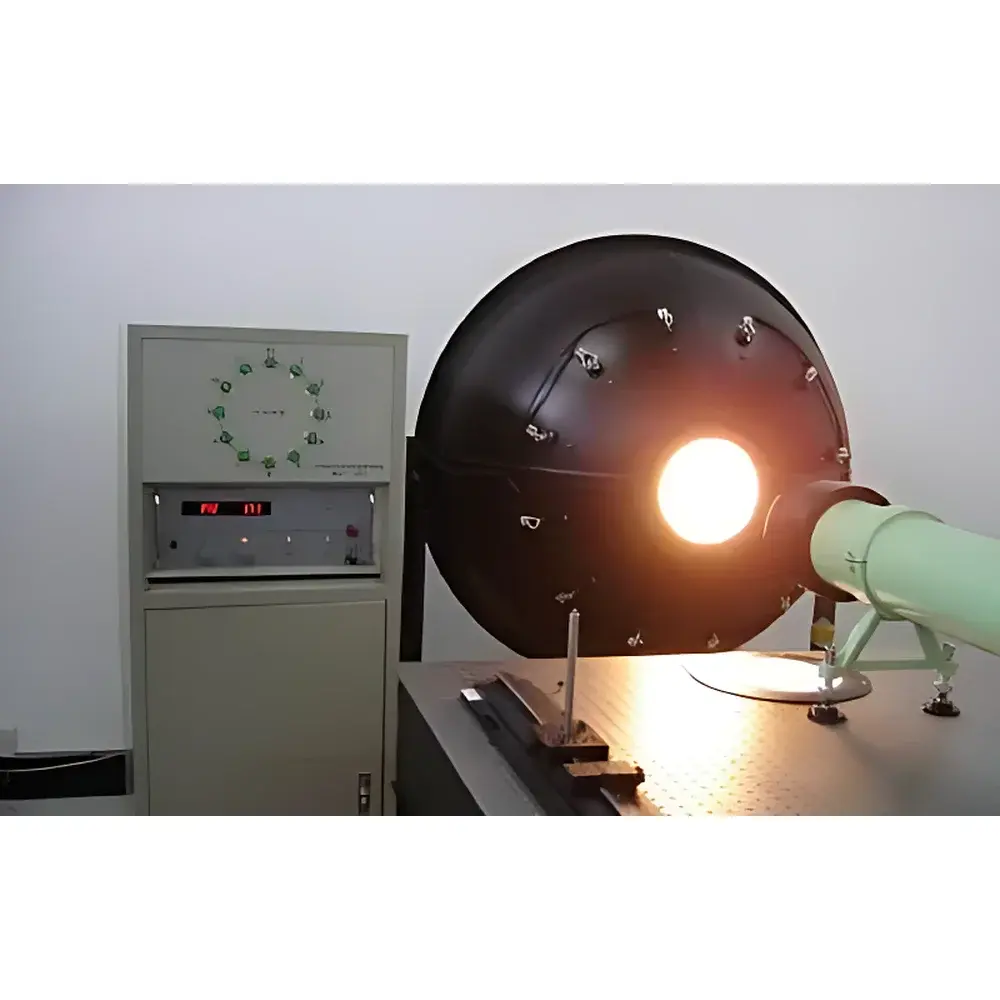
SPL SPL Monochromatic / Single-Wavelength Uniform Light Source System
| Brand | SPL |
|---|---|
| Origin | USA |
| Manufacturer Type | Authorized Distributor |
| Product Origin | Imported |
| Model | SPL Monochromatic / Single-Wavelength Uniform Light Source System |
| Pricing | Available Upon Request |
Overview
The SPL Monochromatic / Single-Wavelength Uniform Light Source System is a precision-engineered optical calibration platform designed for radiometric and photometric validation of imaging sensors, photodetectors, CCD/CMOS arrays, and spectroradiometric instrumentation. Built upon a stable, collimated beam architecture, the system delivers spatially uniform irradiance across a defined target plane—critical for minimizing pixel-to-pixel responsivity errors during detector characterization. Its core optical design employs either a stabilized tungsten-halogen lamp, high-stability LED module, or narrow-linewidth laser source, coupled with precision monochromator or interference filter-based wavelength selection to isolate a single spectral band. This enables traceable, repeatable illumination at user-selectable wavelengths—typically spanning 250–1100 nm depending on source and filter configuration. The system operates on the principle of calibrated spectral irradiance generation, where absolute output is determined via real-time monitoring by an integrated NIST-traceable radiometric detector mounted in a fixed geometry relative to the output aperture.
Key Features
- Configurable light source options: tungsten-halogen lamp (broadband, high CRI), high-power LED (narrow FWHM, long lifetime), or single-mode laser (ultra-narrow linewidth, coherence control)
- Integrated radiometric monitoring detector with real-time analog/digital output for closed-loop intensity stabilization
- Uniformity >98% over Ø25 mm circular field (measured per ISO 13665 and ASTM E275) using optimized diffuser and homogenizer optics
- Continuous intensity adjustment from 0% to 100% of maximum output via analog voltage or digital command (RS-232/USB)
- Wavelength selection via interchangeable interference filters (e.g., 10 nm FWHM BW) or motorized monochromator (optional)
- Factory-calibrated radiometric output with NIST-traceable certificate covering spectral irradiance (W·m⁻²·nm⁻¹) and total radiant flux (W) at specified wavelengths and apertures
- Rugged aluminum housing with thermal management system to ensure <±0.2% output drift over 4-hour operation
Sample Compatibility & Compliance
The system accommodates standard detector packages including TO-can photodiodes, surface-mount Si/InGaAs sensors, scientific-grade CCD and sCMOS cameras, and fiber-coupled spectrometer inputs. It supports calibration workflows compliant with ISO/IEC 17025-accredited laboratories and meets essential requirements for GLP and GMP environments where instrument qualification is mandatory. Radiometric calibrations are performed in accordance with NIST SP 250-95 and ISO/IEC 17025:2017 Annex A.2 guidelines. Optional IQ/OQ documentation packages—including installation verification, operational range testing, and uniformity mapping reports—are available to support FDA 21 CFR Part 11-compliant data integrity protocols.
Software & Data Management
The SPL Uniform Light Source integrates with SPL Control Suite v3.x—a Windows-based application supporting automated wavelength/intensity sweeps, time-resolved stability logging, and export of calibrated irradiance datasets in CSV and HDF5 formats. All measurement records include embedded metadata: timestamp, source ID, filter position, monitored detector reading, ambient temperature, and calibration certificate ID. Audit trail functionality logs user actions, parameter changes, and calibration events with immutable timestamps—ensuring full compliance with FDA 21 CFR Part 11 electronic record requirements. Remote operation via TCP/IP is supported for integration into automated test benches and production line calibration stations.
Applications
- Radiometric calibration of satellite Earth observation sensors and airborne multispectral imagers
- Responsivity mapping and non-uniformity correction (NUC) of scientific CMOS and EMCCD cameras
- Verification of spectral bandpass and out-of-band rejection in optical filters and dichroics
- Linearity testing of photodetectors across five decades of irradiance (10⁻⁶–10⁰ W·m⁻²)
- Development and validation of hyperspectral reconstruction algorithms
- Reference source for inter-laboratory comparison studies under CCPR Key Comparison protocols
FAQ
Is the NIST-traceable calibration certificate included with every unit?
Yes—each system ships with a unique, factory-issued calibration report traceable to NIST Standard Reference Materials (SRMs) 2020, 2030, and 2065, valid for 12 months from date of issue.
Can the system be configured for UV-VIS-NIR coverage beyond 1100 nm?
Yes—custom configurations with InGaAs-detected extended NIR (up to 1700 nm) or deep-UV deuterium lamp sources are available upon request.
What level of spatial uniformity is guaranteed, and how is it verified?
Guaranteed uniformity is ≥98% over a Ø25 mm area at the output port; verified using a calibrated scanning photodiode array per ISO 13665 Annex B and documented in the OQ report.
Does the system support automated calibration sequences for high-throughput production environments?
Yes—via SPL Control Suite’s API (DLL and Python bindings), enabling integration with LabVIEW, MATLAB, or custom MES platforms for unattended batch calibration of detector arrays.





