
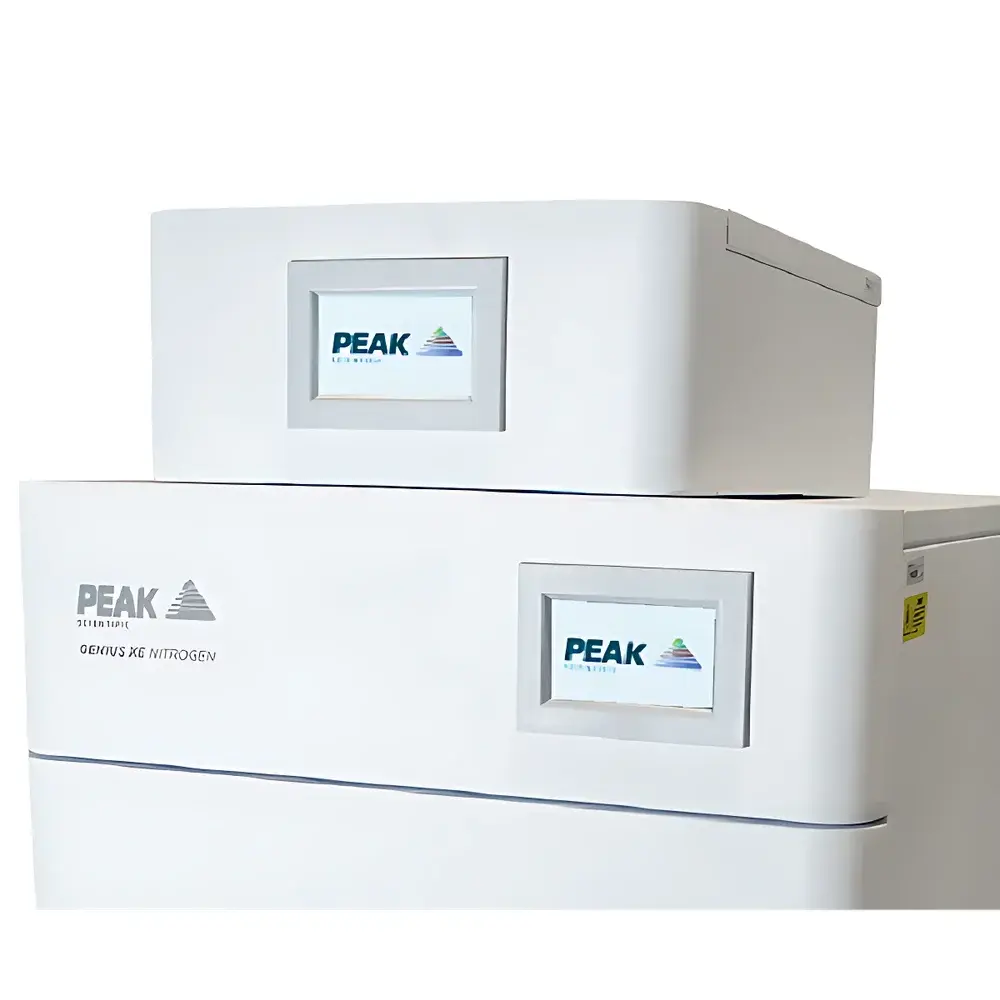
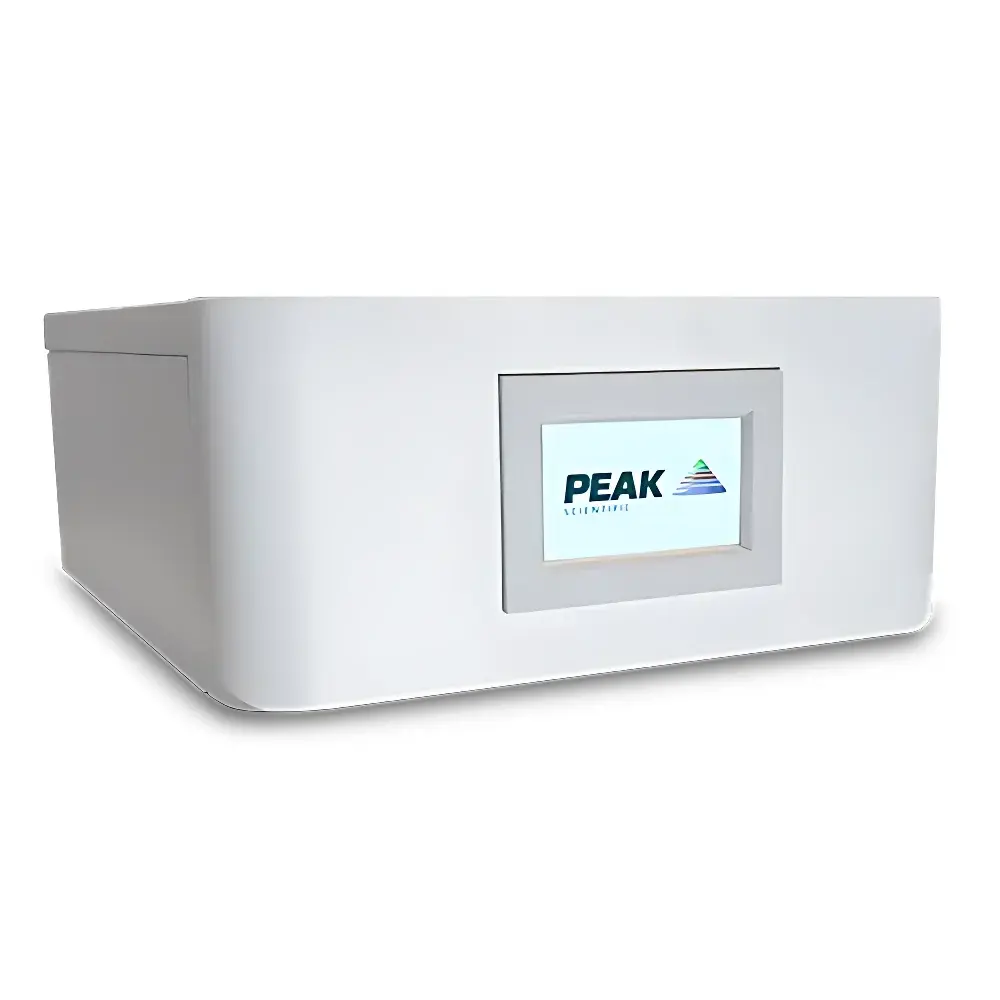
Peak Collision Gas Add-on for Nitrogen Generators
| Brand | PEAK |
|---|---|
| Origin | United Kingdom |
| Manufacturer Type | Original Equipment Manufacturer (OEM) |
| Import Status | Imported |
| Model | Collision Gas Add-on |
| Nitrogen Generation Principle | Pressure Swing Adsorption (PSA) |
| Output Flow Rate | 200 cc/min |
| Output Pressure | 80 psi |
| Nitrogen Purity | 99.999% |
Overview
The Peak Collision Gas Add-on is an engineered auxiliary module designed exclusively for integration with existing PEAK nitrogen generator systems—primarily those deployed in high-sensitivity mass spectrometry (MS) laboratories. It functions as a secondary purification stage, drawing a dedicated nitrogen stream from the primary generator and subjecting it to additional PSA-based refinement to meet the stringent gas specifications required for collision cell operation in triple quadrupole (QQQ), time-of-flight (TOF), and ion trap mass spectrometers. Unlike standalone nitrogen generators, this add-on does not operate independently; rather, it leverages the base system’s stable pressure and feedstock purity while applying proprietary adsorbent media and optimized cycle timing to achieve ultra-high-purity nitrogen (99.999% N₂) at a precisely regulated flow rate of up to 200 cc/min and delivery pressure of 80 psi. Its design adheres to the physical constraints and gas dynamics of collision-induced dissociation (CID) processes, where trace oxygen, moisture, or hydrocarbon contaminants can compromise ion transmission efficiency, signal-to-noise ratio, and quantitative reproducibility.
Key Features
- Secondary PSA purification architecture—integrated inline with PEAK’s core nitrogen generator to deliver dual-purity output streams (standard lab-grade and collision-cell-grade)
- Stable 200 cc/min flow control with pressure regulation maintained at 80 psi ±3 psi, independent of upstream fluctuations within the parent generator’s operational envelope
- Real-time HMI interface with LED status indicators, fault logging, and configurable alarm thresholds for dew point, pressure drop across filters, and adsorbent saturation
- Modular service design enabling synchronized annual maintenance with the host PEAK nitrogen generator—minimizing system downtime and eliminating the need for separate calibration or validation cycles
- No external cylinder dependency: eliminates logistical risks associated with high-pressure gas storage, transport, and changeover—including supply interruption, contamination during connection, and regulatory documentation overhead
- Compact footprint (W × D × H: 240 × 320 × 180 mm) with standard 1/4″ Swagelok® inlet/outlet ports compatible with PEAK’s OEM tubing specifications
Sample Compatibility & Compliance
The Collision Gas Add-on is validated for use with PEAK’s Genius, Precision, and Maxima series nitrogen generators. It is intended solely for laboratory-scale analytical instrumentation requiring ultra-high-purity carrier or collision gas—not for industrial process or inerting applications. The unit complies with IEC 61000-6-2 (immunity) and IEC 61000-6-4 (emissions) for electromagnetic compatibility. While not certified to ISO 8573-1 Class 1 for compressed air, its nitrogen output meets or exceeds ISO 8573-1:2010 Class 1.2.1 (solid particles ≤0.1 µm, water dew point ≤−70 °C, oil content ≤0.01 mg/m³) when operated within specified ambient conditions (15–30 °C, RH <70%). It supports GLP/GMP-aligned workflows through audit-ready maintenance logs stored locally on the HMI and exportable via USB interface.
Software & Data Management
The add-on operates autonomously without host PC software dependency. All operational parameters—including cumulative runtime, filter service intervals, pressure differential history, and alarm event timestamps—are retained in non-volatile memory. Maintenance records are timestamped and include operator ID entry capability for multi-user labs. Data export is supported via USB-C port in CSV format, facilitating integration into laboratory information management systems (LIMS) for preventive maintenance scheduling and FDA 21 CFR Part 11-compliant record retention when paired with validated PEAK generator firmware (v4.2+). No remote connectivity or cloud features are implemented, preserving network security integrity in regulated environments.
Applications
- Collision-induced dissociation (CID) in tandem MS platforms requiring ultra-low background interference
- Reaction monitoring in selected reaction monitoring (SRM) and multiple reaction monitoring (MRM) assays
- High-resolution accurate-mass (HRAM) analysis where residual O₂ or H₂O contributes to polyatomic adduct formation
- Long-duration unattended acquisition runs (>72 h), where cylinder depletion risk is unacceptable
- Multi-instrument nitrogen distribution networks where one PEAK generator serves both LC-MS carrier gas and MS/MS collision gas demands
FAQ
Is the Collision Gas Add-on compatible with non-PEAK nitrogen generators?
No. It is mechanically, pneumatically, and electrically engineered for seamless integration only with PEAK-branded nitrogen generators featuring the designated auxiliary interface port and firmware handshake protocol.
Does installation require modification of the existing PEAK generator?
No. Installation uses the factory-provided auxiliary gas port and plug-and-play cabling; no internal generator hardware or firmware changes are necessary.
What maintenance is required beyond the annual service?
Only routine visual inspection of inlet particulate filters and verification of HMI alarm silence function; no user-replaceable consumables are accessible outside scheduled service.
Can output flow be adjusted below 200 cc/min?
Yes—via calibrated needle valve integrated into the outlet manifold, allowing fine-tuned flow reduction while maintaining pressure stability and purity integrity.
Is third-party validation support available for 21 CFR Part 11 compliance?
Yes. PEAK provides IQ/OQ documentation templates and on-site qualification support for laboratories implementing electronic records and signatures under FDA-regulated quality systems.
Related Products



