
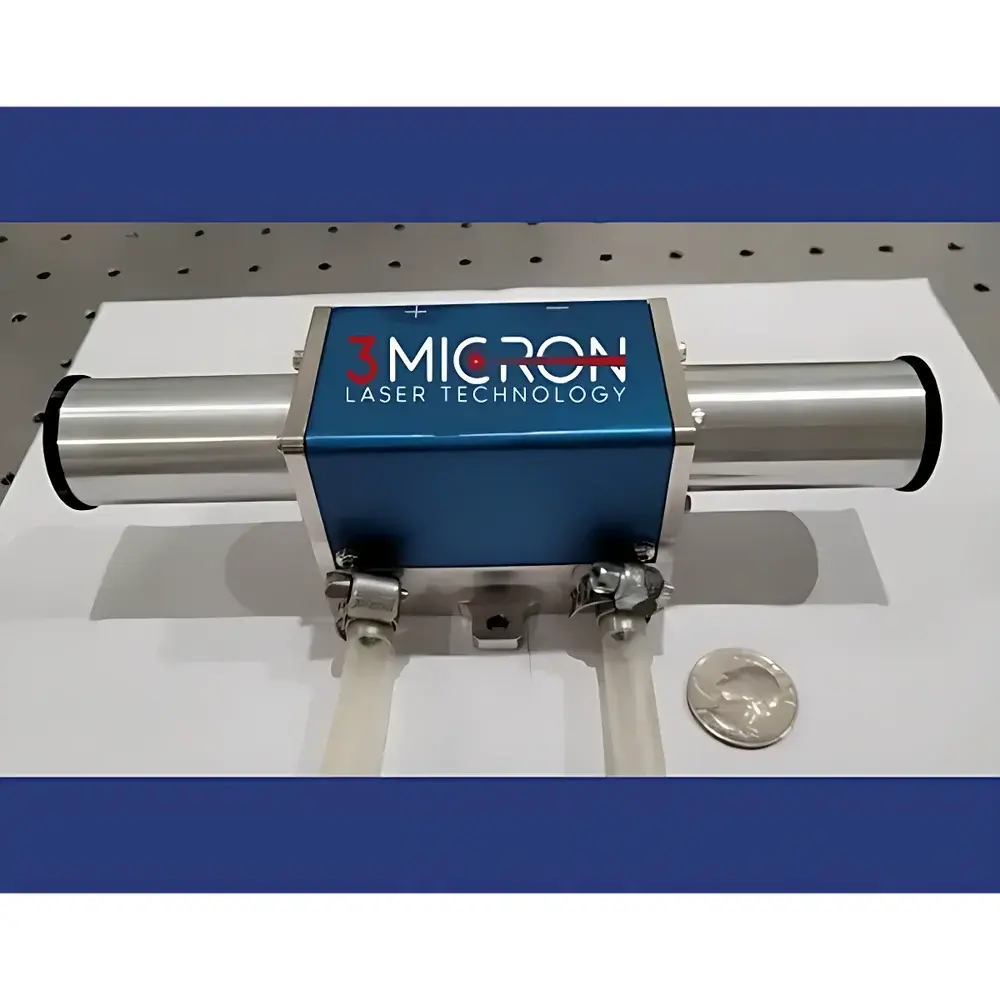
Auniontech 2940 nm Er:YAG Pulsed Solid-State Laser System
| Brand | Auniontech |
|---|---|
| Origin | Shanghai, China |
| Type | Mid-Infrared Pulsed Laser Source |
| Wavelength | 2940 nm |
| Average Output Power Options | 23 W, 55 W, 100 W, 160 W, 200 W |
| Peak Power | 2 kW – 5 kW |
| Pulse Energy | 0.35 J – 7.5 J |
| Pulse Width | 100–1500 µs |
| Repetition Rate | 10–250 Hz |
| Beam Quality | M² = 2–15 |
| Beam Profile | Near-Top-Hat |
| Weight | < 1 kg |
Overview
The Auniontech 2940 nm Er:YAG pulsed solid-state laser system is a medical- and industrial-grade mid-infrared laser source engineered for precision ablation, soft-tissue interaction, and non-metallic material processing. Operating at the fundamental vibrational absorption peak of liquid water (2940 nm), this laser leverages the exceptionally high absorption coefficient (~12,000 cm⁻¹) — approximately tenfold greater than that of CO₂ lasers (10.6 µm) — to achieve highly localized energy deposition with minimal thermal diffusion. Its pulse architecture—featuring microsecond-to-millisecond pulse durations (100–1500 µs) and adjustable repetition rates (10–250 Hz)—is optimized for controlled photothermal vaporization while preserving adjacent tissue integrity. The system employs diode-pumped, flashlamp-free Er:YAG crystal technology, ensuring stable output, low temporal jitter, and long-term operational reliability in both clinical and laboratory environments.
Key Features
- Wavelength-optimized emission at 2940 nm, precisely matching the strongest OH-stretching vibrational resonance in aqueous media
- Multiple power configurations: average output from 23 W to 200 W, with corresponding peak powers ranging from 2 kW to 5 kW
- Adjustable pulse parameters: pulse width (100–1500 µs), repetition rate (10–250 Hz), and pulse energy (0.35 J to 7.5 J) enable application-specific tuning
- Near-top-hat spatial beam profile with M² values between 2 and 15, supporting uniform irradiance distribution across target areas
- Compact, air-cooled design weighing less than 1 kg—suitable for integration into endoscopic platforms, dental handpieces, or OEM laser processing modules
- Robust diode-pumped architecture eliminates flashlamp degradation, reducing maintenance intervals and enhancing pulse-to-pulse stability
Sample Compatibility & Compliance
This laser system is validated for interaction with hydrated biological tissues—including epidermis, dermis, mucosa, and dental enamel—as well as non-metallic industrial substrates such as fused silica, borosilicate glass, polymers (e.g., PMMA, PTFE), and ceramic composites. Its optical characteristics align with key standards governing medical laser safety and performance: IEC 60825-1 (Laser Product Safety), ANSI Z136.1 (Safe Use of Lasers), and ISO 11553-1 (Safety of Laser Processing Equipment). While not certified as a Class IIIB or IV medical device per FDA 21 CFR Part 820 without end-user validation, the system supports integration into Class IIIB/IV medical laser systems compliant with IEC 60601-2-22 requirements. All models include interlock-ready TTL control interfaces and meet CE marking directives for electromagnetic compatibility (EMC) and low-voltage operation.
Software & Data Management
The laser controller features RS-232 and USB-C digital interfaces compatible with LabVIEW™, MATLAB®, and Python-based automation frameworks. Firmware supports real-time parameter logging—including pulse count, actual output energy (via integrated photodiode feedback), temperature monitoring, and error flagging—with timestamped CSV export. For regulated environments, optional audit-trail firmware enables GLP/GMP-compliant operation: all user-initiated parameter changes are recorded with operator ID, timestamp, and pre-/post-change values—fully traceable under FDA 21 CFR Part 11 electronic record requirements when deployed on validated host systems.
Applications
- Dermatology & Aesthetics: Fractional resurfacing, scar revision, actinic keratosis ablation, sebaceous hyperplasia removal, and superficial vascular lesion treatment
- Dentistry: Caries excavation, cavity preparation, soft-tissue surgery (gingivectomy), and enamel conditioning without microfracture
- Otolaryngology & ENT: Precise laryngeal and nasal mucosal ablation with sub-10 µm coagulation depth
- Industrial Micromachining: Low-thermal-load cutting of optical glasses, sapphire wafers, and biodegradable polymer films
- Research: Water-mediated photoacoustic excitation, laser-induced breakdown spectroscopy (LIBS) of hydrated samples, and pump-probe studies of ultrafast vibrational relaxation in biomolecules
FAQ
What is the typical thermal penetration depth in hydrated tissue at 2940 nm?
At 2940 nm, the optical penetration depth in water-rich tissue is approximately 1–3 µm—limited by strong absorption—resulting in near-surface vaporization and minimal lateral thermal spread.
Can this laser be fiber-coupled?
Yes—when equipped with a ZnSe or CaF₂ collimation assembly and compatible mid-IR delivery fibers (e.g., hollow-core photonic bandgap or chalcogenide fibers), the system supports flexible integration into endoscopic or robotic platforms.
Is cooling required during continuous operation?
The system uses passive convection and thermoelectric cooling; no external water chiller is needed for duty cycles ≤ 20% at maximum average power.
How does pulse width affect ablation efficiency in soft tissue?
Shorter pulses (< 250 µs) favor explosive vaporization with minimal residual thermal damage; longer pulses (≥ 1 ms) increase thermal confinement for coagulative effects—enabling tunable ablation-to-coagulation ratios.
Does the system support synchronization with external imaging or motion control systems?
Yes—TTL sync outputs provide programmable delay-adjustable trigger signals for gated OCT acquisition, high-speed camera capture, or CNC stage coordination.






