
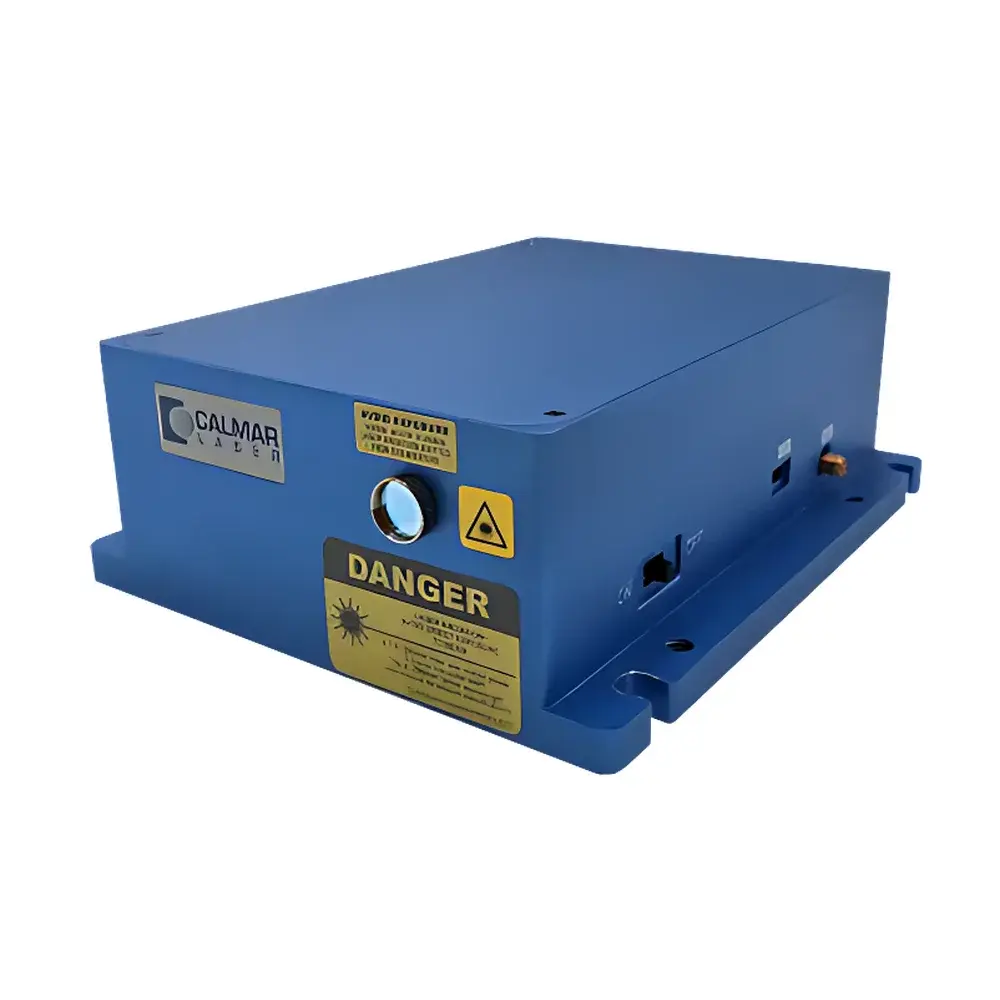
Calmar OEM Series Modular Picosecond/Femtosecond Fiber Lasers (780, 925, 1030, 1064, 1550 nm)
| Brand | Calmar Laser (OEM series by Auniontech) |
|---|---|
| Wavelengths | 780 nm, 925 nm, 1030 nm, 1064 nm, 1550 nm |
| Pulse Width | <90 fs – 10 ps (model-dependent) |
| Repetition Rate | 1–100 MHz (typ.) |
| Average Power | 0.5–200 mW (model-dependent) |
| Spectral Bandwidth (FWHM) | 0.5–30 nm (wavelength- and model-dependent) |
| Output Configuration | Free-space or fiber-coupled (PM or non-PM) |
| Power Supply | +5 V DC |
| Compliance | RoHS-compliant optical module architecture |
| Form Factor | OEM-integrated module or benchtop-ready unit |
Overview
The Calmar OEM Series Modular Picosecond/Femtosecond Fiber Lasers represent a family of passively mode-locked, all-fiber ultrafast laser sources engineered for integration into demanding industrial, scientific, and defense-grade systems. Based on proprietary semiconductor saturable absorber mirror (SESAM) technology refined over two decades, these lasers deliver exceptional temporal stability and turnkey operation without active stabilization electronics. Operating across five strategic wavelength bands—780 nm (Ti:sapphire pump band), 925 nm (biomedical imaging window), 1030/1064 nm (Yb-doped amplifier seeding), and 1550 nm (telecom C-band and eye-safe LIDAR)—the series supports diverse photonic applications requiring high coherence, low timing jitter, and robust environmental immunity. Each variant employs monolithic all-fiber architecture with fusion-spliced components, eliminating free-space alignment and minimizing sensitivity to thermal drift, mechanical shock, and vibration—critical for embedded OEM deployment in portable instrumentation, aerospace platforms, and automated manufacturing cells.
Key Features
- Passively mode-locked design with SESAM-based initiation and self-starting reliability under varying ambient conditions
- Sub-100 fs pulse widths (down to <90 fs at 780/1030/1064 nm; up to 10 ps at 1550 nm LDR variants) with transform-limited spectral phase
- Repetition rates scalable from 1 MHz to >100 MHz via cavity length engineering and harmonic mode-locking options
- Flexible output interface: polarization-maintaining (PM) or standard single-mode fiber pigtails (FC/APC or FC/PC); optional free-space collimated beam delivery
- Compact, conduction-cooled module form factor (e.g., Mendocino-LDR: 75 × 50 × 15 mm) compatible with battery-powered operation (3.3–5.5 V input range)
- OEM-ready electrical interface: TTL-compatible sync output, analog power monitor, and optional I²C-enabled microcontroller for remote parameter interrogation and health monitoring
- Full fiber-integrated architecture with hermetically sealed pump diodes and radiation-hardened components for extended lifetime (>50,000 hours MTBF)
Sample Compatibility & Compliance
These lasers are designed as seed sources for amplification stages (e.g., regenerative amplifiers, fiber chirped-pulse amplifiers) and as standalone excitation sources in time-resolved spectroscopy, multiphoton microscopy, and optical frequency comb generation. The 1550 nm LDR variant meets IEC 60825-1 Class 1M safety requirements when used with appropriate collimation optics. All modules comply with RoHS 2011/65/EU and REACH (EC 1907/2006) directives. Mechanical construction adheres to MIL-STD-810G for shock (50 g, 11 ms half-sine) and vibration (5–500 Hz, 0.04 g²/Hz PSD). Thermal performance is validated across –10 °C to +60 °C operating range with <0.05 nm/°C wavelength drift (1550 nm) and <1% RMS power fluctuation (24 h continuous operation).
Software & Data Management
While the base modules operate autonomously, optional firmware-enabled microcontrollers (e.g., Mendocino series) support I²C or UART communication for real-time telemetry: output power, diode temperature, pulse repetition rate lock status, and internal error flags. Logged data can be exported via ASCII-formatted serial dump for traceability in GLP/GMP environments. Integration with third-party DAQ systems (National Instruments, Keysight) is facilitated through LabVIEW drivers and Python SDK (available upon NDA). No proprietary software installation is required for basic operation—only +5 V DC power and optional trigger synchronization.
Applications
- Seed source for high-energy femtosecond amplifiers (e.g., Yb:fiber, Nd:YVO₄, Ti:sapphire CPA systems)
- Time-of-flight LIDAR and 3D flash imaging (1550 nm LDR variant optimized for atmospheric transmission and eye safety)
- Two-photon excited fluorescence (TPEF) and second-harmonic generation (SHG) microscopy (780 nm and 925 nm variants)
- Optical coherence tomography (OCT) system development (1064 nm for deeper tissue penetration; 1310/1550 nm for ophthalmic and dermatological imaging)
- Ultrafast pump-probe spectroscopy and carrier dynamics analysis in semiconductors and 2D materials
- Photonic integrated circuit (PIC) testing and characterization, including nonlinear waveguide response mapping
- Frequency comb stabilization and optical clock distribution in metrology-grade timing networks
FAQ
Are these lasers FDA-cleared for medical device integration?
No—these are Class 3B/4 OEM laser modules intended for incorporation into end-user systems subject to final regulatory review. System integrators must perform full IEC 60601-2-22 or ISO 13485 validation per application.
Can pulse duration be externally compressed?
Yes—models with transform-limited spectra (e.g., 780 nm, 1030 nm, 1064 nm) support grating- or prism-based compression to sub-50 fs durations; compression ratio depends on measured spectral phase and dispersion profile.
What is the maximum allowable back-reflection into the output fiber?
< –30 dB for PM-fiber variants; < –40 dB for free-space collimated outputs. Higher reflectivity may induce Q-switching instabilities or SESAM damage.
Is there factory calibration traceable to NIST standards?
Yes—pulse width (autocorrelation), average power (NIST-traceable thermopile sensor), and center wavelength (wavemeter calibrated against HeNe reference) are documented per unit in the Certificate of Conformance.
Do you offer custom wavelength tuning or repetition rate adjustment?
Limited customization is available for volume OEM orders (≥50 units), including cavity-length trimming for ±5% rep-rate shift and FBG-based wavelength selection within specified gain bands.






