
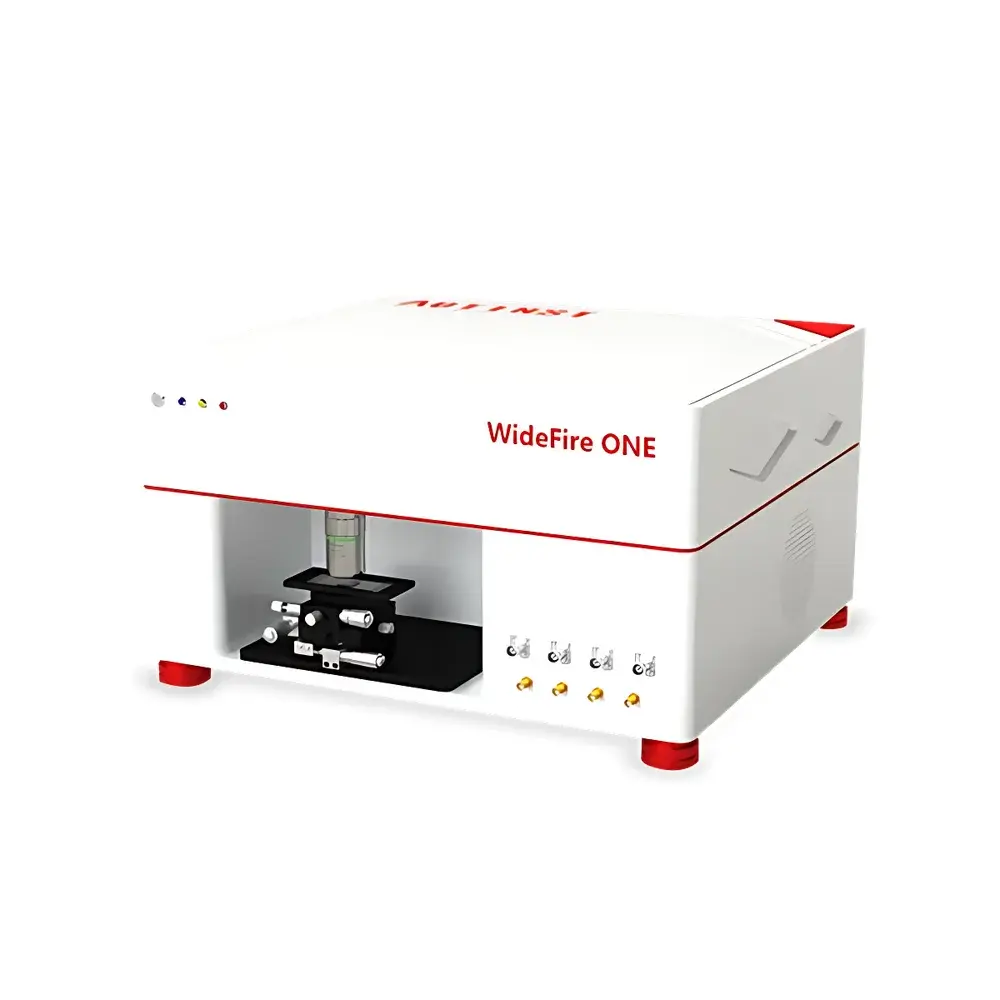
WildFire-ONE SDTR In-Plane Thermal Conductivity Measurement System
| Brand | Auniontech |
|---|---|
| Origin | Shanghai, China |
| Manufacturer Type | Authorized Distributor |
| Region of Origin | Domestic (China) |
| Model | SDTR In-Plane Thermal Conductivity Analyzer |
| Pricing | Available Upon Request |
Overview
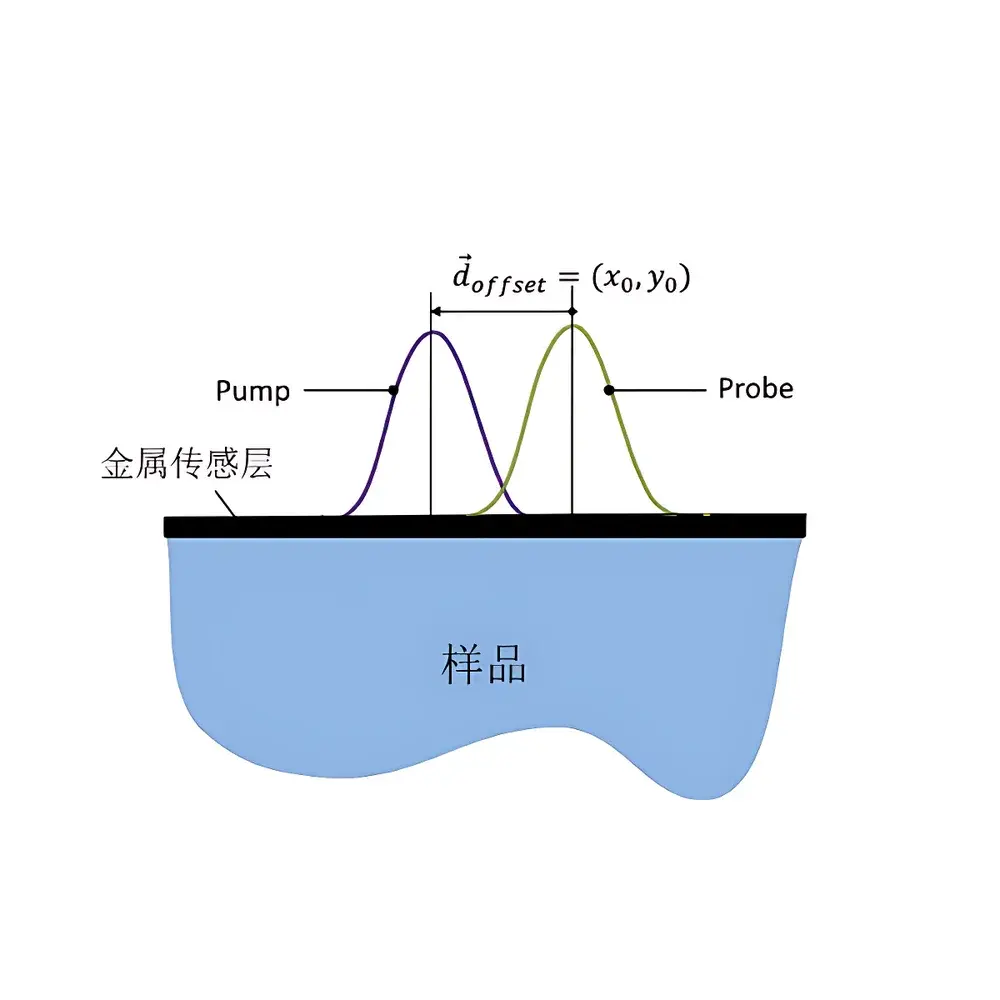
The WildFire-ONE SDTR In-Plane Thermal Conductivity Measurement System is an advanced optical pump-probe instrument engineered for high-precision, non-contact characterization of in-plane thermal transport properties in solid materials. It implements Spatial Domain Thermal Reflectance (SDTR), a frequency-domain photothermal technique rooted in the physical principles of heat diffusion and thermo-optic modulation. Unlike conventional bulk methods—such as laser flash analysis (LFA), guarded hot plate, or steady-state comparative cut-bar techniques—the WildFire-ONE is specifically optimized for sub-millimeter-scale samples (down to ~10 µm lateral dimensions), where traditional approaches suffer from edge-loss artifacts, poor signal-to-noise ratio, and insufficient spatial resolution. The system operates by modulating a focused pump laser (638 nm, 100 mW) at frequencies ranging from DC to 5 MHz (upgradable to 200 MHz), inducing localized periodic heating; a co-aligned probe beam (785 nm, 20 mW) then maps the resulting surface temperature field via reflectance changes. By acquiring amplitude and phase distributions across the heated region—and fitting them to a rigorously derived 2D/3D heat diffusion model—the system extracts the full in-plane thermal conductivity tensor (κxx, κyy, κxy) with traceable uncertainty.
Key Features
- Proprietary phase-difference fitting algorithm (Patent No. ZL 2021 1 1527522.3), eliminating absolute phase calibration drift and improving measurement repeatability
- Integrated automated beam profiling module for real-time, in situ measurement of pump/probe spot size (≤2% uncertainty), minimizing modeling error from input parameter inaccuracies
- High-fidelity micro-imaging subsystem for precise sample alignment, surface inspection, and laser spot positioning
- Modular cryogenic and high-temperature stages available: 4–300 K, 80–500 K, and 300–1200 K configurations support thermally dependent anisotropy studies
- Compact, vibration-insensitive optical architecture with rigid aluminum breadboard base and motorized XYZ translation stages
- Measurement uncertainty ≤5% for in-plane thermal conductivity across isotropic and anisotropic thin films, multilayers, and bulk single crystals (e.g., X-cut quartz)
Sample Compatibility & Compliance
The WildFire-ONE accommodates electrically insulating and semiconducting materials—including dielectric thin films (SiO₂, AlN, h-BN), transition metal dichalcogenides (MoS₂, WSe₂), polymer composites, thermoelectric ceramics (Bi₂Te₃), and crystalline substrates (sapphire, SiC, quartz). Sample thickness ranges from 1 mm; lateral dimensions ≥50 µm are sufficient for reliable tensor reconstruction. The system complies with ISO 22007-2 (thermal conductivity determination by photothermal methods) and supports GLP/GMP-aligned data integrity through timestamped audit trails, user-access controls, and electronic signature-capable reporting. All firmware and software adhere to IEC 62304 for medical device software lifecycle management—relevant for instruments deployed in regulated R&D environments.
Software & Data Management
The proprietary WildFire Control Suite provides fully automated acquisition, real-time visualization, and model-based inversion. Users define scan parameters (step size, dwell time, modulation frequency sweep), initiate alignment routines, and launch batch measurements without manual intervention. Raw amplitude/phase maps are stored in HDF5 format with embedded metadata (laser power, spot size, ambient temperature, stage position). Built-in fitting engines implement finite-element and analytical solutions of the heat equation under user-specified boundary conditions (e.g., adiabatic, convective, or substrate-coupled). Export options include CSV, MATLAB .mat, and PDF reports compliant with ASTM E2581 requirements for thermal property documentation. Software validation packages—including IQ/OQ protocols and 21 CFR Part 11 compliance modules—are available upon request.
Applications
- Quantifying in-plane anisotropy in 2D materials and epitaxial heterostructures for next-generation thermal interface design
- Mapping local thermal conductivity gradients in CVD-grown graphene and hexagonal boron nitride films
- Validating phonon transport models in nanostructured thermoelectrics and low-k dielectrics
- Process monitoring of thin-film deposition uniformity and interfacial quality in semiconductor packaging
- Thermal reliability assessment of flexible electronics substrates under thermal cycling conditions
- Supporting USP and ISO 13822 thermal property validation for biomedical device materials
FAQ
What sample preparation is required prior to measurement?
Minimal preparation is needed: samples must be optically flat, clean, and free of oxidation layers or contaminants that absorb at 638/785 nm. No metallization or coating is required.
Can the system measure cross-plane thermal conductivity?
No—the WildFire-ONE is optimized exclusively for in-plane (lateral) thermal transport. Cross-plane measurements require complementary techniques such as time-domain thermoreflectance (TDTR) or frequency-domain thermoreflectance (FDTR).
Is vacuum or inert atmosphere operation supported?
Yes. The sample stage accommodates custom vacuum chambers (<10⁻³ mbar) or gas-purged enclosures for oxidation-sensitive measurements.
How is traceability ensured for calibration?
System calibration relies on NIST-traceable reference standards (e.g., fused silica, sapphire) and internal beam profiling verification—no external reference material is consumed during routine operation.
Does the software support custom model development?
Yes. The API enables Python-based integration of user-defined heat transfer models and inverse solvers via the WildFire SDK.



