
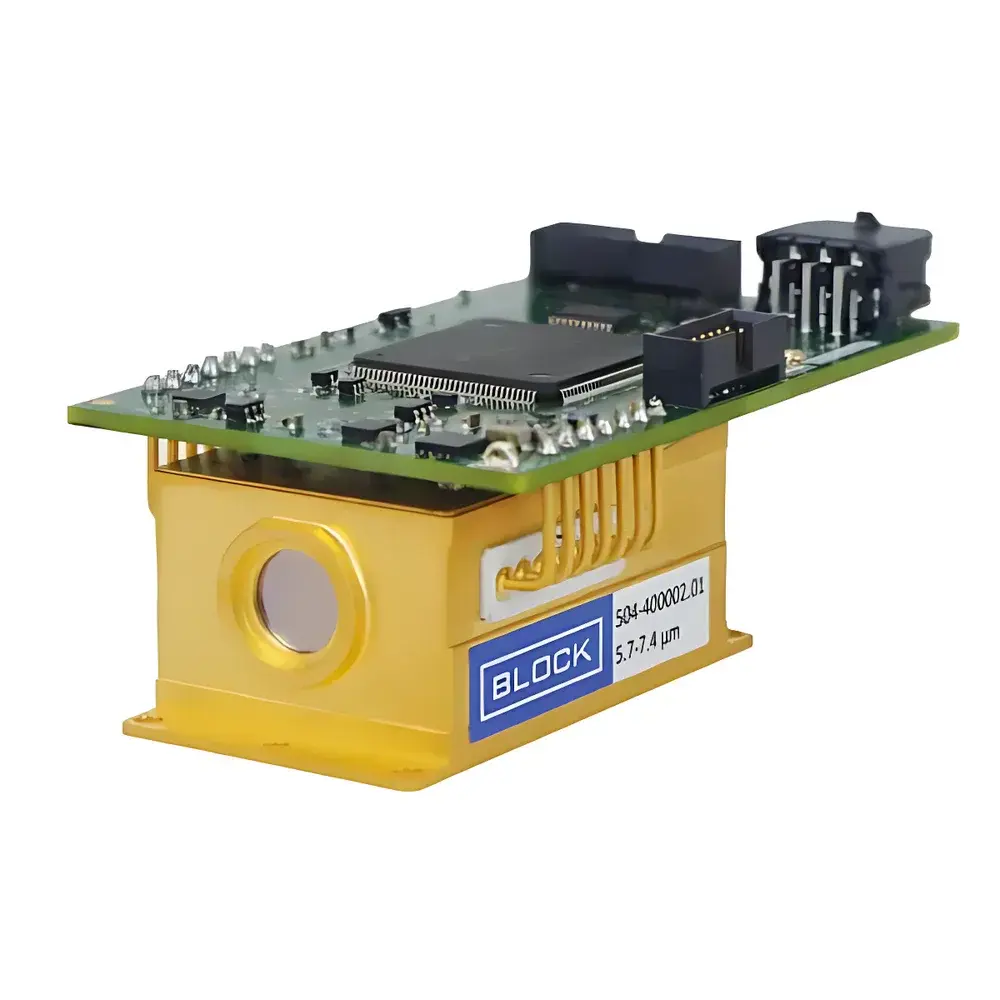
Auniontech LT-S & sQCL Tunable Pulsed Mid-Infrared External Cavity Quantum Cascade Lasers
| Brand | Auniontech |
|---|---|
| Model | LT-S (Benchtop) / sQCL (OEM Module) |
| Wavelength Ranges | 5.4–6.0 µm, 6.1–7.3 µm, 7.4–10.4 µm, 9.9–12.8 µm |
| Spectral Linewidth | <2 cm⁻¹ |
| Spectral Accuracy/Repeatability | <2 cm⁻¹ / <±0.2 cm⁻¹ |
| Pulse Width | 20–300 ns |
| Repetition Rate | up to 3 MHz (LT-S), up to 1 MHz (sQCL) |
| Average Power | 0.5–20 mW (at 5% duty cycle) |
| Beam Mode | TEM₀₀ |
| Beam Dimensions | 2 mm × 4 mm (collimated) |
| Polarization | Vertical, Extinction Ratio >100:1 |
| Wavenumber Stability | <±0.2 cm⁻¹ over 1 h (25 °C) |
| Power-Temperature Drift | <±0.01% per °C (10–65 °C) |
| Wavenumber-Temperature Drift | <0.01 cm⁻¹ per °C (10–65 °C) |
| Dimensions | LT-S: 235.7 × 168.3 × 44.5 mm |
| sQCL Module | 72.7 × 43.2 × 35.7 mm (circuit included) |
| Cooling | Internal fan (LT-S) |
| Tuning Modes | Move Tune, Step Tune, Sweep Tune |
| Sweep Speed | up to 25 cm⁻¹/ms (LT-S) |
| Pulse-to-Pulse Power Stability | Stdev <1.5%, <±0.15% avg over 1 h (25 °C) |
| Average Power Stability | <±0.1% avg over 1 h (25 °C) |
Overview
The Auniontech LT-S and sQCL series are high-performance, tunable pulsed mid-infrared external cavity quantum cascade lasers (EC-QCLs) engineered for precision spectroscopic applications across research, industrial process monitoring, environmental sensing, and security screening. Operating in four discrete, user-selectable spectral bands—5.4–6.0 µm, 6.1–7.3 µm, 7.4–10.4 µm, and 9.9–12.8 µm—these lasers leverage the fundamental vibrational absorption signatures of molecules in the mid-IR region (3.5–16.0 µm), where >90% of organic and inorganic compounds exhibit strong, structurally specific rovibrational transitions. Unlike broadband thermal sources or Fourier-transform infrared (FTIR) systems, EC-QCLs function as narrowband, high-brightness, wavelength-agile “pre-dispersed light sources”: each laser pulse is spectrally defined prior to interaction with the sample, enabling shot-noise-limited detection without spectral multiplexing overhead. This architecture delivers superior spectral resolution (<2 cm⁻¹), high wavenumber accuracy (<±0.2 cm⁻¹), and exceptional long-term stability—critical for quantitative trace-gas analysis, standoff chemical identification, and time-resolved surface interrogation.
Key Features
- Four independently addressable tuning ranges covering key atmospheric transmission windows and molecular fingerprint regions—including the 7–12 µm band essential for detecting chemical warfare agents (CWAs), toxic industrial chemicals (TICs), explosives (e.g., PETN, RDX), and biological aerosols (e.g., Bacillus thuringiensis, E. coli).
- External cavity design incorporating a diffraction grating enables precise, repeatable wavelength selection via mechanical rotation—supporting Move Tune (manual), Step Tune (discrete wavelength hopping), and Sweep Tune (continuous spectral scanning at up to 25 cm⁻¹/ms).
- TEM₀₀ collimated output (2 mm × 4 mm) with vertical linear polarization (>100:1 extinction ratio) and industry-leading pointing stability—optimized for coupling into multi-pass gas cells, reflection optics, or fiber-based probe heads.
- High pulse fidelity: 20–300 ns pulse width, repetition rates up to 3 MHz (LT-S) or 1 MHz (sQCL), and duty cycles up to 8%—minimizing ambient light interference and enabling gated detection for enhanced signal-to-noise ratio (SNR) in open-path or reflective configurations.
- Robust thermal and temporal stability: Wavenumber drift <±0.2 cm⁻¹ over 1 hour at 25 °C; power drift <±0.1% over same interval; temperature coefficients as low as 0.01 cm⁻¹/°C—ensuring measurement reproducibility under field-deployable conditions.
- Modular platform architecture: LT-S is a turnkey benchtop system with integrated driver, cooling, and control interface; sQCL is a compact OEM module (72.7 × 43.2 × 35.7 mm) with embedded electronics, designed for integration into handheld analyzers, UAV-mounted sensors, or portable chemical threat detectors.
Sample Compatibility & Compliance
These EC-QCL systems are compatible with gaseous, liquid, and solid-phase samples—enabling direct, non-contact, and non-destructive analysis without sample preparation or consumables. Gas-phase measurements comply with ASTM E2886-21 (standard practice for standoff detection of hazardous chemicals using IR spectroscopy) and support GLP/GMP-aligned data integrity when paired with validated acquisition software. Liquid and tissue measurements benefit from the high photon flux (>10× that of globar sources) and water-transparency advantages of mid-IR QCLs—facilitating rapid glucose quantification in biofluids or label-free histopathology of biopsy sections. All units meet CE marking requirements for electromagnetic compatibility (EN 61326-1) and safety (EN 60825-1:2014 Class 1M laser product). Firmware supports audit-trail logging and user-access controls aligned with FDA 21 CFR Part 11 readiness for regulated environments.
Software & Data Management
The LT-S and sQCL platforms integrate with Auniontech’s LaserTune™ control suite—a Windows-based application supporting real-time spectrum acquisition, multi-wavelength sequence programming, and synchronization with external detectors (e.g., MCT, InSb) or data acquisition hardware (NI PXI, USB-6363). Raw interferogram-free spectral data is exported in HDF5 and CSV formats, preserving metadata (wavelength, power, temperature, timestamp) for traceability. The SDK provides C/C++, Python, and LabVIEW APIs for OEM integration, enabling closed-loop feedback control in process analytics or AI-driven spectral classification pipelines. Machine learning workflows—such as PCA, PLS-DA, or CNN-based pattern recognition—can be deployed directly on acquired spectra to identify complex mixtures (e.g., VOC blends in exhaled breath) or discriminate between morphologically similar biomolecules (e.g., protein isoforms or glycoforms).
Applications
- Standoff Chemical Detection: Identification of explosive residues, CWAs (e.g., sarin simulants), and TICs at distances exceeding 300 m using photoacoustic or photothermal IR spectroscopy—deployed in airport perimeter monitoring, critical infrastructure protection, and battlefield reconnaissance.
- Medical Breath Analysis: Quantitative detection of disease biomarkers—including acetone (diabetes), NO (asthma), isoprene (cholesterol metabolism), and THCA (cannabis exposure)—with sub-ppb sensitivity and second-scale acquisition times.
- Industrial Process Control: Real-time monitoring of combustion byproducts (NO, CO, CH₄) in flue gas streams; catalyst deactivation tracking via surface adsorbate spectroscopy; and polymer curing kinetics via in-line IR absorption mapping.
- Environmental Monitoring: Open-path atmospheric sensing of greenhouse gases (N₂O, CH₄), volatile organic compounds (VOCs), and particulate-bound organics—compatible with mobile labs and drone-mounted payloads.
- Biomedical Imaging: High-resolution mid-IR reflectance imaging of unstained tissue sections, single-cell spectroscopy in microfluidic chambers, and label-free detection of protein aggregation in neurodegenerative disease models.
- Fundamental Research: Time-resolved absorption spectroscopy of transient species in shock tubes (e.g., iC₄H₈ post-detonation), ultrafast vibrational dynamics in 2D materials, and dual-comb spectroscopy when paired with a second stabilized QCL.
FAQ
What distinguishes EC-QCLs from conventional FTIR or diode lasers?
EC-QCLs combine the spectral brightness of laser sources with the wide, continuous tunability of external cavity designs—delivering >100× higher spectral radiance than thermal emitters and orders-of-magnitude better resolution and speed than near-IR diode lasers operating outside molecular fingerprint regions.
Can these lasers be integrated into portable or handheld instruments?
Yes—the sQCL OEM module (72.7 × 43.2 × 35.7 mm) includes fully integrated drive electronics and thermal management, requiring only +12 V DC input and digital TTL triggers—ideal for battery-powered field analyzers or drone-mounted chemical sensors.
Do these systems support regulatory compliance for clinical or pharmaceutical use?
When configured with validated firmware, audit-trail logging, and electronic signature capabilities, the LT-S platform meets foundational requirements for 21 CFR Part 11 and ISO 13485-aligned instrument qualification in diagnostic development labs.
How is wavelength calibration maintained during long-term operation?
Each unit undergoes factory calibration against NIST-traceable reference cells (e.g., N₂O, CO) and incorporates onboard temperature-compensated grating positioning algorithms—ensuring <±0.2 cm⁻¹ wavenumber accuracy over 1 hour without recalibration.
What optical interfaces are supported for beam delivery?
Collimated 2 mm × 4 mm output is compatible with standard SMF-28 or ZBLAN mid-IR fibers (via AR-coated couplers), parabolic mirrors (f = 25–100 mm), or commercial multi-pass gas cells (e.g., 10–200 m pathlength); free-space alignment fixtures and kinematic mounts are available as accessories.





