
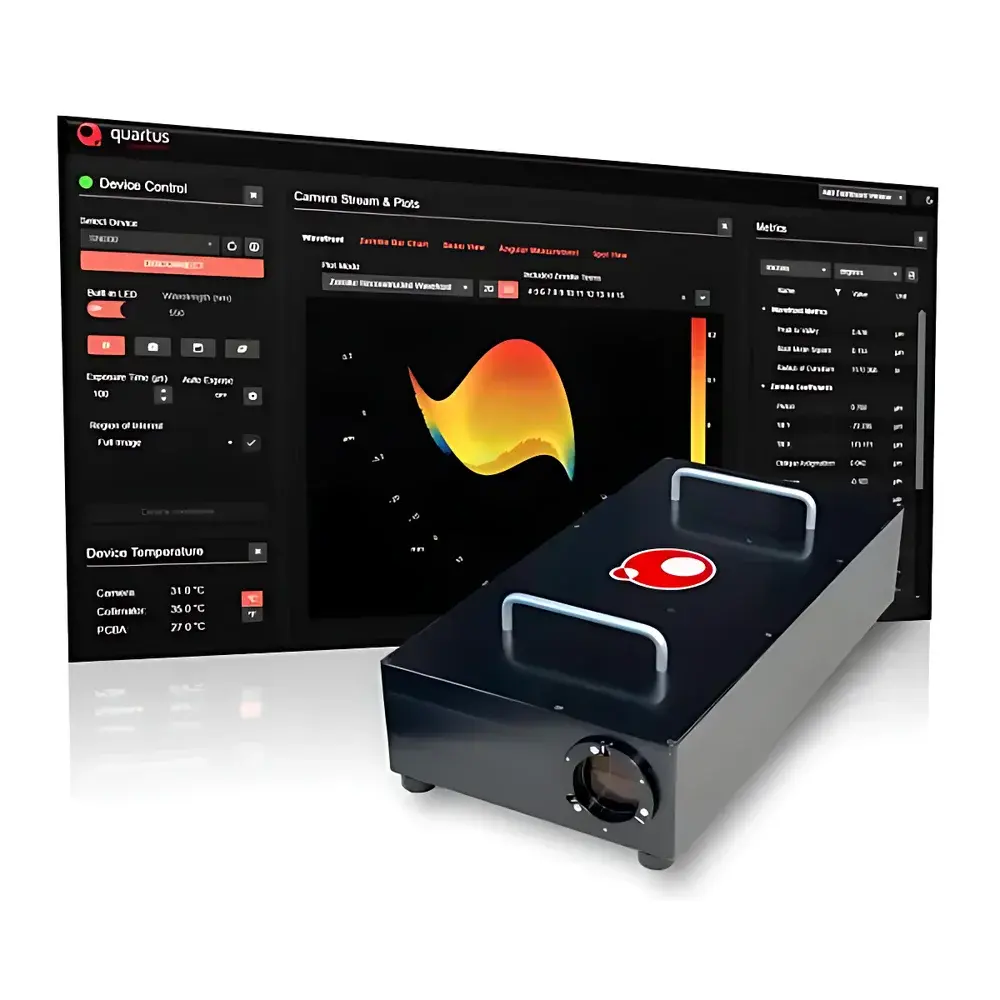
Auniontech QOQ Series Tri-Functional Optical Metrology System — Wavefront, Beam Angle & Surface Profile Analyzer
| Brand | Auniontech |
|---|---|
| Origin | Shanghai, China |
| Model | QOQ-048-0550-075 |
| Aperture | 48 mm |
| Integrated Source | LED (IEC 62471 RG1, 550 nm) |
| Mask Pitch | 500 µm |
| Mask Clear Aperture | 250 µm |
| Effective Mask Diameter | 68 mm |
| EFL | 75 mm |
| Minimum Beam Diameter | 5 mm |
| Spectral Range | 400–750 nm |
| Sensor Resolution | 5472 × 3648 px |
| Pixel Pitch | 2.4 µm |
| Bit Depth | 8-bit |
| Max. Tilt | >6° |
| Tilt Accuracy | <1 arcsec |
| Tilt Resolution | <0.5 arcsec |
| Wavefront RMS Accuracy | 30 nm |
| Wavefront RMS Sensitivity | 15 nm |
| Wavefront Dynamic Range | >1.5 mm |
| Software Compatibility | Windows & macOS |
| API Support | gRPC (Python/C++/MATLAB) |
| Compliance | IEC 62471:2006 |
Overview
The Auniontech QOQ Series Tri-Functional Optical Metrology System is a high-precision, multi-modal optical characterization platform engineered for quantitative wavefront analysis, beam angle metrology, and surface topography profiling in a single compact instrument. Based on the principle of lateral shearing interferometry with integrated Hartmann-Shack sensing architecture, the system delivers absolute phase measurement via spatially resolved intensity modulation across a calibrated micro-lens array. Its 48 mm clear aperture enables direct measurement of collimated, focused, or divergent beams—without auxiliary beam expanders or relay optics—while maintaining high dynamic range (>1.5 mm PV) and sub-arcsecond angular resolution. Designed for laboratory, manufacturing, and field-deployable use, the QOQ-048 variant integrates a stable, low-risk LED source (IEC 62471 RG1, 550 nm) and supports broadband operation from 400 nm to 750 nm, making it suitable for characterizing lasers, LEDs, supercontinuum sources, and white-light illumination systems under real-world alignment conditions.
Key Features
- Tri-functional operation: simultaneous wavefront reconstruction (Zernike decomposition), beam pointing angle tracking (<1 arcsec accuracy), and surface profile mapping (PV, RMS, slope error)
- High-dynamic-range phase measurement enabled by calibrated micro-lens array (500 µm pitch, 250 µm clear aperture) and 5472 × 3648 pixel CMOS sensor (2.4 µm pitch, 8-bit depth)
- Real-time, interactive 2D/3D wavefront visualization with user-defined color maps, residual error overlays, and tilt vector annotation
- Auto-alignment engine with X/Y beam centroid tracking and closed-loop electronic collimation control
- Removable reference mirror module for in-situ self-calibration and audit-mode verification per GLP-compliant workflows
- Temperature-compensated firmware for stable metrology during mobile deployment or thermal transients
- Compact, ruggedized enclosure with integrated carry case—designed for transport between cleanrooms, test benches, and remote field sites
- Native gRPC-based API supporting Python, C++, and MATLAB for OEM integration, automated test sequences, and custom algorithm deployment
Sample Compatibility & Compliance
The QOQ system accommodates optical components and beams across diverse coherence regimes and geometries: highly coherent CW or pulsed lasers (TEM00 to multimode), partially coherent LEDs, broadband white-light sources, and structured illumination patterns. It measures reflective surfaces—including flat, spherical, aspheric, and freeform mirrors—without requiring null optics or external reference flats. Transmissive elements (lenses, windows, diffractive optics) are characterized via transmitted wavefront analysis. All configurations comply with IEC 62471:2006 photobiological safety requirements for integrated LED illumination (RG1 classification). The system supports traceable calibration protocols aligned with ISO 10110-5 (surface form tolerances) and ISO 14999-3 (interferometric wavefront testing), and its data logging architecture provides timestamped, parameter-tagged records compatible with FDA 21 CFR Part 11 audit trail requirements when deployed in regulated environments (e.g., medical optics QA or aerospace component certification).
Software & Data Management
Control and analysis are performed via Auniontech’s cross-platform MetroSuite software (Windows/macOS native binaries), offering intuitive GUI-driven workflows and scriptable automation. Real-time acquisition includes gain, exposure, wavelength, and ROI configuration; all parameters are embedded in metadata. Measurement sessions support long-duration recording (≥24 h) with lossless frame buffering and on-the-fly statistical aggregation (mean, std dev, drift rate). Export formats include CSV (for Zernike coefficients, slope maps, centroid trajectories), TIFF (phase/residual images), HDF5 (full dataset serialization), and industry-standard ZMX (for OpticStudio import). The gRPC API exposes full instrument control—including hardware-triggered acquisition, asynchronous data streaming, and live parameter updates—enabling integration into CI/CD pipelines, robotic alignment stations, or adaptive optics control loops. Software update history, user access logs, and configuration snapshots are retained locally for GLP/GMP compliance audits.
Applications
- Surface figure metrology of optical flats, prisms, and off-axis paraboloids (PV, RMS, power spectrum)
- In-process monitoring of lens polishing and coating uniformity (intensity homogeneity mapping)
- Beam quality assessment (M², BPP, Strehl ratio) for industrial lasers and fiber-coupled modules
- Adaptive optics loop calibration: deformable mirror actuator response mapping and closed-loop wavefront correction validation
- Semiconductor wafer flatness and stress-induced deformation analysis (via reflected wavefront distortion)
- Astronomical optics commissioning: primary mirror segment alignment, secondary focus stability tracking
- Ophthalmic optics verification: prescription lens wavefront error, contact lens sagittal curvature, and aberration compensation fidelity
- Optomechanical assembly verification: boresight error quantification, bearing runout (wobble) measurement, and kinematic mount stability assessment
FAQ
What types of light sources can be measured with the QOQ system?
The system supports continuous-wave and pulsed lasers (400–750 nm), LEDs, supercontinuum sources, and broadband white-light illumination—regardless of coherence length, divergence, or focus state.
Is external calibration required before each measurement?
No. The removable reference mirror and internal LED source enable on-demand self-calibration (audit mode) without external interferometers or standards.
Can the QOQ system measure both reflective and transmissive optics?
Yes—reflective surfaces are measured directly; transmissive components require a simple back-reflection setup or optional transmission adapter.
Does the software support automated pass/fail reporting for production QA?
Yes. MetroSuite includes configurable tolerance limits, statistical process control (SPC) charts, and PDF/CSV report generation with digital signature fields.
Is the system suitable for cleanroom environments?
The sealed optical head, ESD-safe enclosure, and absence of moving parts (no motorized stages) meet ISO Class 5 cleanroom compatibility requirements.
How is temperature drift compensated during extended measurements?
Onboard thermal sensors feed real-time corrections to the phase reconstruction algorithm, maintaining wavefront RMS stability within ±5 nm over ±5°C ambient variation.




