
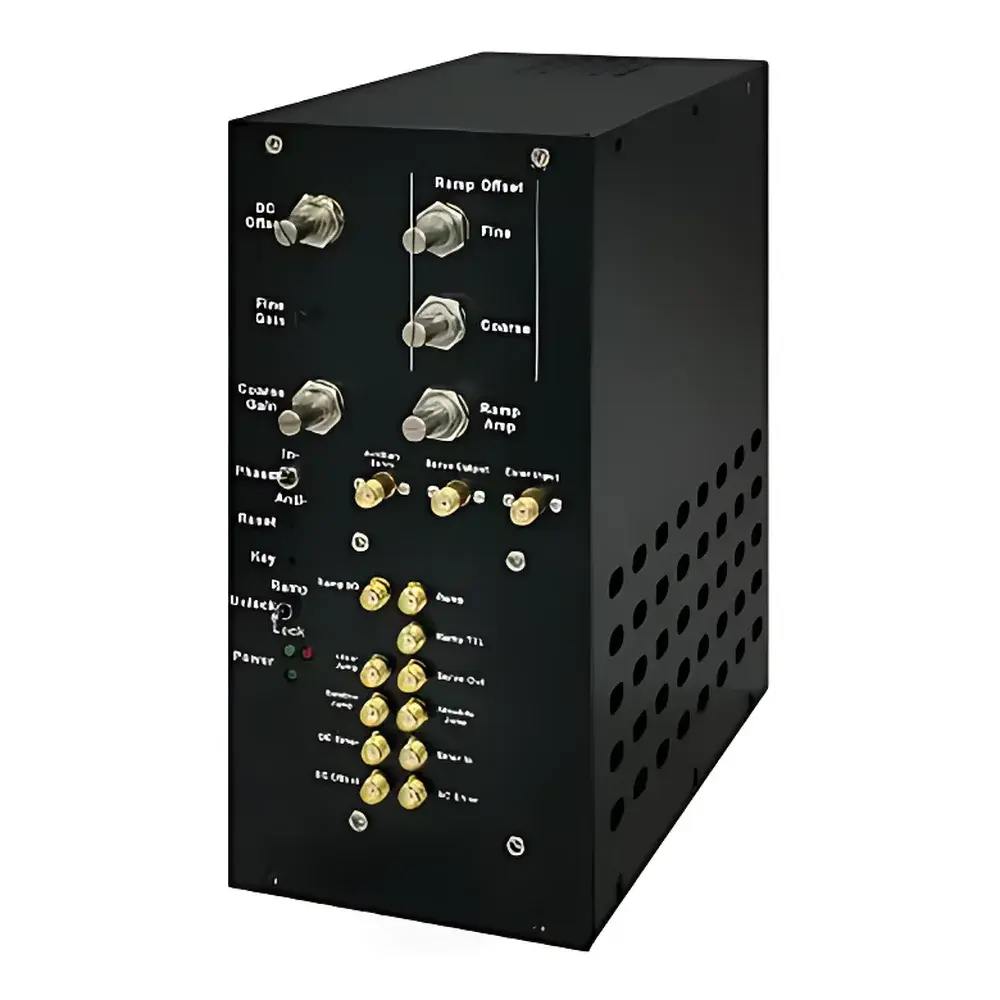
Auniontech T-PIID-NN01 Analog PIID Laser Servo Controller
| Brand | Auniontech |
|---|---|
| Origin | Shanghai, China |
| Manufacturer Type | Authorized Distributor |
| Product Category | Domestic |
| Model Functionality | Frequency Reference & PID Loop Control |
| Pricing | Available Upon Request |
Overview
The Auniontech T-PIID-NN01 is a high-stability analog laser servo controller engineered for precision closed-loop stabilization of optical frequency, intensity, and position in ultra-low-noise experimental environments. Based on dual-stage integrator architecture (PIID — Proportional-Integral-Integral-Derivative), it implements robust feedback control without digital latency or quantization noise, making it particularly suited for applications demanding sub-mHz stability, such as cavity locking, Pound–Drever–Hall (PDH) error signal conditioning, and piezoelectric transducer (PZT) actuator regulation. Unlike digital controllers, the T-PIID-NN01 operates entirely in the analog domain, preserving signal fidelity across bandwidths up to ≥8 MHz — enabling fast transient response and minimal phase lag critical for real-time optical servoing.
Key Features
- Dual-integrator loop topology (PIID) for enhanced low-frequency gain and improved disturbance rejection, especially effective for 1/f noise suppression in laser diode current and PZT voltage control.
- Fully adjustable loop parameters: proportional gain (P), first integral time constant (I₁), second integral time constant (I₂), and derivative coefficient (D), configurable via front-panel potentiometers or remote analog voltage inputs.
- Integrated signal generator (sine/square/triangle, 1 mHz–100 kHz, amplitude ±10 V) for modulation-based locking schemes and system characterization.
- Peak-locking mode: enables direct lock to the extremum of an input photodiode signal without external modulation hardware or lock-in amplifiers — reducing system complexity and cost while maintaining lock fidelity.
- Lock protection circuitry with user-configurable unlock detection threshold, hold time, and relock stabilization window; outputs freeze at last valid value upon loss-of-lock and automatically attempt recovery after defined intervals.
- Signal centering function: applies programmable DC offset to the output stage prior to lock acquisition — essential when nominal operating points deviate from 0 V (e.g., asymmetric PZT hysteresis curves or biased photodetector outputs).
- Rugged industrial-grade analog design with low-drift op-amps, shielded signal paths, and EMI-suppressed power regulation — optimized for laboratory and OEM integration.
Sample Compatibility & Compliance
The T-PIID-NN01 interfaces seamlessly with common optical transducers including photodiodes (with transimpedance amplification), quadrant detectors, interferometric error sensors, and MEMS/PZT actuators. Its ±10 V analog I/O supports standard laboratory instrumentation (e.g., oscilloscopes, DAQ systems, function generators) and integrates into larger control stacks compliant with GLP/GMP data integrity expectations. While not certified to specific ISO/IEC standards out-of-the-box, its analog architecture inherently avoids firmware-related validation complexities associated with digital controllers — facilitating traceable calibration and audit-ready operation in regulated R&D environments (e.g., quantum optics labs subject to internal QA protocols aligned with ISO/IEC 17025).
Software & Data Management
As a fully analog controller, the T-PIID-NN01 requires no embedded firmware, drivers, or host software. All configuration is performed via physical controls or analog voltage inputs, eliminating cybersecurity risks, OS dependencies, and version compatibility issues. For documentation and traceability, users are advised to record manual settings (potentiometer positions, jumper configurations, and external bias voltages) alongside experimental metadata. When integrated into automated test systems, the controller’s analog outputs can be logged using third-party DAQ hardware compliant with IEEE 1643 or NI-DAQmx frameworks. Optional analog-to-digital interface modules (sold separately) support synchronization with time-stamped measurement records under FDA 21 CFR Part 11-compliant data acquisition platforms.
Applications
- Laser frequency stabilization to high-finesse optical cavities (e.g., in gravitational wave detector prototypes or atomic clock development).
- Intensity noise suppression in master oscillator power amplifier (MOPA) chains for coherent lidar and quantum memory experiments.
- Active vibration isolation of optical tables via feedback-driven voice-coil or PZT actuators.
- Real-time compensation of thermal drift in interferometric biosensors and nanoscale metrology setups.
- OEM integration into turnkey spectroscopy systems requiring deterministic, low-latency servo response without microcontroller-induced jitter.
FAQ
What types of sensors and actuators are compatible with the T-PIID-NN01?
It accepts standard ±10 V single-ended or differential analog inputs from photodiodes, lock-in amplifiers, or error signal generators, and drives ±10 V-compatible loads including PZTs, laser diode current sources, and galvanometric mirrors.
Does the controller support remote parameter adjustment?
Yes — all loop gains and time constants can be modulated via external analog voltage inputs (0–5 V or ±5 V scaling), enabling dynamic tuning from a DAQ system or microcontroller.
Is the peak-locking mode compatible with arbitrary reference waveforms?
It is optimized for periodic signals with well-defined maxima/minima (e.g., sinusoidal or square-wave modulated error signals); non-periodic or noisy inputs may require pre-filtering.
Can the lock protection behavior be disabled?
Yes — the lock protection circuit can be bypassed via front-panel jumper selection for applications requiring continuous output regardless of lock status.
What is the typical settling time after automatic relock?
Depends on configured hold and stabilization times; typical values range from 100 ms to 2 s, adjustable per application requirements.




