
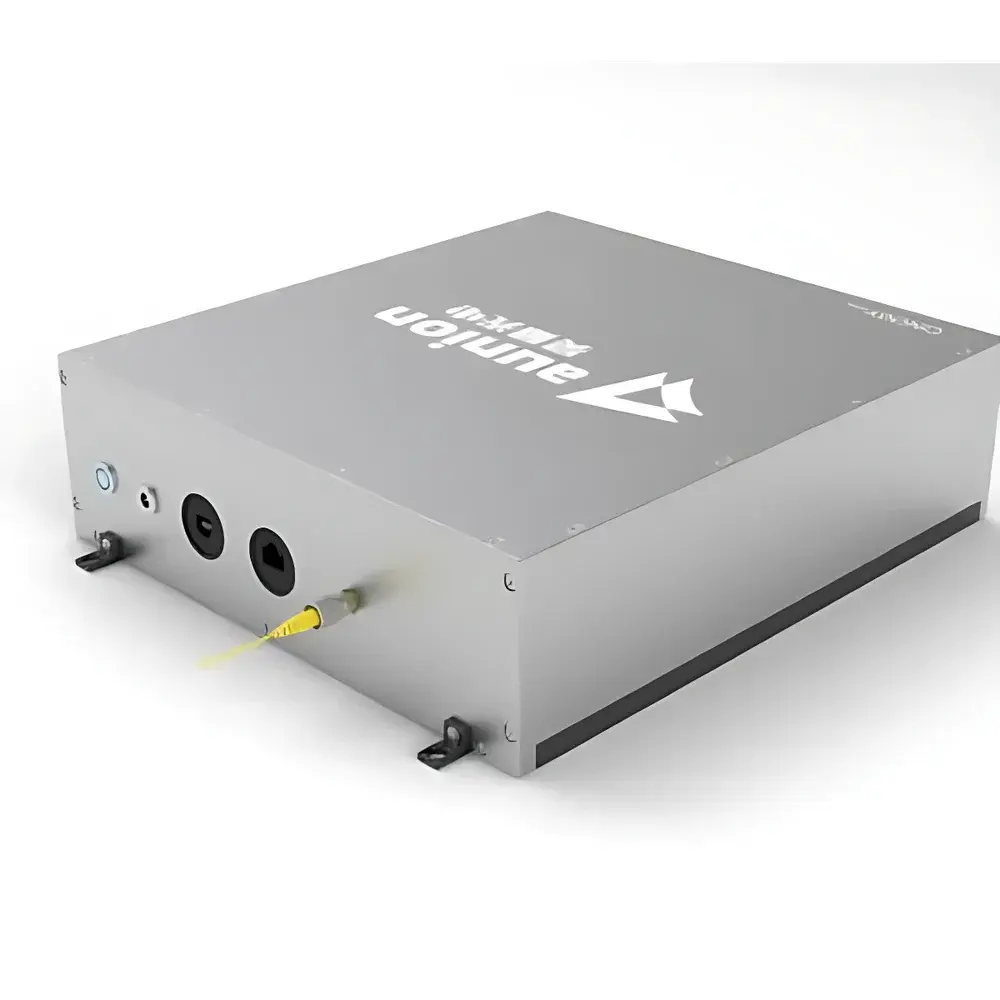
Auniontech AUT-CI-FCM2 Series Fiber-Optic M² Measurement System
| Brand | Auniontech |
|---|---|
| Origin | Shanghai, China |
| Manufacturer Type | Authorized Distributor |
| Product Category | Domestic |
| Model | AUT-CI-FCM2 Series |
| Pricing | Available Upon Request |
| Wavelength Range | 200–1700 nm |
| Fiber Interface | FC/APC (interchangeable connector options) |
| Core Function | Automated M², beam waist, divergence angle, Rayleigh length, BPP, and 2D/3D intensity distribution measurement |
| Software Platform | RayCi-Pro v5.x (Cinogy INSIDE certified) |
| Compliance | ISO 11146-1:2021, ISO 11146-2:2021, ANSI Z136.1-2022 |
Overview
The Auniontech AUT-CI-FCM2 Series Fiber-Optic M² Measurement System is a fully integrated, turnkey solution engineered for precise characterization of laser beams emitted directly from optical fibers. Based on the internationally recognized ISO 11146-1 and ISO 11146-2 standards for laser beam width, divergence, and M² determination, this system employs a calibrated CinCam CMOS/InGaAs beam profiling camera platform coupled with proprietary RayCi-Pro software to deliver traceable, repeatable beam quality metrics. Unlike free-space M² measurement setups requiring manual alignment and iterative scanning, the AUT-CI-FCM2 eliminates optical realignment by accepting fiber-coupled input via standardized FC/APC connectors—enabling direct coupling of single-mode, multimode, or polarization-maintaining fibers without beam expansion or collimation optics. The system operates across a broad spectral range (200–1700 nm), supporting UV, visible, NIR, and SWIR lasers commonly used in fiber laser development, telecom component testing, biophotonics instrumentation, and industrial laser source qualification.
Key Features
- Fully automated M² calculation per ISO 11146 methodology—including beam width (D4σ and knife-edge definitions), Rayleigh length, far-field divergence, and beam parameter product (BPP)
- Integrated CinCam high-dynamic-range beam camera with pixel-level calibration and temperature-stabilized sensor housing for low-noise acquisition
- RayCi-Pro v5.x software with Cinogy INSIDE certification—providing real-time beam centroid tracking, stability analysis (RMS position jitter over time), and statistical reporting compliant with GLP audit trails
- Modular fiber interface: FC/APC standard configuration with optional adapters for SC, LC, ST, or SMA connectors; supports both bare-fiber and terminated fiber inputs
- Compact benchtop enclosure (320 × 280 × 120 mm) with internal beam dump and ESD-safe housing—designed for integration into production test stations or R&D labs with limited footprint
- No user alignment required: factory-aligned optical path ensures measurement repeatability < ±0.8% across multiple instrument units (verified via NIST-traceable reference sources)
Sample Compatibility & Compliance
The AUT-CI-FCM2 is optimized for characterizing continuous-wave (CW) and quasi-CW fiber-delivered lasers with output powers ranging from 10 µW to 500 mW (with optional neutral density attenuation). It accommodates Gaussian, super-Gaussian, donut-mode, and higher-order LP modes typical of specialty fibers. All measurements conform to ISO 11146-1:2021 (determination of beam widths and divergences) and ISO 11146-2:2021 (M² calculation procedures), ensuring data interoperability with international laser safety (ANSI Z136.1-2022) and medical device validation frameworks. The system supports 21 CFR Part 11-compliant electronic signatures and audit logging when deployed in regulated environments such as ISO 13485-certified manufacturing facilities or FDA-regulated photonic device development labs.
Software & Data Management
RayCi-Pro serves as the central control and analysis engine, offering dual-mode operation: guided wizard-based workflows for rapid M² acquisition and advanced scripting (Python API) for custom protocol automation. Raw image sequences, metadata (timestamp, exposure, gain, wavelength), and processed parameters are stored in HDF5 format—enabling long-term archival and third-party analysis in MATLAB, Python (SciPy), or LabVIEW. The software includes built-in report generation templates aligned with ISO/IEC 17025 requirements, including uncertainty budgeting per GUM (Guide to the Expression of Uncertainty in Measurement). Export options include CSV, PDF, and XML for LIMS integration.
Applications
- Qualification of fiber-coupled diode lasers, fiber amplifiers, and supercontinuum sources prior to OEM integration
- Production-line verification of M² stability in telecom pump modules and EDFA subsystems
- R&D validation of mode field diameter (MFD) and beam asymmetry in photonic crystal fibers and hollow-core fibers
- Beam quality benchmarking for ultrafast fiber oscillators (e.g., Yb-doped, Er-doped) operating at kHz–MHz repetition rates
- Support for ISO 11146-compliant laser safety classification (Class 4 hazard assessment via measured divergence and irradiance profiles)
- Calibration transfer between fiber-coupled reference lasers and end-user systems in metrology laboratories
FAQ
Does the AUT-CI-FCM2 require external beam conditioning optics?
No—the system is designed exclusively for direct fiber-coupled input and contains no adjustable free-space optics. Beam collimation, focusing, and scanning are performed internally using motorized stages synchronized with the camera.
Can it measure pulsed lasers?
Yes, provided pulse energy is within sensor damage thresholds and repetition rate allows sufficient frame averaging; recommended minimum PRF is 1 kHz for stable centroid tracking.
Is NIST-traceable calibration included?
Each unit ships with a factory calibration certificate referencing NIST-traceable beam width standards at 633 nm and 1550 nm; annual recalibration services are available through Auniontech’s Shanghai metrology lab.
What software licensing model applies?
RayCi-Pro is supplied with perpetual node-locked license; major version upgrades (v5.x → v6.x) require optional maintenance subscription.
How is compliance with FDA 21 CFR Part 11 enforced?
Audit trail activation, electronic signature capture, and role-based access control are configurable within RayCi-Pro; full validation documentation (IQ/OQ/PQ protocols) is available upon request for regulated deployments.
Related Products



