
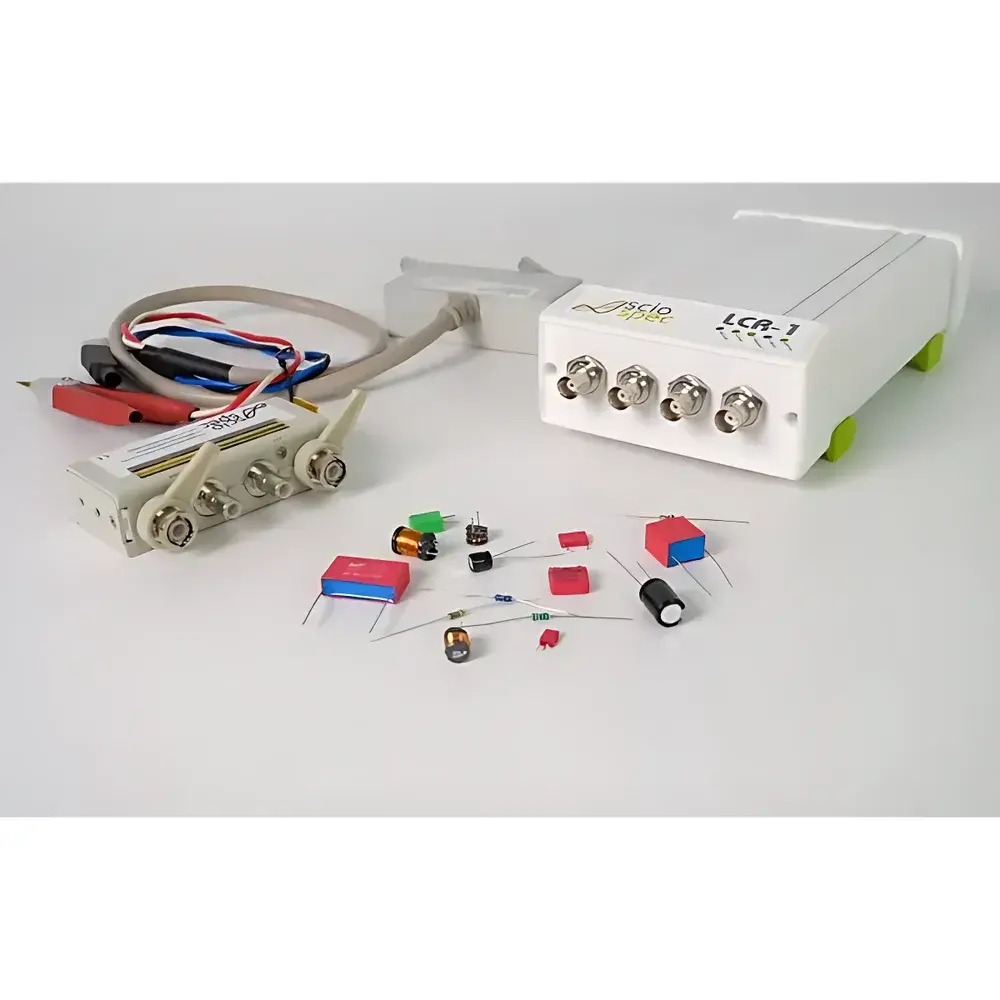
Sciospec LCR-1 Compact High-Precision Impedance Analyzer
| Brand | Sciospec |
|---|---|
| Origin | Germany |
| Model | LCR-1 |
| Frequency Range | 100 mHz – 500 kHz (extendable to 1 MHz or 10 MHz) |
| Measurement Range | R = 1 mΩ – 1 TΩ, C = 10 fF – 1 kF, L = 1 nH – 1 TH |
| Basic Accuracy | 0.01% |
| Channel Count | Single-channel |
| Measurement Ports | 2-, 3-, and 4-terminal configurations supported |
| Compliance | CE, RoHS, ISO/IEC 17025-compatible operation |
Overview
The Sciospec LCR-1 is a compact, high-precision single-channel impedance analyzer engineered for rigorous electrical characterization across research laboratories, quality control environments, and industrial R&D settings. Built upon the same core measurement architecture as Sciospec’s flagship multi-channel impedance analyzers, the LCR-1 delivers laboratory-grade performance—wide dynamic range, sub-0.01% basic accuracy, and microsecond-level measurement speed—within a benchtop form factor optimized for ease of integration and daily operational efficiency. Its underlying principle relies on precision AC four-terminal (Kelvin) voltage-current sensing combined with digital lock-in detection and adaptive signal averaging, enabling stable, low-noise impedance spectroscopy from ultra-low frequencies (100 mHz) up to 500 kHz (with optional firmware/hardware upgrades supporting 1 MHz or 10 MHz). Unlike conventional LCR meters limited to scalar parameter extraction, the LCR-1 supports full complex impedance (Z*, θ), admittance (Y*), and derived material parameters (e.g., conductivity σ, permittivity ε*, loss tangent tan δ) — making it suitable not only for component validation but also for dielectric and electrochemical material studies.
Key Features
- Single-channel architecture with integrated analog front-end and FPGA-based real-time signal processing
- Support for 2-, 3-, and 4-terminal measurement configurations to minimize parasitic effects and ensure traceable contact resistance compensation
- Frequency sweep capability from 100 mHz to 500 kHz (standard), extendable to 1 MHz or 10 MHz via calibrated hardware modules
- Dynamic measurement range spanning 1 mΩ to 1 TΩ (resistance), 10 fF to 1 kF (capacitance), and 1 nH to 1 TH (inductance)
- 0.01% basic magnitude accuracy with phase resolution better than 0.01°, validated per IEC 60359 and ASTM D257 standards
- Configurable integration time, averaging cycles, and auto-ranging thresholds for optimized SNR in noisy or low-signal environments
- Direct access to preconfigured test setups for rapid deployment in production line or teaching lab workflows
- Front-panel navigation and USB/Ethernet connectivity for remote command execution via SCPI protocol
Sample Compatibility & Compliance
The LCR-1 accommodates diverse sample geometries and electrical interfaces through a modular adapter ecosystem. Standard accessories include industry-compliant coaxial cable kits, universal SMD/THT component fixtures, Kelvin clip sets for low-resistance measurements, and purpose-built fixtures for thin-film dielectric analysis (e.g., interdigitated electrodes), liquid electrolyte cells (with temperature-controlled electrode holders), and bulk material characterization (parallel-plate or toroidal configurations). All fixtures are designed to maintain impedance integrity across the full operating frequency band and minimize stray capacitance (< 0.5 pF) and inductance (< 10 nH). The instrument complies with CE marking requirements and adheres to electromagnetic compatibility (EMC) Directive 2014/30/EU and Low Voltage Directive 2014/35/EU. When operated under documented calibration and procedural controls, its measurement uncertainty budget aligns with ISO/IEC 17025:2017 requirements for accredited testing laboratories. It supports audit-ready data logging compatible with GLP/GMP documentation frameworks.
Software & Data Management
The LCR-1 operates with Sciospec’s Impedance Studio software suite — a Windows-based application providing intuitive graphical interface for sweep setup, real-time Bode/Nyquist visualization, equivalent circuit modeling (ECM), and export of raw complex impedance datasets in CSV, TXT, and IMP formats. The software implements full traceability features including user authentication, electronic signatures, and immutable audit trails for all measurement configurations and results — satisfying FDA 21 CFR Part 11 requirements for regulated industries. Batch-mode automation via Python API enables integration into automated test systems (ATE) or statistical process control (SPC) platforms. Raw data files embed metadata such as timestamp, operator ID, fixture ID, environmental conditions (if external sensors are connected), and calibration certificate reference numbers.
Applications
- Quality assurance of passive components (capacitors, inductors, resistors) during incoming inspection and post-assembly verification
- Dielectric spectroscopy of polymer films, ferroelectric ceramics, and battery separator membranes
- Electrochemical impedance spectroscopy (EIS) of corrosion inhibitors, fuel cell catalyst layers, and Li-ion electrode slurries
- Conductivity mapping of transparent conductive oxides (TCOs) and printed electronics inks
- Material homogeneity assessment in composite laminates and nanocomposites via frequency-dependent permittivity profiling
- Education and training in electrical engineering labs for fundamental concepts in AC circuit theory, resonance, and relaxation phenomena
FAQ
What is the standard calibration interval recommended for the LCR-1?
Sciospec recommends annual calibration using NIST-traceable standards; extended intervals may be justified under controlled environmental conditions and documented stability monitoring per ISO/IEC 17025 Clause 6.6.
Can the LCR-1 perform temperature-dependent impedance sweeps?
Yes — when paired with optional temperature-controlled sample stages and external thermocouple feedback, the instrument supports synchronized impedance acquisition at user-defined thermal setpoints via trigger-based external control.
Is firmware upgrade support included after purchase?
All firmware updates released within two years of product delivery are provided free of charge; long-term support contracts are available for extended maintenance coverage.
Does the LCR-1 meet requirements for ISO 17025-accredited testing?
Yes — when used with certified fixtures, documented procedures, and periodic metrological verification, the system satisfies key technical requirements for impedance measurement accreditation under ISO/IEC 17025:2017 Clause 7.7.
How is measurement uncertainty quantified for a given test configuration?
Uncertainty budgets are generated automatically within Impedance Studio based on selected frequency, range, fixture type, and environmental inputs — referencing Sciospec’s published Type A and Type B uncertainty models per GUM (JCGM 100:2008).



