
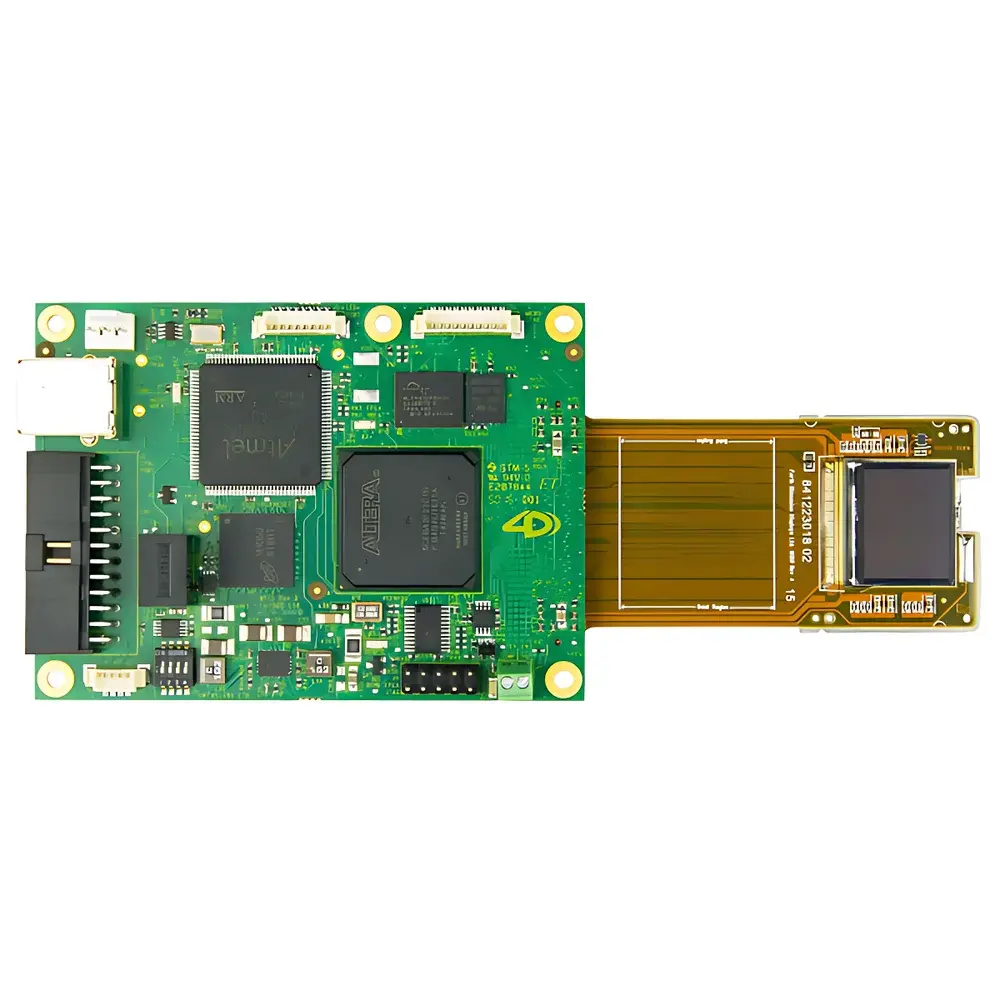
ForthDD SXGA-3DM 1280×1024 Pure-Amplitude Liquid Crystal on Silicon Spatial Light Modulator
| Origin | UK |
|---|---|
| Manufacturer Type | Distributor |
| Import Status | Imported |
| Model | SXGA-3DM |
| Price Range | USD 38,000–64,000 |
| Resolution | 1280 × 1024 pixels |
| Modulation Type | Pure-amplitude reflective SLM |
| Switching Speed | 40 µs |
| Frame Rate | 3.2 kHz |
| Fill Factor | >96% |
| Wavelength Range | 430–760 nm |
| Onboard Memory | 768 full-resolution grayscale frames |
| Trigger Interface | TTL-compatible input/output |
| Data Interfaces | RS-232, USB 2.0 |
| Technology | Ferroelectric liquid crystal (FLC) on silicon with temporal imaging architecture |
Overview
The ForthDD SXGA-3DM is a high-performance, pure-amplitude reflective spatial light modulator (SLM) based on ferroelectric liquid crystal on silicon (LCOS) technology. Engineered for precision optical modulation in demanding research and industrial applications, it operates on the principle of voltage-controlled birefringence in a ferroelectric nematic LC layer aligned on a custom CMOS backplane. Unlike phase-only or hybrid SLMs, the SXGA-3DM is optimized for linear, high-fidelity amplitude modulation—making it particularly suitable for digital holography, adaptive optics beam shaping, optical trapping, structured illumination microscopy, and real-time photonic mask generation. Its 1280 × 1024 pixel array delivers SXGA-grade spatial resolution with >96% active fill factor, minimizing diffraction artifacts from inter-pixel gaps. The device leverages ForthDD’s proprietary temporal imaging architecture, enabling deterministic, frame-synchronized amplitude control without analog voltage drift or gamma dependence.
Key Features
- True pure-amplitude modulation mode with calibrated grayscale linearity across 8-bit input depth
- High-speed operation: up to 3.2 kHz full-frame update rate with 40 µs pixel switching time
- Onboard non-volatile memory supporting storage and playback of 768 full-resolution grayscale patterns—enabling standalone operation without host PC
- Programmable TTL trigger interface for precise synchronization with external devices including scientific cameras, pulse lasers, translation stages, and function generators
- Compact form factor (112 mm × 92 mm × 28 mm) with integrated thermal management, designed for OEM integration into optical benches and closed-loop systems
- Dual data interface support: USB 2.0 (for configuration and low-latency pattern loading) and RS-232 (for embedded system integration and remote command scripting)
- Optimized spectral response across the visible spectrum (430–760 nm), with anti-reflection coated front surface and polarization-sensitive design requiring linearly polarized input
Sample Compatibility & Compliance
The SXGA-3DM is compatible with standard collimated free-space optical setups using linearly polarized illumination. It requires alignment with the incident polarization axis parallel to the device’s designated orientation marker. No sample mounting or preparation is required—the device functions as an active optical element within the beam path. While not a measurement instrument per se, its use in metrology-grade systems complies with foundational optical engineering standards including ISO 10110 (optical component specification), ISO 11146 (laser beam parameters), and EN 61000-6-3 (EMC emission limits). When deployed in regulated environments—for example, in FDA-reviewed optical instrumentation or GLP-compliant holographic cytometry platforms—the device’s deterministic timing, traceable firmware versioning, and reproducible grayscale response support audit-ready documentation workflows.
Software & Data Management
ForthDD provides the SLM Control Suite—a cross-platform application (Windows/macOS/Linux) supporting pattern generation, gamma calibration, sequence programming, and real-time triggering configuration. The suite exports industry-standard formats (BMP, TIFF, RAW) and supports Python API integration via DLL/Shared Library bindings for automated experiment control. All onboard memory operations—including pattern upload, playback scheduling, and trigger latency calibration—are accessible programmatically. Audit trails (timestamped pattern load events, firmware revision logs, and trigger signal diagnostics) are exportable in CSV format. The system does not implement FDA 21 CFR Part 11 electronic signature functionality; however, its deterministic behavior and version-controlled firmware enable third-party validation under GxP-aligned quality management systems.
Applications
- Digital micromirror alternative in structured illumination fluorescence microscopy (SIM), where high fill factor and rapid amplitude switching improve optical sectioning fidelity
- Dynamic amplitude masks for laser material processing—enabling real-time beam profile correction and multi-spot parallel ablation
- Calibration reference in wavefront sensor characterization, leveraging its known pixel-level reflectance uniformity and sub-millisecond repeatability
- Optogenetics stimulation patterning, synchronized to electrophysiological acquisition hardware via TTL triggers
- Education and prototyping platforms for Fourier optics laboratories, offering deterministic, software-defined diffraction control without mechanical slits or apertures
- Integration into quantum optics experiments requiring high-repetition-rate, spatially resolved intensity gating of single-photon sources
FAQ
Is the SXGA-3DM compatible with femtosecond laser pulses?
Yes—provided pulse energy density remains below 0.5 J/cm² at 800 nm (typical damage threshold for AR-coated FLC-SLMs); users must ensure proper dispersion compensation upstream to avoid temporal broadening.
Can multiple SXGA-3DM units be synchronized in a single setup?
Yes—via daisy-chained TTL trigger distribution using the device’s configurable input/output trigger pins and external delay generators.
Does the device support analog voltage input for direct waveform modulation?
No—it is a fully digital device accepting only 8-bit grayscale image data; amplitude control is achieved through temporal dithering within the native 3.2 kHz frame clock.
What is the typical RMS wavefront error introduced by the LCOS surface?
<0.15 λ over the clear aperture (measured at 633 nm), consistent with high-end reflective SLM specifications for interferometric applications.
Is firmware upgrade supported in the field?
Yes—via USB using ForthDD-signed binaries; all updates preserve onboard pattern memory and retain user calibration profiles.



