
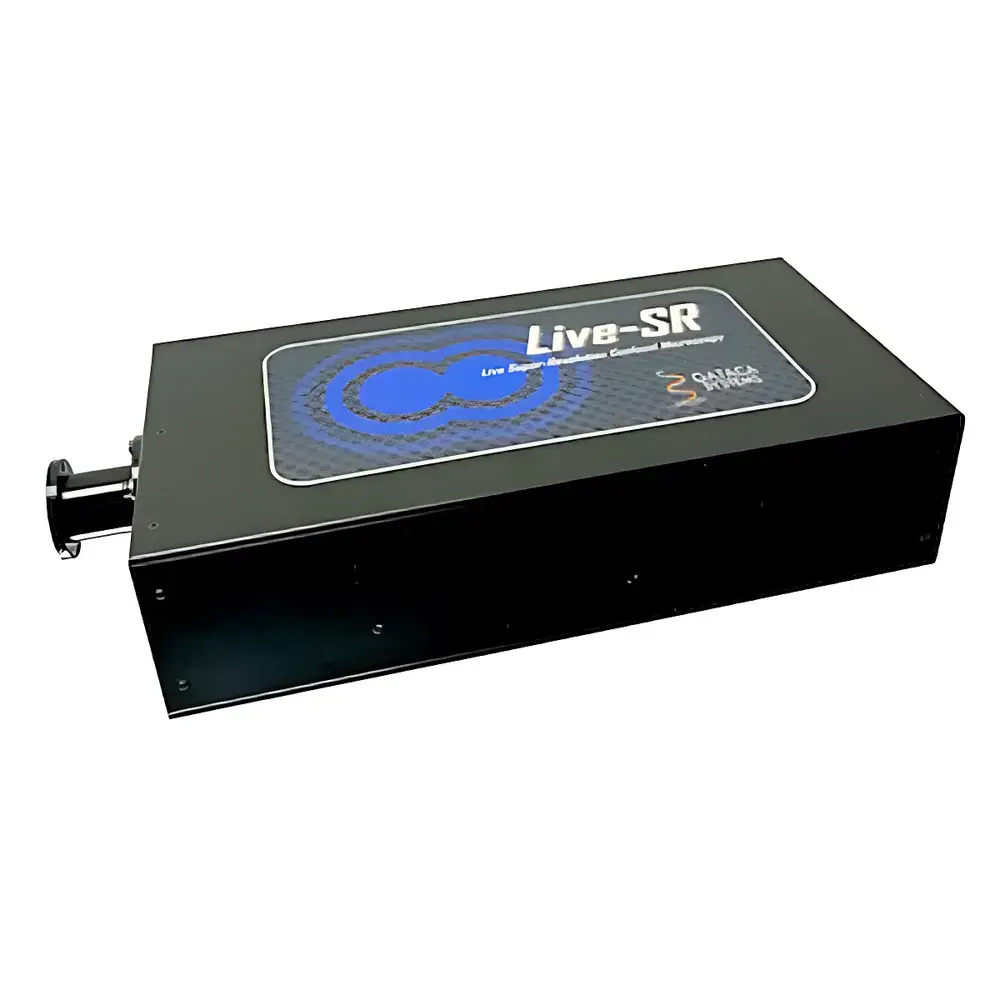
Auniontech LIVE-SR Super-Resolution Confocal Module
| Brand | Auniontech |
|---|---|
| Origin | Shanghai, China |
| Manufacturer Type | Authorized Distributor |
| Country of Origin | China |
| Model | LIVE-SR (Modular Add-on for Spinning-Disk Confocal Systems) |
| Pricing | Available Upon Request |
Overview
The Auniontech LIVE-SR Super-Resolution Confocal Module is a precision-engineered optical add-on designed to upgrade conventional spinning-disk confocal microscopes into high-speed, low-phototoxicity super-resolution imaging platforms. Leveraging optically modulated structured illumination microscopy (SIM) with real-time computational demodulation—integrated synchronously with spinning-disk scanning—the LIVE-SR module achieves isotropic lateral and axial resolution enhancement without compromising temporal fidelity. Unlike stochastic single-molecule localization techniques (e.g., PALM/STORM), LIVE-SR operates on deterministic pattern-based optical decoding, enabling reliable, reproducible ~100 nm 3D resolution across biological specimens under physiological conditions. Its architecture is optimized for live-cell applications where photobleaching, thermal stress, and motion artifacts must be minimized—making it particularly suited for long-term time-lapse imaging of subcellular dynamics, organelle trafficking, and cytoskeletal remodeling.
Key Features
- Isotropic 3D spatial resolution improved to ~100 nm (lateral and axial) via optical SIM demodulation coupled with spinning-disk detection
- Low phototoxicity design: Reduced excitation dose per frame enables extended viability in live mammalian cells, primary neurons, and embryonic tissues
- Optically enhanced intermediate image generation: Preserves native contrast and signal-to-noise ratio prior to digital reconstruction
- Simultaneous multi-color super-resolution acquisition using standard fluorophores (e.g., GFP, mCherry, Alexa Fluor dyes) without requiring special blinking buffers or oxygen scavenging systems
- High-speed acquisition up to 1000 fps at super-resolution mode (dependent on camera readout, disk rotation speed, and illumination stability)
- Native support for batch acquisition workflows: Multi-channel, Z-stack, multi-position, and time-series protocols are fully compatible with standard microscope control software APIs
- Real-time dynamic mode and auto-focus tracking integration for drift-compensated long-duration imaging
- Seamless functional compatibility with FRAP (Fluorescence Recovery After Photobleaching), photoactivation (PA), and laser ablation modules via TTL and analog I/O interfaces
- Motorized bypass mechanism allows rapid switching between conventional confocal and super-resolution modes without realignment
- Deep-tissue imaging capability enabled by optimized light-sheet-compatible optical path design and reduced scattering sensitivity
- No fluorophore-specific labeling requirements: Compatible with conventional fluorescent proteins and synthetic dyes used in routine cell biology
Sample Compatibility & Compliance
The LIVE-SR module is validated for use with fixed and live biological samples including cultured adherent cells, suspension cells, organoids, zebrafish embryos, and Drosophila tissues. It complies with ISO 10993-5 (biological evaluation of medical devices — cytotoxicity testing) for non-invasive imaging protocols and supports GLP/GMP-aligned experimental documentation when integrated with audit-trail-enabled acquisition software. While not a medical device itself, the module facilitates research-grade imaging compliant with NIH, EMBO, and Nature Methods best practices for quantitative fluorescence microscopy. No modifications to existing microscope safety interlocks or laser classification (Class 3B/4) are required upon installation.
Software & Data Management
The module interfaces natively with industry-standard acquisition platforms including MetaMorph, Micro-Manager, and NIS-Elements via hardware abstraction layer (HAL) drivers. Real-time SIM reconstruction is performed on GPU-accelerated processing units (NVIDIA CUDA-compatible), supporting on-the-fly deconvolution, chromatic aberration correction, and intensity normalization. Raw data is saved in open-format TIFF stacks with embedded metadata (OME-TIFF compliant), ensuring traceability for FAIR (Findable, Accessible, Interoperable, Reusable) data principles. Batch processing pipelines support automated alignment, channel registration, and Z-projection across multi-dimensional datasets. Optional integration with MATLAB or Python-based analysis frameworks (e.g., scikit-image, napari) is supported through documented API endpoints.
Applications
- Live-cell nanoscale tracking of membrane protein clusters and synaptic vesicle pools
- Quantitative 3D morphometry of mitochondria, endoplasmic reticulum, and nuclear pore complexes
- Time-resolved analysis of mitotic spindle assembly and chromosome segregation
- Multi-parametric co-localization studies across ≥3 spectral channels with <50 nm positional accuracy
- Long-term developmental imaging in transparent model organisms (e.g., C. elegans, Danio rerio)
- Correlative light-electron microscopy (CLEM) sample preparation guidance via high-fidelity fiducial marker mapping
- Validation benchmarking for AI-based super-resolution reconstruction algorithms
FAQ
Is the LIVE-SR module compatible with all spinning-disk confocal systems?
Yes—provided the host system offers accessible optical ports (C-mount or infinity-corrected tube lens interface), TTL synchronization signals, and mechanical space for module insertion. Compatibility matrices are available for Yokogawa CSU-X1/X2, Andor CSU-W1, and Nikon CSU series.
Does LIVE-SR require specialized fluorophores or buffer formulations?
No. Standard fluorescent labels—including EGFP, tdTomato, CF dyes, and ATTO dyes—perform optimally without chemical additives or environmental control beyond typical CO₂ incubation.
Can the module be retrofitted onto upright microscopes?
Yes, with optional kinematic mounting adapters and beam-path realignment kits—available upon technical consultation.
What computing resources are required for real-time reconstruction?
A workstation equipped with NVIDIA RTX A4000/A6000 GPU, ≥32 GB RAM, and ≥10 Gbps network storage is recommended for sustained 1000 fps operation.
Is regulatory documentation (CE, FDA 510(k)) available?
The LIVE-SR module is classified as a research-use-only (RUO) instrument under EU IVDR Annex XVI and US FDA 21 CFR §809.3. Technical files and risk assessments are provided to qualified institutional purchasers upon request.




