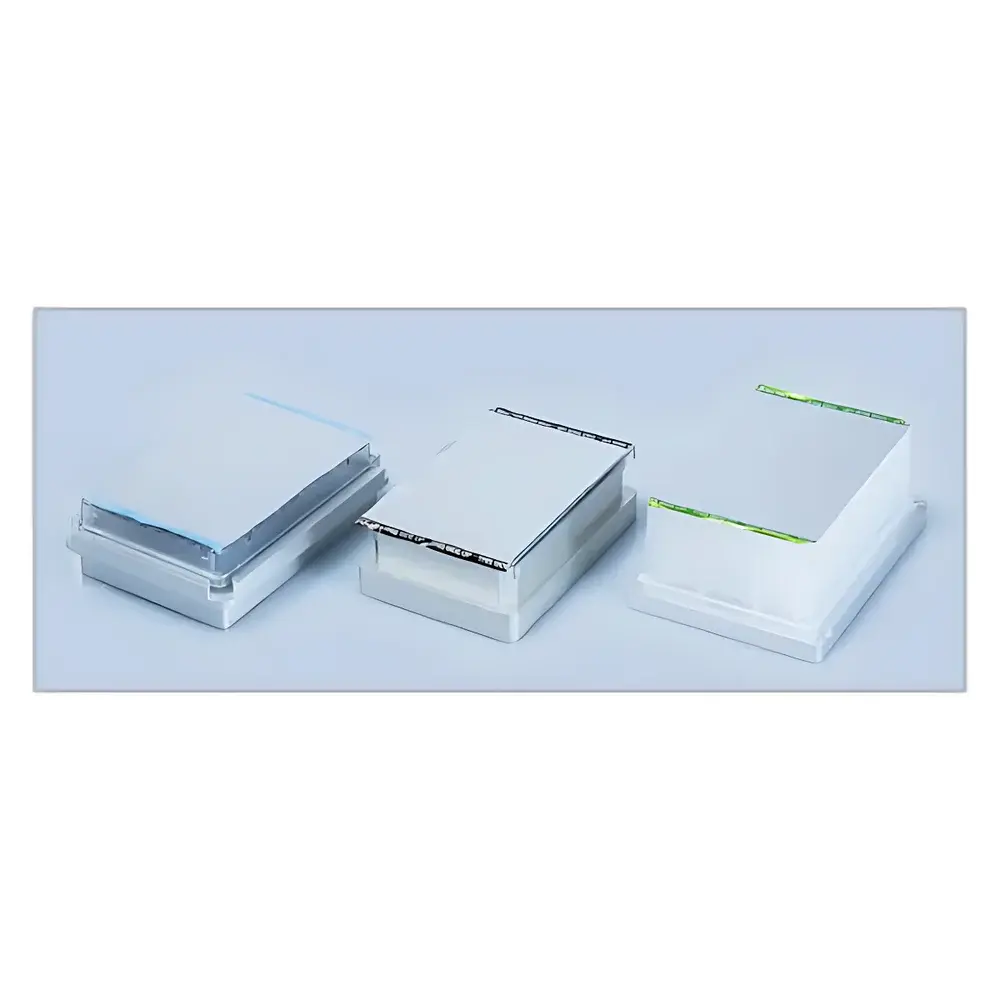
Vitl Life Science Solutions Microplate Heat Sealing Films (Auniontech Distribution)
| Brand | Vitl Life Science Solutions (Distributed by Auniontech) |
|---|---|
| Origin | United Kingdom |
| Product Type | Laboratory Consumables for PCR & Microplate Sealing |
| Compatibility | Standard 96-well, 384-well, and deep-well plates (PP, PE, PS, COC) |
| Thickness Options | 20 µm, 38 µm, 68 µm, 70 µm, 75 µm, 85 µm, 105 µm |
| Temperature Range | −200 °C to +180 °C (varies by film type) |
| Seal Integrity | Peelable and pierceable |
| Optical Transparency | Yes (except black variant) |
| Dimensions | 125 mm × 80 mm per sheet |
| Packaging | 100 sheets per pack |
| Color-Coded Identification | Green, Blue, Yellow, Red, Black |
| Regulatory Status | CE-marked, ISO 13485–compatible manufacturing environment |
| Application-Specific Certification | DMSO-compatible (V901001), high-temp PCR-rated (V901005, V901006) |
Overview
Vitl Life Science Solutions Microplate Heat Sealing Films are precision-engineered consumables designed for reliable, contamination-free sealing of standard and specialty microplates used in molecular biology, diagnostics, and high-throughput screening. These films operate on the principle of thermoplastic adhesion—activated by controlled thermal energy from compatible heat sealers—to form hermetic, low-permeability barriers over plate wells. Engineered for reproducible performance across diverse polymer substrates—including polypropylene (PP), polyethylene (PE), polystyrene (PS), and cyclic olefin copolymer (COC)—each film variant is calibrated to deliver optimal melt flow, interfacial bonding strength, and post-seal integrity under defined temperature and dwell time conditions. Their consistent thickness tolerance (±1.5 µm), dimensional stability, and low extractables profile meet stringent requirements for sensitive assays such as quantitative PCR (qPCR), enzymatic activity profiling, and long-term biobanking.
Key Features
- Color-coded identification system (green, blue, yellow, red, black) enables rapid visual differentiation of film types based on thermal profile, peelability, and substrate compatibility.
- Pre-marked orientation indicators (front/back labeling) eliminate misalignment during loading—preventing thermal damage to plates or inconsistent seal formation.
- Optically transparent variants support real-time plate scanning, fluorescence detection, and barcode readability without film removal.
- All films are pierceable with standard pipette tips and robotic liquid handlers, enabling downstream re-access without full delamination.
- Controlled peel force profiles ensure secure retention during centrifugation, freeze-thaw cycling, and automated storage retrieval—while permitting clean, residue-free removal when required.
- Manufactured under ISO 13485–aligned quality systems; lot-specific certificates of analysis available upon request.
Sample Compatibility & Compliance
Each film variant is validated for adherence to common microplate polymers and assay chemistries. The 20 µm green film (V901002) provides ultra-low-temperature sealing for cryogenic storage (−80 °C), while the 105 µm transparent film (V901006) withstands extended thermal cycling up to 110 °C—meeting ASTM E2585 criteria for PCR plate integrity verification. The red 70 µm film (V901001) demonstrates verified chemical resistance to dimethyl sulfoxide (DMSO) at concentrations ≤10%, supporting high-throughput drug solubility and cytotoxicity assays. All films comply with USP for plastic packaging components and exhibit extractables levels below ICH Q5C thresholds. They are suitable for use in GLP- and GMP-regulated environments where traceability, audit readiness, and batch consistency are mandatory.
Software & Data Management
While the films themselves are passive consumables, their performance is fully integrated into Vitl’s ecosystem of thermal sealing instrumentation—including the VTS programmable temperature-controlled sealer and MicroTS compact benchtop unit. When paired with Vitl’s Sealing Protocol Manager software (v3.2+), users can assign specific film types to predefined plate formats and thermal profiles, ensuring repeatable parameter recall across shifts and operators. Audit trails log seal time, temperature ramp rate, dwell duration, and operator ID—supporting compliance with FDA 21 CFR Part 11 requirements for electronic records and signatures. Calibration certificates for associated sealers are traceable to UKAS-accredited standards.
Applications
- Long-term archival storage of genomic DNA, RNA, and cDNA libraries at −80 °C or in vapor-phase liquid nitrogen.
- qPCR and digital PCR workflows requiring evaporation prevention and cross-contamination control across 384-well formats.
- High-throughput screening (HTS) of compound libraries in DMSO-based assays using deep-well polypropylene plates.
- Clinical diagnostic sample stabilization prior to transport or batched analysis under CLIA/CAP guidelines.
- Automated biobanking operations integrating robotic plate handling, barcode scanning, and environmental monitoring.
FAQ
Which film should I use for qPCR applications requiring repeated thermal cycling?
For standard qPCR (up to 40 cycles, 95 °C denaturation), select the 75 µm red film (V901005) or 105 µm transparent film (V901006), both validated for ≥110 °C peak exposure and minimal well-to-well leakage.
Can these films be used with non-Vitl heat sealers?
Yes—films are compatible with any temperature- and pressure-controlled sealer capable of uniform thermal distribution across 125 mm × 80 mm area; however, optimal bond strength requires calibration against Vitl’s published thermal profiles.
Are the films sterile or certified for clinical use?
Films are supplied non-sterile; terminal sterilization via gamma irradiation or ethylene oxide is not recommended due to potential polymer degradation. Sterile versions (ISO 11137 Class 1) are available under custom order with documented bioburden validation.
How do I verify seal integrity post-application?
Perform dye penetration testing using 0.1% methylene blue solution followed by visual inspection under white light, or quantify evaporation loss gravimetrically per ISO 15197 Annex C protocols.