
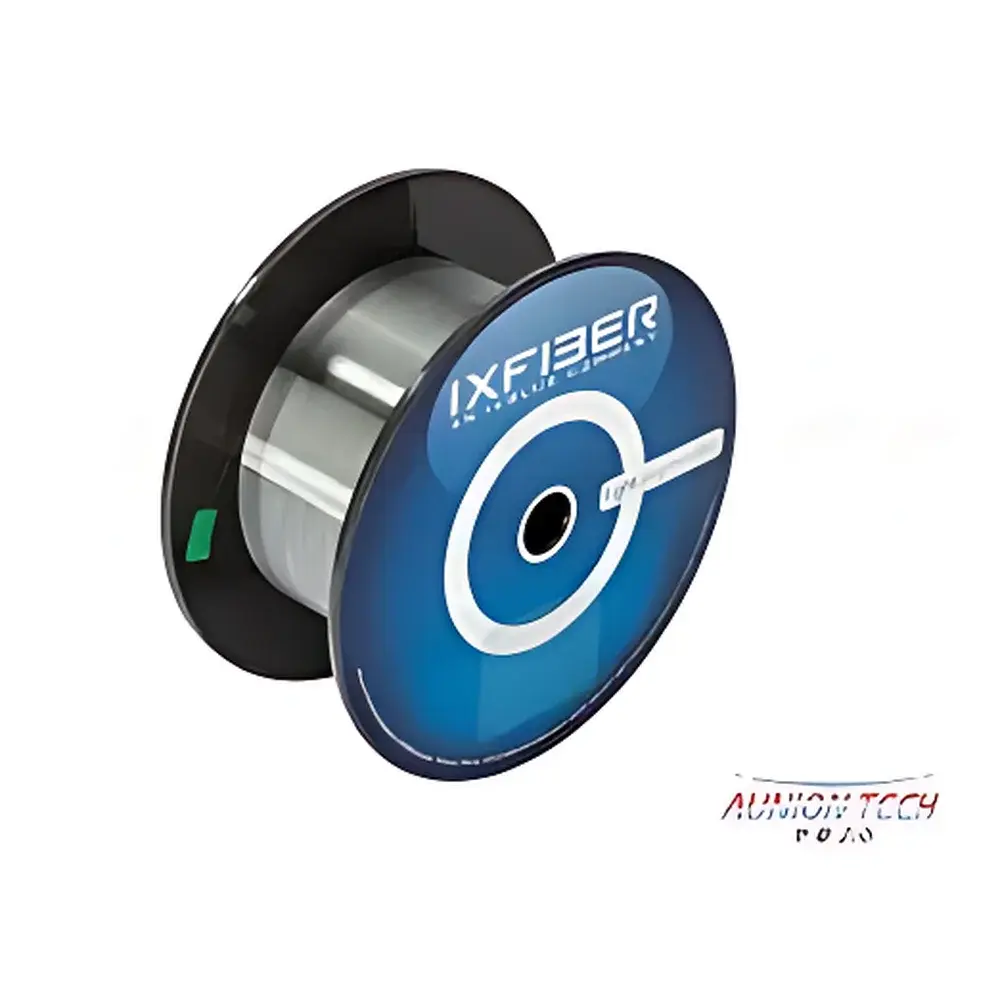
IXFiber Rad-Hard Fiber – Radiation-Hardened Specialty Optical Fiber for Space-Grade Spectroscopy and Sensing
| Brand | IXFiber (distributed by Auniontech) |
|---|---|
| Origin | France |
| Type | Radiation-Hardened Specialty Fiber |
| Model | IXfiber_Rad_Hard_Fiber |
| Spectral Range | 800–1700 nm (optimized for InGaAs detection) |
| Detector Compatibility | InGaAs-based spectrometers |
| Resolution | Up to 7680 pixels (system-dependent) |
| Sensitivity | High (typical responsivity >1.0 A/W at 1550 nm) |
| Signal-to-Noise Ratio | >80 dB (full-well, cooled operation) |
| Dynamic Range | >68 dB (typical, 16-bit digitization) |
| Stray Light Rejection | <−67 dB (optimized grating + fiber coupling design) |
Overview
The IXFiber Rad-Hard Fiber is a space-qualified, radiation-hardened optical fiber engineered for high-reliability spectral transmission in extreme ionizing radiation environments. Unlike standard silica-based fibers, this specialty fiber incorporates modified core dopants (e.g., phosphorus co-doping, cerium stabilization) and optimized cladding geometry to suppress radiation-induced attenuation (RIA) and preserve transmission stability under prolonged exposure to X-rays, gamma rays, protons, and heavy ions—common in low-Earth orbit (LEO), geostationary transfer orbit (GTO), and deep-space missions. Its design adheres to the fundamental principles of radiation-resistant photonics: minimizing non-bridging oxygen hole centers (NBOHC) and E′-center formation through compositional control and hydrogen-loading mitigation strategies. As an integral component in fiber-coupled spectroscopic systems—including UV-Vis-NIR and SWIR spectrometers—the IXFiber Rad-Hard Fiber enables stable light delivery from remote or confined sample zones to radiation-sensitive InGaAs array detectors without signal degradation over mission lifetimes exceeding 10 years. It is not a standalone instrument but a critical enabling subsystem for space-qualified fiber optic spectrometers, fiber gyroscopes (FOGs), distributed temperature/strain sensors, and laser amplifier chains.
Key Features
- Radiation tolerance validated to ≥100 krad(Si) total ionizing dose (TID) with RIA <0.07 dB/krad (model-dependent)
- Available in both polarization-maintaining (Panda-type) and non-PM configurations for interferometric and coherent applications
- Core diameters of 6 µm and 12 µm support single-mode and low-multimode coupling into spectrograph slit inputs
- Low background loss (<15–20 dB/km at 1550 nm) ensures minimal insertion loss across C- and L-band spectral windows
- Controlled cutoff wavelength (<1150 nm) guarantees robust single-mode operation above 1310 nm
- Splice loss <0.20 dB to standard SMF-28 fiber—enabling seamless integration into existing optical benches and OEM modules
- Compatible with industry-standard FC/PC, SMA 905, and custom hermetic connectors for vacuum and thermal cycling environments
Sample Compatibility & Compliance
The IXFiber Rad-Hard Fiber is designed for use in vacuum-compatible, thermally cycled optical paths typical of satellite payloads and ground-based radiation test facilities. It maintains mechanical integrity across −40°C to +85°C operating temperatures and survives launch-level vibration (per ECSS-Q-ST-70-08C). While the fiber itself is not certified to a specific regulatory standard, its performance data aligns with requirements outlined in ECSS-E-ST-20-07C (space product assurance), NASA GSFC-STD-7000A (radiation hardness assurance), and MIL-STD-883 (method 1019.8 for TID testing). When integrated into spectroscopic systems, it supports compliance with ISO/IEC 17025 traceable calibration workflows and facilitates GLP/GMP-aligned spectral data acquisition where long-term repeatability is mandated.
Software & Data Management
As a passive optical component, the IXFiber Rad-Hard Fiber does not incorporate embedded firmware or digital interfaces. However, its radiometric stability directly contributes to measurement integrity in spectrometer platforms running vendor-agnostic software such as OceanView, SpectraSuite, or custom LabVIEW- or Python-based acquisition suites. Its low RIA coefficient ensures that dark-current correction, baseline drift compensation, and photometric calibration remain valid over extended operational periods—reducing the frequency of recalibration events required under ASTM E275 and ISO 13406-2 protocols. For systems requiring audit trails (e.g., FDA 21 CFR Part 11-compliant environments), the fiber’s consistent transmission profile simplifies validation documentation by eliminating time-dependent spectral artifacts.
Applications
- Spaceborne fiber-optic spectrometers for Earth observation (e.g., atmospheric gas monitoring, vegetation indices)
- Fiber-coupled Raman and fluorescence sensors in nuclear reactor monitoring and spent fuel characterization
- High-stability interferometric sensing in satellite attitude control systems (FOG, interferometric strain gauges)
- Deep-space communication relay optics requiring multi-year transmission fidelity
- Ground-based radiation testbeds simulating Van Allen belt or solar particle event exposure
- Medical isotope production facility diagnostics where gamma fields exceed 10 kGy/h
FAQ
What radiation types and doses is this fiber qualified for?
It is characterized for total ionizing dose (TID) up to 100 krad(Si) under Co-60 gamma irradiation; proton and electron fluence data are available upon request per customer mission profiles.
Can it be spliced to standard telecom fiber?
Yes—low-loss fusion splicing to SMF-28 is achievable using commercial fusion splicers with arc power optimization; splice loss remains <0.20 dB with proper cleave and alignment.
Is hydrogen loading used to enhance radiation resistance?
No—hydrogen loading is avoided due to outgassing risks in vacuum; radiation hardening is achieved via intrinsic glass composition and defect engineering.
Does it support UV transmission below 800 nm?
Not recommended—its primary optimization is in the 800–1700 nm window; UV-induced RIA increases significantly below 800 nm.
Are PM versions available with defined extinction ratio specifications?
Yes—Panda-type variants maintain >20 dB polarization extinction ratio after 100 krad(Si) exposure, verified per IEC 61300-2-43.
Related Products





