
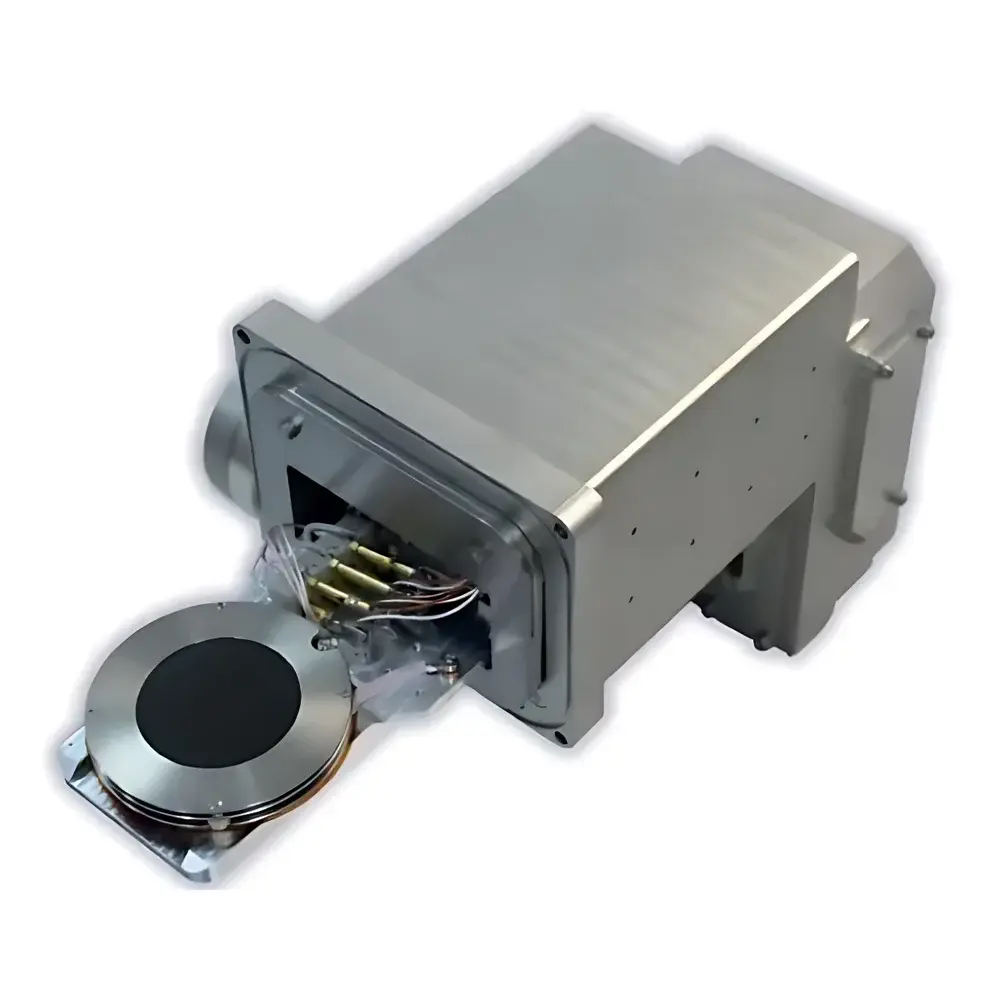
Auniontech DLD-120 Delayline Detector
| Brand | Auniontech |
|---|---|
| Model | DLD-120 |
| Active Diameter | 120 mm |
| Lateral Resolution | ≤ 50 µm |
| Permanent Random Imaging Count Rate | > 5 × 10⁶ counts/s |
| Special Layout Imaging Count Rate | > 20 × 10⁶ counts/s |
| Max. Burst Rate | up to 100 × 10⁶ counts/s |
| Multi-Hit Capability | ≥ 4 simultaneous hits |
| High-Voltage Floating | up to 10 kV |
| Time Bin Resolution | 6.8 ps |
| Position-Integrated Time Resolution | < 200 ps |
| Maximum Start Repetition Rate | 9 MHz |
| Interface | USB 3.0 & Gigabit Ethernet |
| Compliance | Designed for vacuum-integrated TOF and ultrafast photon/particle imaging systems |
Overview
The Auniontech DLD-120 Delayline Detector is a high-performance, vacuum-compatible microchannel plate (MCP)-based position- and time-resolving detector engineered for single-particle event detection in time-of-flight (TOF), ultrafast spectroscopy, and coincidence imaging applications. It operates on the principle of delay-line anode readout: incident particles (electrons, ions, or photons) strike an MCP stack, generating secondary electron cascades that are collected by a segmented delay-line anode. The temporal offset between signal arrivals at either end of orthogonal X- and Y-delay lines enables precise 2D spatial reconstruction, while the absolute time-of-arrival relative to a synchronized trigger yields sub-200 ps time resolution. This architecture eliminates frame-based integration limitations, supporting true event-by-event timestamping with nanosecond-scale dead-time recovery—making it ideal for low-duty-cycle, high-dynamic-range experiments where temporal fidelity and spatial linearity are non-negotiable.
Key Features
- True single-event counting with <200 ps position-integrated time resolution and 6.8 ps time-bin precision
- Large active area (up to 120 mm diameter) with lateral resolution down to 50 µm across the full aperture
- High sustained count rate: >5 million counts/s under permanent random illumination; >20 million counts/s achievable with optimized electrode layout
- Burst-mode capability: up to 100 million counts/s equivalent throughput during short-duration pulses
- Multi-hit discrimination: supports ≥4 simultaneous particle impacts within one readout cycle without positional ambiguity
- Floating high-voltage operation: compatible with bias potentials up to ±10 kV, enabling direct coupling to MCP stacks in ultra-high vacuum (UHV) chambers
- Dual high-speed interfaces: USB 3.0 for lab-based configuration and diagnostics; Gigabit Ethernet for real-time streaming in distributed control environments
- Low-jitter start repetition rate support up to 9 MHz, ensuring synchronization with high-repetition-rate pulsed lasers or RF-driven ion sources
Sample Compatibility & Compliance
The DLD-120 is designed for integration into UHV-compatible analytical instruments operating at pressures ≤1×10⁻⁷ mbar. Its all-metal, ceramic-sealed construction ensures minimal outgassing and long-term stability in demanding beamline or surface science environments. The detector complies with IEC 61000-6-3 (EMC emission standards) and meets mechanical interface specifications aligned with standard ConFlat (CF) flange mounts (e.g., CF-100, CF-150). While not certified to ISO/IEC 17025 as a standalone metrology device, its performance characteristics—including linearity deviation <0.5% over full field and pulse-height uniformity ±8%—are validated per internal test protocols traceable to NIST-calibrated timing references. It is routinely deployed in systems requiring adherence to GLP-compliant data acquisition workflows, including those subject to FDA 21 CFR Part 11 audit trails when paired with compliant host software.
Software & Data Management
The DLD-120 ships with Auniontech’s DLD Control Suite—a cross-platform application (Windows/Linux) supporting real-time histogramming (1D TOF, 2D position, 3D time-position), event list export in HDF5 and ASCII formats, and programmable region-of-interest (ROI) gating. APIs (C/C++, Python bindings via ctypes) enable integration into LabVIEW, MATLAB, EPICS, or custom DAQ frameworks. Timestamped event lists include raw X/Y coordinates, arrival time (ps resolution), amplitude-derived gain correction flags, and optional external TTL marker tags. All acquired datasets retain embedded metadata (detector ID, HV settings, acquisition timestamp, firmware version), satisfying FAIR data principles. Optional plug-ins support automated calibration routines for spatial distortion correction and time-walk compensation using reference pulsed sources.
Applications
- Time-of-flight mass spectrometry (TOF-MS) and electron/ion energy analyzers (XPS, UPS, EELS)
- Time-resolved photoelectron emission microscopy (ToF-PEEM) and ultrafast surface dynamics studies
- Medium-energy ion scattering with TOF detection (MEIS-TOF) for near-surface compositional mapping
- Atom probe tomography (APT) and 3D atom probe reconstruction requiring picosecond-level hit sequencing
- Gated X-ray imaging for pump-probe experiments at synchrotrons and XFEL facilities
- Fluorescence lifetime imaging (FLIM) and FLIM-FRET in confocal or widefield modalities with TCSPC compatibility
- X-ray absorption/emission spectroscopy (XAS/XES) requiring high-efficiency, time-tagged photon counting
FAQ
What vacuum conditions are required for optimal DLD-120 operation?
The detector is rated for continuous operation at pressures ≤1×10⁻⁷ mbar; bake-out capability up to 150°C is supported for UHV system integration.
Can the DLD-120 be used with existing MCP stacks from other vendors?
Yes—its floating anode design and configurable HV input allow direct interfacing with third-party MCP assemblies, provided mechanical alignment and voltage isolation meet specification.
Is time-zero calibration included in the standard firmware?
Yes—the Control Suite includes automated time-zero drift compensation using periodic reference pulses, with user-adjustable lock-in bandwidths for varying experimental duty cycles.
Does the detector support hardware-based coincidence triggering?
It provides two dedicated TTL-compatible external trigger inputs (Start and Gate) with adjustable delay and width, enabling hardware-level coincidence logic without host CPU latency.
Are custom active-area geometries available?
Auniontech offers OEM design services for non-circular apertures (e.g., rectangular, slotted) and hybrid multi-anode configurations upon technical review and minimum order quantity agreement.




