
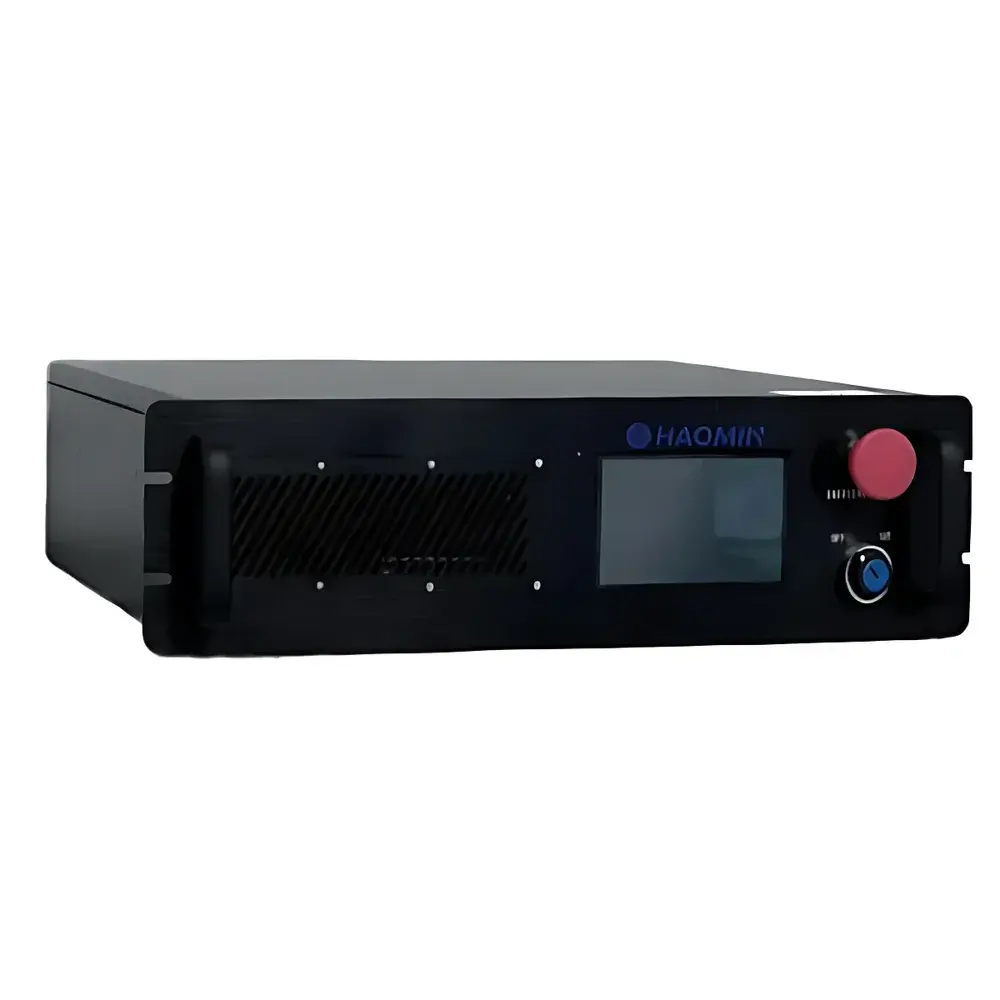
Auniontech P-SFFL-10-HP High-Power Narrow-Linewidth 1064 nm Single-Frequency Fiber Laser
| Brand | Auniontech |
|---|---|
| Origin | Shanghai, China |
| Model | P-SFFL-10-HP |
| Wavelength Range | 1020–1080 nm (customizable) |
| Output Power | 0–10 W (continuously adjustable) |
| Linewidth | ≤20 kHz (with 20 km delay line) |
| Polarization Extinction Ratio | ≥18 dB |
| Output Stability | ±0.5 % (RMS, 8 h) |
| Beam Quality (M²) | ≤1.1 |
| Spectral SNR | ≥50 dB |
| Operating Temperature | 0–40 °C |
| Cooling Method | Air-cooled |
| Control Interface | RS232 |
| Output Fiber | PMF, 10/125 µm, FC/APC connector, >0.5 m length |
| Dimensions | Standard 3U rack-mount chassis |
Overview
The Auniontech P-SFFL-10-HP is a high-power, single-frequency, narrow-linewidth fiber laser engineered for demanding applications requiring exceptional spectral purity, long-term amplitude and frequency stability, and robust linearly polarized output. Operating in the 1020–1080 nm range—commonly centered at 1064 nm—the system employs a distributed feedback (DFB) seed oscillator followed by a master oscillator power amplifier (MOPA) architecture based on polarization-maintaining (PM) double-clad fiber. This design eliminates mode-hopping and ensures true single-longitudinal-mode (SLM) continuous-wave (CW) emission. The laser’s core performance metrics—including sub-20 kHz intrinsic linewidth (verified via delayed self-heterodyne interferometry with 20 km fiber delay), <±0.5% RMS power stability over 8 hours, and M² < 1.1—are achieved through integrated thermal management, precision polarization control, and proprietary PM-fiber fusion splicing techniques that suppress stimulated Brillouin scattering (SBS) and other nonlinear effects at multi-watt power levels.
Key Features
- True single-frequency operation with no mode hops across full power and temperature ranges
- Output power continuously adjustable from 10% to 100% of rated maximum (up to 10 W)
- Integrated STM32 microcontroller enabling local front-panel operation with emergency shutdown switch and real-time LCD power/status display
- Full all-PM architecture: DFB seed + PM pre-amplifier + PM power amplifier stages ensure stable linear polarization with extinction ratio ≥18 dB
- Optimized thermal design with air-cooling supports uninterrupted operation in standard laboratory environments (0–40 °C ambient)
- Optional piezoelectric transducer (PZT) wavelength tuning (DC–10 kHz modulation bandwidth, >2 GHz range) and thermal wavelength tuning (0.8 nm over operating range)
- Rack-mountable 3U chassis compliant with industrial vibration and EMI specifications
Sample Compatibility & Compliance
The P-SFFL-10-HP is compatible with standard optical setups used in ultra-stable interferometry, coherent beam combining, and quantum optics experiments. Its FC/APC-terminated 10/125 µm PM fiber output ensures low back-reflection coupling into external modulators, frequency doublers, or fiber-based sensors. The system meets CE marking requirements for electromagnetic compatibility (EN 61326-1) and safety (EN 60825-1:2014 Class 4 laser product). While not certified to ISO/IEC 17025 or GLP/GMP out-of-the-box, its traceable power stability, wavelength repeatability, and built-in RS232 interface support integration into validated workflows compliant with ISO 10110-5 (laser beam characterization) and ASTM E2912 (laser-based sensing systems). All optical components are selected and processed to minimize contamination-sensitive outgassing—suitable for cleanroom-adjacent deployment.
Software & Data Management
Local control is fully accessible via the front-panel interface; remote operation is supported through ASCII-command-based RS232 communication (baud rate configurable up to 115200). A vendor-provided Windows-compatible terminal application enables scripting of power ramping sequences, logging of real-time output power and internal temperature readings, and configuration of PZT modulation parameters. The firmware implements non-volatile memory storage for user-defined calibration offsets and operational presets. Though no native API or SDK is included, the deterministic command-response protocol allows seamless integration with LabVIEW, Python (pySerial), MATLAB, or custom SCADA platforms. Audit-trail functionality is not embedded but can be implemented externally via timestamped serial log capture—sufficient for basic 21 CFR Part 11-aligned recordkeeping when paired with controlled environment documentation.
Applications
- Coherent LIDAR & Doppler velocimetry: Sub-kHz linewidth enables long coherence length (>10 km) required for heterodyne detection in atmospheric sensing and wind profiling
- Fiber-optic gyroscopes (FOGs) and inertial navigation: Low phase noise and high polarization fidelity reduce bias drift and scale factor errors in Sagnac interferometers
- Second-harmonic generation (SHG): Stable 1064 nm input enables efficient conversion to 532 nm green light in PPLN or MgO:PPLN waveguides for atomic physics and metrology
- Atomic cooling and trapping (e.g., Yb, Er, Dy): Precise wavelength tunability and narrow linewidth meet stringent requirements for magneto-optical traps (MOTs) and optical lattices
- Distributed acoustic sensing (DAS) and strain monitoring: High SNR (>50 dB) and low relative intensity noise (RIN) improve signal-to-noise ratio in φ-OTDR systems
- Optical frequency comb stabilization: Used as a low-noise pump or local oscillator in electro-optic or microresonator-based comb systems
FAQ
Is this laser qualified for use in Class 1 enclosed systems?
Yes—when integrated into an interlocked, beam-enclosed subsystem meeting IEC 60825-1:2014 Annex G requirements, the P-SFFL-10-HP can serve as the source in Class 1 OEM instruments.
Can the center wavelength be customized outside the 1020–1080 nm range?
Standard customization is limited to that band. For wavelengths below 1020 nm or above 1080 nm (e.g., 976 nm or 1120 nm), engineering feasibility assessment and NRE charges apply due to seed diode and gain fiber availability constraints.
What is the typical warm-up time to achieve specified power and frequency stability?
Full thermal equilibrium and specification compliance are achieved within 30 minutes of cold start at 25 °C ambient; stabilization time extends to 45 minutes at lower ambient temperatures (≤15 °C).
Does the laser include factory calibration data for wavelength and power?
Each unit ships with a test report listing measured center wavelength (via high-resolution wavemeter), output power vs. setpoint curve, polarization extinction ratio, and linewidth verification data—traceable to NIST-calibrated reference instruments.
Is water cooling available as an option?
No—air cooling is standard and sufficient for continuous 10 W operation. Water-cooled variants are not offered due to added complexity and limited demand; users requiring higher average power should consider the P-SFFL-20 series under separate inquiry.





