
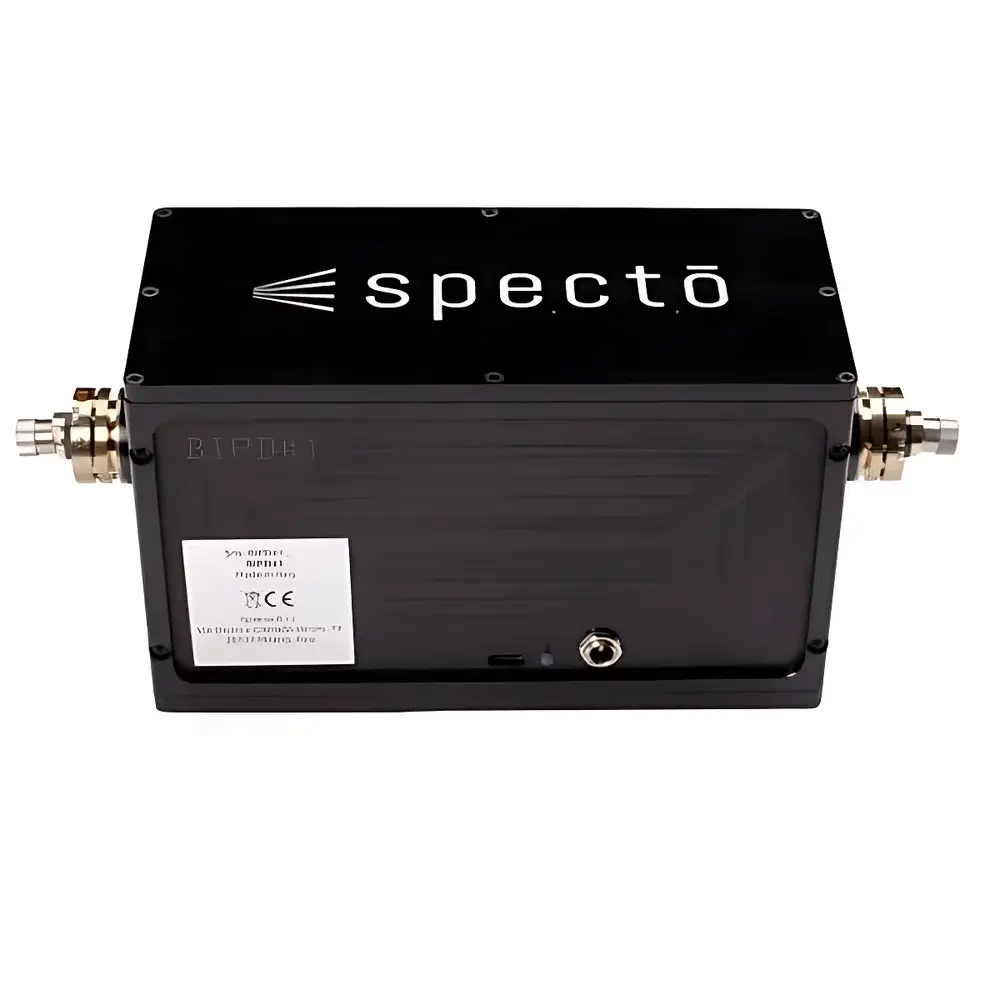
Auniontech BIPD-Based High-Rejection Tunable Optical Filter
| Brand | Auniontech |
|---|---|
| Origin | Shanghai, China |
| Manufacturer Type | Authorized Distributor |
| Product Category | Domestic |
| Model | BIPD-TF Series |
| Price | USD 1 (Reference Only) |
| Operating Wavelength | 450–900 nm |
| Insertion Loss | < 2 dB |
| Free Spectral Range (FSR) | 20–6000 GHz (0.7–200 cm⁻¹) |
| Extinction Ratio | > 45 dB |
| Filter Bandwidth (3-dB) | < 300 MHz (< 0.001 cm⁻¹) |
| Operating Temperature | 15–35 °C |
| Dimensions | 10 cm × 8 cm × 17 cm |
| Optical Interface | Free-space or Fiber-coupled |
| Thermal Stability | > 45 dB over 60 min |
Overview
The Auniontech BIPD-Based High-Rejection Tunable Optical Filter is an engineered solution for ultra-selective spectral filtering in Brillouin and low-frequency Raman spectroscopy. It operates on the principle of Birefringence-Induced Phase Delay (BIPD), a solid-state, all-optical filtering mechanism that generates high-fidelity, narrowband transmission windows without moving parts or active thermal tuning. Unlike acousto-optic or Fabry–Pérot tunable filters, the BIPD architecture delivers millisecond-scale wavelength agility across the visible and near-infrared spectrum while maintaining exceptional out-of-band rejection—critical for isolating weak Brillouin-shifted signals buried beneath intense Rayleigh elastic scattering. Its compact monolithic design integrates seamlessly into standard microscope-based Brillouin setups, including both spontaneous and stimulated configurations, and supports alignment-free integration with commercial confocal, multiphoton, or fiber-coupled optical platforms.
Key Features
- Millisecond-level tunability across 450–900 nm—enabling real-time spectral scanning without mechanical reconfiguration
- Extinction ratio exceeding 45 dB, ensuring robust suppression of Rayleigh background in Brillouin measurements
- Narrow 3-dB bandwidth < 300 MHz (< 0.001 cm⁻¹), resolving Brillouin shifts as small as 0.1 GHz with high fidelity
- Insertion loss < 2 dB across full operational band—preserving signal-to-noise ratio in photon-limited applications
- Thermal stability > 45 dB over 60 minutes at constant ambient temperature (15–35 °C), supporting long-duration acquisitions
- Modular interface options: free-space collimated input/output or FC/PC or FC/APC fiber ports for system integration
- No external power or driver electronics required—passive, polarization-sensitive operation compatible with standard laser sources
Sample Compatibility & Compliance
The filter is designed for use in label-free, non-destructive optical characterization of heterogeneous and turbid media—including biological tissues, hydrogels, polymers, and colloidal suspensions. Its high extinction ratio and narrow linewidth enable reliable Brillouin frequency shift extraction even under high-scattering conditions where conventional notch filters fail. The device complies with ISO 10110-7 (optical component surface quality) and meets RoHS Directive 2011/65/EU requirements. While not certified to IEC 61000-4 electromagnetic immunity standards, its passive architecture inherently eliminates EMI susceptibility—making it suitable for use in shielded optical labs and GLP-compliant environments where electronic noise must be minimized. For regulated applications (e.g., pharmaceutical material characterization per USP ), the filter may be incorporated into validated optical measurement workflows when paired with traceable calibration references.
Software & Data Management
As a passive optical component, the BIPD filter does not require embedded firmware or proprietary control software. Wavelength tuning is achieved via manual rotation of the birefringent crystal assembly or through optional motorized rotation stages (e.g., Thorlabs K10CR1 or Newport CONEX-AG-PS100), which integrate with standard motion control APIs (LabVIEW, Python pySerial, MATLAB Instrument Control Toolbox). When deployed in automated Brillouin spectrometers, the filter’s position can be synchronized with spectrometer grating angles and CCD exposure timing using TTL triggers. Audit-trail-capable data acquisition systems (e.g., those compliant with FDA 21 CFR Part 11) may log filter orientation metadata alongside spectral datasets to ensure full traceability in GMP-aligned research settings.
Applications
- Brillouin Microspectroscopy: Quantitative mapping of longitudinal acoustic phonon frequencies to derive local viscoelastic parameters—including bulk modulus, shear modulus, and viscosity—in live cells, organoids, and extracellular matrices
- Low-Wavenumber Raman Spectroscopy: Detection of terahertz-range intermolecular vibrations (0.1–10 cm⁻¹) for polymorph identification, crystallinity assessment, and hydrogen-bond network analysis in pharmaceutical solids
- Stimulated Brillouin Scattering (SBS) Microscopy: Background-free pump-probe imaging with sub-micron spatial resolution and GHz spectral selectivity
- Fundamental Light–Matter Interaction Studies: High-resolution interrogation of phonon–photon coupling in 2D materials, metamaterials, and soft condensed matter systems
FAQ
What is the physical operating principle of the BIPD filter?
It relies on controlled birefringence-induced phase delay between orthogonal polarization components in a uniaxial crystal stack, generating constructive interference only at discrete wavelengths determined by crystal orientation and optical path length.
Can the filter be used with pulsed lasers?
Yes—its passive, broadband response supports femtosecond to continuous-wave sources; however, pulse dispersion must be compensated separately in ultrashort-pulse applications.
Is custom FSR or center wavelength available?
Yes—Auniontech offers OEM configuration services for tailored FSR (20–6000 GHz), central wavelength (within 450–900 nm), and fiber interface type (SMF-28, HI1060, or PM fiber); lead time and NRE fees apply.
Does the filter require temperature stabilization?
No active cooling/heating is needed; performance remains stable within 15–35 °C ambient range. For sub-0.1 cm⁻¹ repeatability over multi-hour sessions, enclosure within a temperature-controlled optical bench is recommended.
How is calibration performed?
Calibration uses a stabilized HeNe laser (632.8 nm) and/or a gas absorption cell (e.g., H₂O vapor lines at 720 nm) to map angular position to absolute wavenumber; traceable NIST-calibrated wavemeters may be used for primary validation.




