
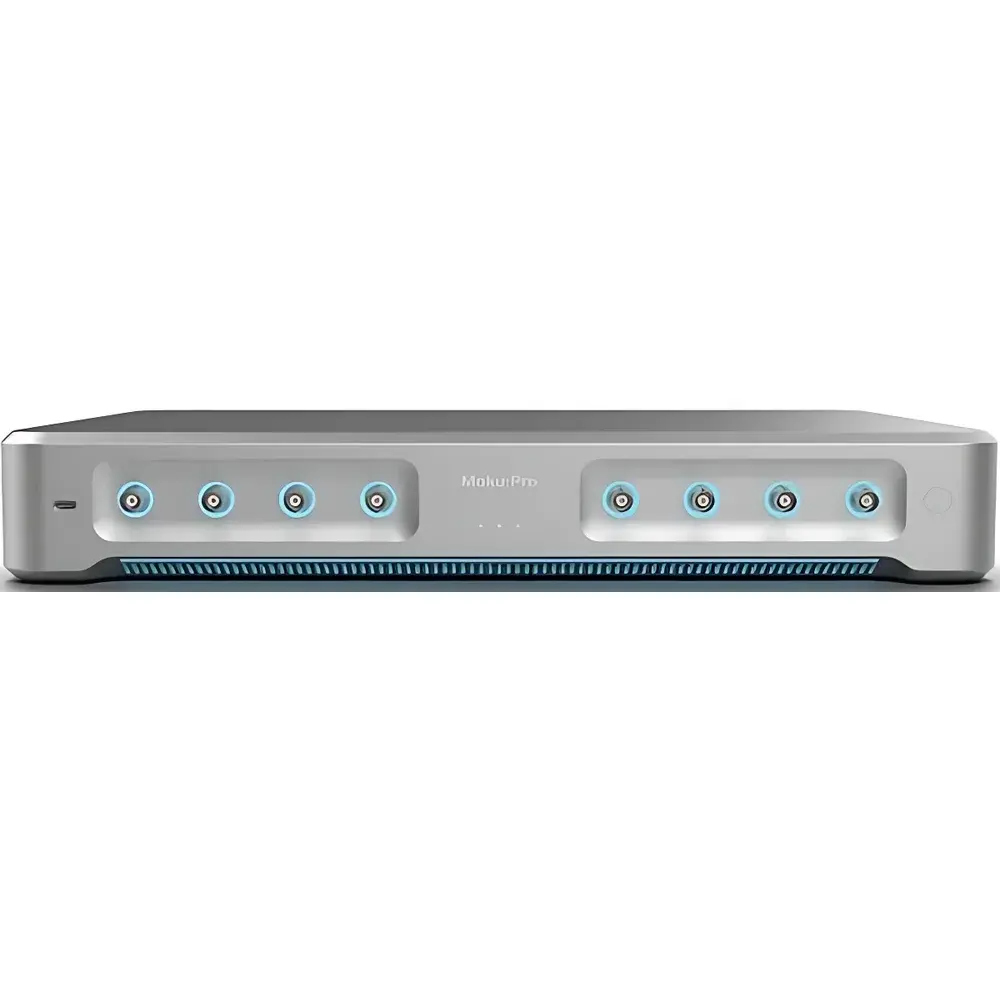
Moku:Pro Frequency Response Analyzer
| Brand | auniontech |
|---|---|
| Origin | Australia |
| Manufacturer Type | Authorized Distributor |
| Import Status | Imported |
| Model | Moku:Pro |
| Price Range | USD $105,000 – $132,000 (approx.) |
Overview
The Moku:Pro Frequency Response Analyzer is a high-performance, FPGA-accelerated instrumentation platform engineered for precision frequency-domain characterization of dynamic systems. Unlike traditional analog sweep-based analyzers, it implements digital correlation techniques with real-time lock-in demodulation—enabling coherent, noise-immune measurement of magnitude and phase response across a 10 mHz to 300 MHz bandwidth. Its architecture leverages a Xilinx Ultrascale+ FPGA to execute simultaneous multi-channel signal generation and acquisition at up to 1 GSa/s sampling rate, ensuring high reproducibility and minimal phase drift during extended sweeps. The instrument operates on the principle of swept-sine excitation combined with synchronous demodulation, delivering vector frequency response functions (FRFs) with dynamic range exceeding 120 dB and a noise floor as low as –135 dBm (1 Hz RBW). Designed for laboratory-grade R&D and validation environments, it replaces legacy benchtop setups requiring multiple instruments—including function generators, spectrum analyzers, lock-in amplifiers, and impedance analyzers—into a single, software-defined platform.
Key Features
- Simultaneous 4-channel input and 4-channel output capability, supporting differential, single-ended, and ratio-based measurements (e.g., Vout/Vin, Iout/Iin)
- Configurable sine sweep modes: linear or logarithmic frequency stepping from 10 mHz to 300 MHz
- Real-time mathematical channel processing: live addition, subtraction, multiplication, and division of acquired transfer functions
- Harmonic demodulation up to the 15th order for nonlinear system analysis and distortion assessment
- Adjustable averaging (1–1024 cycles) and settling time per point to optimize SNR versus measurement speed
- Integrated spectrum analyzer mode: 4-channel concurrent FFT analysis from DC to 300 MHz, with resolution bandwidth down to 2.2 Hz and minimum span of 100 Hz
- Four independent 500 MHz sine wave generators with programmable amplitude, offset, and phase
- Cursor- and marker-based measurement tools for peak detection, bandwidth (–3 dB), phase margin, gain margin, and resonance identification
Sample Compatibility & Compliance
The Moku:Pro interfaces seamlessly with passive and active electronic circuits, piezoelectric transducers, MEMS devices, optical modulators, RF filters, and feedback control loops. Its 50 Ω input/output impedance and ±5 V input range accommodate standard test fixtures and probe-based configurations. All measurements comply with IEEE Std 1057 (digitizing waveform recorders) and support traceable calibration workflows. Data export formats (CSV, HDF5, MATLAB .mat) are compatible with ISO/IEC 17025-compliant reporting pipelines. While not certified for safety-critical industrial automation (e.g., SIL2), its deterministic timing and audit-ready logging features align with GLP and pre-GMP development environments in photonics R&D and academic labs.
Software & Data Management
The instrument is controlled via Moku Cloud Compile™—a browser-based interface that compiles custom instrument configurations directly onto the FPGA without host PC dependency. Real-time data streaming supports continuous acquisition at full bandwidth, with on-device buffering up to 128 MSamples per channel. All measurements include embedded metadata: timestamp (UTC-synced), hardware configuration, calibration state, and user-defined notes. Exported datasets contain full traceability for post-processing in Python (via moku SDK), MATLAB, or LabVIEW. Audit trails—including parameter changes, firmware updates, and user login events—are retained locally and exportable for regulatory review under FDA 21 CFR Part 11 Annex 11 guidelines when deployed in validated research settings.
Applications
- Characterization of closed-loop control systems: open-loop Bode plots, stability margins, and servo bandwidth verification
- Impedance spectroscopy of electrochemical cells and piezoelectric materials using voltage/current ratio analysis
- Optical modulator S-parameter extraction and RF photonic link gain/phase response mapping
- Vibration mode analysis in MEMS resonators and micro-optomechanical systems
- Filter design validation: group delay, passband ripple, stopband rejection, and phase linearity assessment
- Education and curriculum development in signals & systems, control theory, and analog electronics laboratories
- Pre-compliance EMC testing of power supply feedback networks and EMI filter insertion loss
FAQ
What is the maximum sweep resolution achievable in frequency response mode?
The instrument supports up to 512 points per sweep, with frequency step resolution determined by the selected sweep type (linear/logarithmic) and span. Minimum frequency step is 10 mHz in linear mode.
Does the Moku:Pro support external clock synchronization?
Yes—it accepts 10 MHz reference input and provides 10 MHz output for phase-coherent multi-instrument setups.
Can I perform impedance measurements without an external current probe?
Direct impedance measurement requires voltage and current sensing; while the Moku:Pro provides four differential voltage inputs, current measurement necessitates an external calibrated transimpedance amplifier or shunt resistor.
Is firmware update reversible?
Firmware versions are version-controlled and can be rolled back via the web interface using signed binaries stored in local history.
How is calibration maintained over temperature and time?
The device performs automatic internal gain/offset calibration at power-on and after major environmental shifts; NIST-traceable external calibration is recommended annually for metrology-grade applications.





