
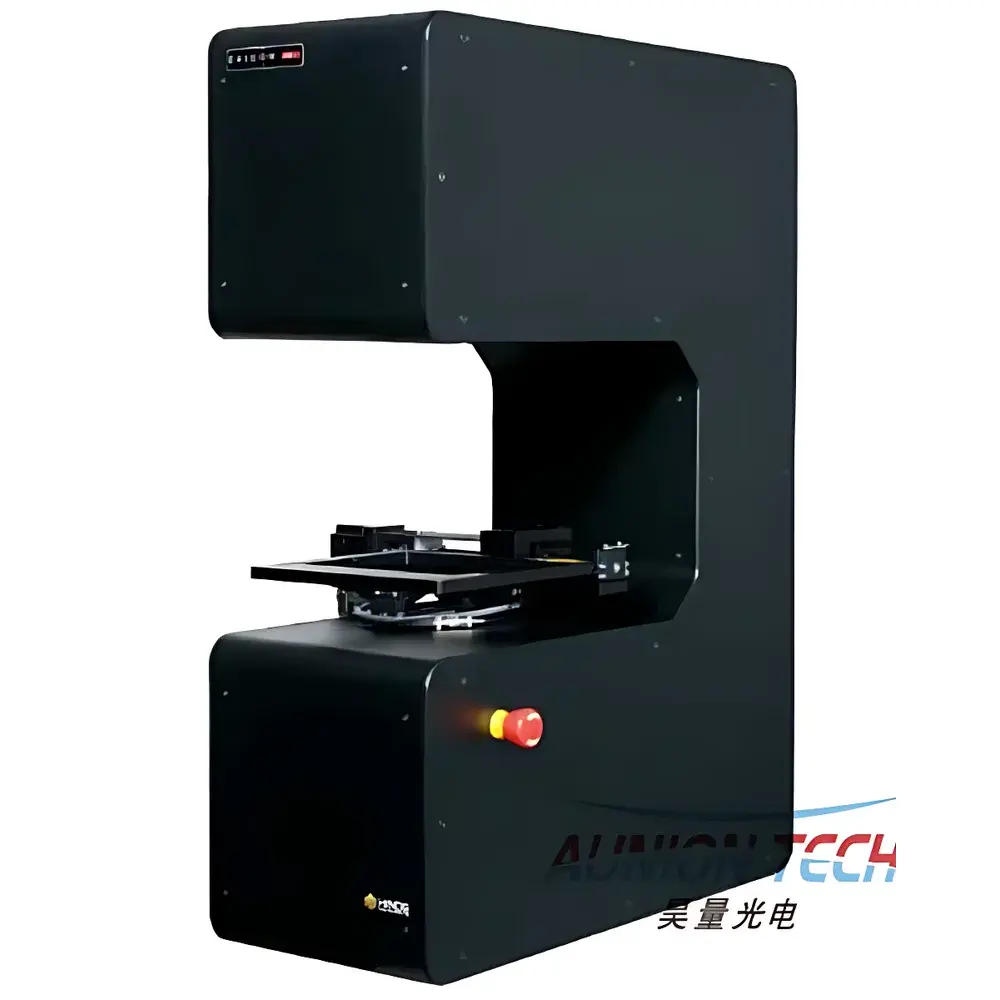
Hinds Instruments Mueller_Polarimeter_150XT Mueller Matrix Measurement System
| Brand | Hinds Instruments |
|---|---|
| Origin | USA |
| Model | Mueller_Polarimeter_150XT |
| Component Category | Optical Component |
| Measurement Principle | Photoelastic Modulator (PEM)-based Full Mueller Matrix Polarimetry |
| Acquisition Speed | < 1 second per full 4×4 Mueller matrix |
| Output | 16-element Mueller matrix, linear/circular retardance, diattenuation, depolarization, optical rotation |
| Software | Exicor™ v5.x with real-time visualization and export (CSV, HDF5, MATLAB-compatible) |
Overview
The Hinds Instruments Mueller_Polarimeter_150XT is a high-speed, full-field Mueller matrix polarimeter engineered for quantitative, traceable measurement of complete polarization response in optically anisotropic materials. Based on dual-photoelastic-modulator (PEM) architecture operating at orthogonal resonant frequencies, the system implements time-resolved synchronous detection to resolve all 16 elements of the Mueller matrix without mechanical rotation or moving optics. This solid-optics design eliminates alignment drift and vibration-induced artifacts—critical for long-duration stability in metrology-grade applications. The instrument operates in transmission or reflection configuration across the visible to near-infrared spectrum (typically 400–1100 nm, configurable with spectral filters or broadband sources), delivering calibrated Stokes vector input/output data that enables rigorous decomposition into retardance, diattenuation, depolarization, and orientation parameters. It is designed for use in environments requiring compliance with ISO/IEC 17025 calibration traceability and supports integration into automated production test benches under GLP/GMP frameworks.
Key Features
- Full 4×4 Mueller matrix acquisition in < 1 second—enabling real-time monitoring of dynamic birefringent processes
- No moving parts in the optical path: fixed-beam geometry ensures long-term repeatability and minimal maintenance
- Simultaneous measurement of all 16 Mueller matrix elements with calibrated photometric accuracy (±0.5% relative intensity, ±0.3° phase resolution)
- Integrated Exicor™ software provides on-the-fly calculation of derived parameters: linear/circular retardance (nm), fast-axis orientation (°), linear/circular diattenuation, depolarization index, and optical rotation angle
- Modular source and detector options support customization for specific wavelength bands, spatial resolution requirements, or sample geometry (e.g., macro-scale optics, micro-patterned LCDs, or tissue sections)
- Factory-calibrated using NIST-traceable reference standards including quartz waveplates and calibrated depolarizers
Sample Compatibility & Compliance
The Mueller_Polarimeter_150XT accommodates planar, transparent, semi-transparent, and reflective samples up to 150 mm × 150 mm (custom stages available). It supports standardized measurement protocols aligned with ASTM E2982-21 (Standard Practice for Mueller Matrix Polarimetry of Optical Components) and ISO 15367-2 (Interferometry — Polarization interferometers — Part 2: Calibration methods). For regulated industries, the Exicor™ software platform complies with FDA 21 CFR Part 11 requirements when deployed with audit trail, electronic signature, and role-based access controls enabled. All raw Mueller matrix datasets include embedded metadata (wavelength, temperature, ambient humidity, calibration timestamp) to satisfy GLP documentation standards.
Software & Data Management
Exicor™ v5.x provides a deterministic, scriptable interface built on Qt/C++ with Python API (pyExicor) for integration into custom analysis pipelines. Data output formats include IEEE-compliant HDF5 (with SI-unit metadata), CSV (tabular Mueller elements), and native .exi binary for archival. Batch processing supports multi-sample alignment, drift correction via reference channel normalization, and statistical mapping (e.g., retardance uniformity across LCD panels). The software includes pre-validated analysis modules for liquid crystal cell characterization (pretilt angle, director distribution), stress-induced birefringence mapping in molded optics, and chiral biomolecule quantification via circular birefringence.
Applications
- Characterization of complex optical components: achromatic waveplates, polarization beam splitters, metasurfaces, and AR/VR waveguide combiners
- Process control in flat-panel display manufacturing: in-line retardance uniformity verification of compensation films and LC cell alignment layers
- Materials science research: quantification of strain fields in polymer composites, crystalline domain structure in ferroelectrics, and magnetic-field-induced birefringence in magneto-optic garnets
- Biomedical optics: label-free assessment of collagen fiber orientation in histological sections, amyloid-beta fibril chirality, and glucose-induced optical rotation in aqueous solutions
- Defense & aerospace: certification of radiation-hardened optical coatings and polarization-preserving fibers for free-space quantum communication systems
FAQ
What is the minimum measurable retardance with the 150XT system?
The system achieves sub-degree angular resolution in retardance measurement, corresponding to ~1 nm at 633 nm for linear retardance. Detection limit depends on signal-to-noise ratio and integration time—typical RMS noise floor is < 0.005 in normalized Mueller elements.
Can the system measure reflection-mode Mueller matrices?
Yes—configured with a 45° off-axis imaging module and polarization-maintaining collection optics, the 150XT supports both transmission and reflection geometries with identical matrix fidelity.
Is calibration required between measurements?
No routine recalibration is needed; the PEM-based architecture maintains intrinsic stability. A daily verification using a certified quartz reference plate is recommended for ISO 17025 compliance.
Does the system support spatially resolved (imaging) Mueller matrix acquisition?
Yes—the standard configuration includes a motorized XYZ translation stage; optional CCD-coupled versions enable full-field imaging polarimetry with pixel-level Mueller matrix extraction (resolution limited by optics and detector pixel pitch).
How is data integrity ensured during long-term deployment?
All acquisitions embed cryptographic checksums, hardware-timestamped logs, and version-stamped calibration coefficients. Exicor™ supports automated backup to network-attached storage with SHA-256 verification.





