
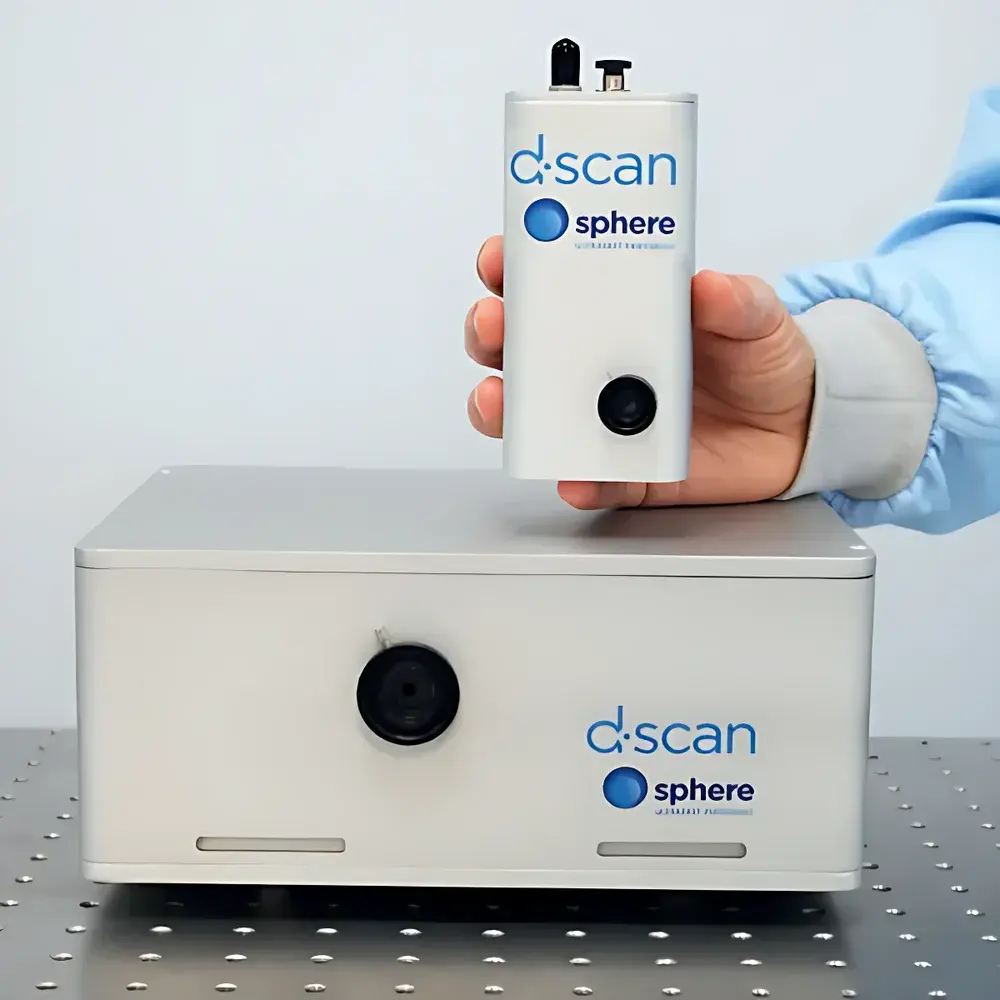
Auniontech d-scan Ultrafast Laser Pulse Measurement and Compression System
| Brand | Auniontech |
|---|---|
| Origin | Shanghai, China |
| Manufacturer Type | Authorized Distributor |
| Product Category | Domestic |
| Model | Ultrafast Laser Pulse Measurement System |
| Price | Upon Request |
Overview
The Auniontech d-scan Ultrafast Laser Pulse Measurement and Compression System is an in-line, compact, and high-fidelity instrument engineered for simultaneous characterization and active compression of femtosecond to few-cycle laser pulses. Based on the dispersion-scan (d-scan) technique—a second-harmonic generation (SHG)-based spectral interferometric method—the system reconstructs the full electric field E(t) of ultrashort pulses by acquiring a 2D spectrogram as a function of applied dispersion (e.g., via motorized wedge insertion or grating separation). Unlike single-shot methods such as FROG or SPIDER, d-scan offers inherent robustness against beam pointing instability and relaxed alignment tolerance while maintaining sub-femtosecond temporal resolution. It is specifically designed for integration into ultrafast laser chains—including Ti:sapphire oscillators, chirped-pulse amplifiers (CPA), optical parametric amplifiers (OPA), and hollow-core fiber (HCF) compressors—enabling real-time, on-target pulse optimization without interrupting the experimental beam path.
Key Features
- Simultaneous measurement and closed-loop compression: Integrates seamlessly with commercial and custom pulse compressors (e.g., chirped mirrors, prism pairs, HCF-based post-compressors) to enable automated dispersion tuning and feedback-driven pulse minimization.
- Sub-10-second acquisition time: Full d-scan trace acquisition—including beam coupling, dispersion scanning, and SHG signal capture—completes in under 10 seconds; total setup alignment requires less than 60 seconds.
- Multi-wavelength platform variants: Four optimized configurations—d-scan B (450–1000 nm), d-scan R (500–1050 nm), d-scan NIR (600–1100 nm), and d-scan 1.5 (1500–1700 nm)—cover key ultrafast spectral bands from visible through mid-IR.
- High dynamic range and phase sensitivity: Capable of resolving spectral phase deviations down to <100 as² across bandwidths exceeding 300 nm (FWHM), supporting accurate reconstruction of pulses as short as 2.5 fs (transform-limited) and up to 200 fs.
- Vacuum-compatible and synchronization-ready options: Optional vacuum-rated mechanical stages and external TTL trigger inputs support integration into high-intensity laser-matter interaction chambers and pump-probe setups operating at kHz–MHz repetition rates.
Sample Compatibility & Compliance
The d-scan system is compatible with linearly polarized input beams up to 20 mm aperture (d-scan B) and supports pulse energies ranging from >100 pJ at 80 MHz (oscillator-level) to ≥1 µJ at 1 kHz (amplifier-level). It meets essential requirements for GLP/GMP-aligned ultrafast labs: all firmware and software modules comply with audit-trail logging standards per FDA 21 CFR Part 11 when configured with optional secure user authentication and electronic signature modules. While not certified to ISO/IEC 17025, the system’s calibration traceability follows NIST-traceable reference pulse measurements using stabilized Ti:sapphire oscillator outputs and certified spectral phase references (e.g., known chirped mirror group delay dispersion profiles). The mechanical design adheres to IEC 61000-6-3 (EMC emission) and IEC 61000-6-2 (immunity) standards for laboratory instrumentation.
Software & Data Management
The proprietary d-scan Control Suite provides real-time acquisition, iterative phase retrieval via Tikhonov-regularized inversion algorithms, and interactive visualization of d-scan traces, spectral intensity/phase, and reconstructed temporal intensity/phase profiles. Raw data are stored in HDF5 format with embedded metadata (wavelength grid, dispersion step size, acquisition timestamp, hardware configuration). Export options include ASCII, MATLAB .mat, and Python-compatible NumPy arrays. For regulated environments, optional software validation packages include IQ/OQ documentation, version-controlled release notes, and change control logs. The suite supports remote operation via TCP/IP and integrates with LabVIEW, Python (via PyVISA), and MATLAB APIs for custom automation in multi-instrument workflows.
Applications
- Optimization of hollow-core fiber compressors: Enables direct in-situ measurement of CEP-stable, single-cycle pulses (e.g., 3.2 fs at 740 nm, 1.3 cycles) during gas-filled HCF compression, with feedback to wedge positioners for minimum pulse duration.
- Characterization of broadband OPCPA outputs: Resolves complex spectral phase distortions arising from nonlinear crystal dispersion and stretcher-compressor mismatch in few-cycle VIS–NIR sources.
- Real-time diagnostics in high-harmonic generation (HHG): Provides shot-to-shot electric field monitoring to correlate attosecond pulse train quality with driver pulse phase structure.
- Development of octave-spanning supercontinua: Validates spectral phase continuity across >1-octave bandwidths generated in photonic crystal fibers or multilayer graphene.
- CEP stabilization loop integration: Serves as the phase-sensing front-end in feedback systems that modulate acousto-optic dispersive elements or piezo-driven wedges.
FAQ
What is the minimum pulse duration the d-scan system can characterize?
The d-scan B variant resolves transform-limited pulses down to 2.5 fs (FWHM) at central wavelengths near 800 nm, limited primarily by the SHG crystal bandwidth and spectrometer resolution—not by the algorithm itself.
Can d-scan be used with amplified laser systems operating below 1 kHz?
Yes—external synchronization options allow triggering at repetition rates as low as 10 Hz; however, signal averaging may be required for optimal SNR at energies below 1 µJ/pulse.
Does the system require recalibration when switching between wavelength ranges?
No—each d-scan variant (B/R/NIR/1.5) is factory-calibrated for its designated spectral band; inter-band switching necessitates hardware module replacement, not software recalibration.
Is vacuum compatibility available as a standard option?
Vacuum-rated versions (up to 10⁻⁶ mbar) are available as configurable options, including stainless-steel housings, ceramic shaft feedthroughs, and non-outgassing optical mounts.
How does d-scan compare to SPIDER or FROG in terms of alignment sensitivity?
d-scan exhibits significantly lower alignment sensitivity than SPIDER (no interferometric stability required) and greater tolerance to beam pointing jitter than GRENOUILLE-type FROG, making it suitable for industrial and long-term operational environments.




