
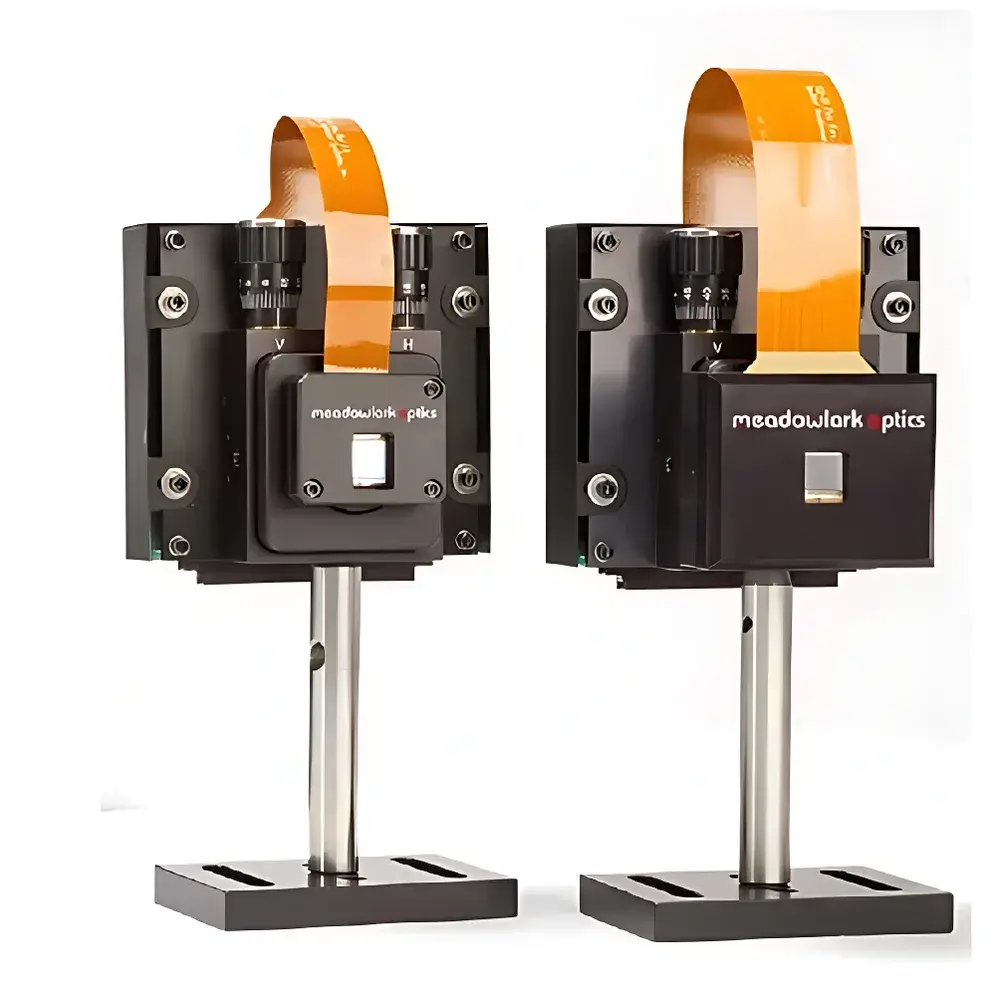
Meadowlark Optics D3128 Transmissive Liquid Crystal Spatial Light Modulator
| Brand | Meadowlark Optics |
|---|---|
| Origin | USA |
| Manufacturer Type | Authorized Distributor |
| Product Category | Imported |
| Model | Transmissive SLM |
| Price | Upon Request |
| Transmission Efficiency | >90% |
| Laser Damage Threshold | 500 W/cm² (CW), 300 mJ/cm² (10 ns, 532 nm) |
| Phase Modulation Range | 2π |
| Amplitude Modulation Range | 0–100% |
| Wavefront Distortion (at 632.8 nm) | ≤ λ/4 |
| Beam Deviation | ≤ 2 arcmin |
| Operating Temperature | 10°C to 45°C |
| Wavelength Range | 450–1800 nm (user-specified center wavelength) |
| Pixel Configurations | Hexagonal array (127 pixels, 1 mm pitch) or Linear array (1 × 128, 98 µm × 4 mm) |
Overview
The Meadowlark Optics D3128 Transmissive Liquid Crystal Spatial Light Modulator (SLM) is a high-performance, electronically addressable optical device engineered for precise, dynamic control of the phase and amplitude profiles of linearly polarized light across a two-dimensional or one-dimensional aperture. Based on nematic liquid crystal technology, this transmissive SLM operates via voltage-controlled birefringence to impose spatially varying optical path differences—enabling real-time wavefront shaping without mechanical motion. Its design adheres to fundamental principles of polarization optics and electro-optic modulation, making it suitable for applications demanding high fidelity, low wavefront error, and robust CW/pulsed laser compatibility. With a transmission efficiency exceeding 90% and a continuous-wave damage threshold of 500 W/cm² (and 300 mJ/cm² for 10 ns pulses at 532 nm), the D3128 SLM supports demanding photonics workflows in ultrafast optics, adaptive optics, and precision metrology.
Key Features
- Transmissive architecture optimized for integration into collimated beam paths and folded optical systems
- Nematic liquid crystal layer enabling full 2π phase modulation and 0–100% amplitude modulation under linear polarization input
- Two configurable pixel geometries: hexagonal array (127-pixel, 1 mm pitch) and linear array (1 × 128, 98 µm × 4 mm active area)
- Low wavefront distortion (≤ λ/4 RMS at 632.8 nm) ensures minimal aberration introduction during closed-loop correction
- Beam deviation limited to ≤ 2 arcminutes—critical for alignment-sensitive interferometric and imaging setups
- D3128 dedicated controller providing high-speed frame rates compatible with real-time feedback loops (e.g., Shack-Hartmann or pyramid wavefront sensing)
- Wide spectral coverage from 450 nm to 1800 nm; center wavelength specified per application requirements
- Thermally stable operation between 10°C and 45°C, supporting laboratory and industrial environments
Sample Compatibility & Compliance
The D3128 SLM is compatible with standard linearly polarized laser sources across UV-VIS-NIR bands, including Ti:sapphire oscillators, fiber lasers, HeNe, and DPSS systems. It requires external polarization management (e.g., half-wave plate + polarizer) for optimal phase-only or amplitude-only operation. The device conforms to industry-standard optical mounting interfaces (e.g., SM1-threaded housings) and integrates seamlessly with wavefront sensors such as Phasics lateral-shearing interferometers and commercial adaptive optics testbeds. While not certified to ISO 9001 or FDA 21 CFR Part 11 out-of-the-box, its deterministic response, reproducible gray-level mapping, and non-volatile calibration tables support GLP/GMP-aligned experimental protocols when deployed with traceable metrology chains.
Software & Data Management
Control is enabled via Meadowlark’s native SLM Control Software (Windows-based), offering GUI-driven pattern generation, LUT calibration, and dynamic sequence scripting. APIs (C/C++, Python, MATLAB) permit integration into custom acquisition pipelines—e.g., coupling with camera-triggered wavefront correction loops or pulse-shaping algorithms in ultrafast labs. All phase/amplitude maps are stored as 16-bit grayscale bitmaps; firmware supports gamma correction and pixel-by-pixel uniformity compensation. Audit trails—including timestamped configuration files, applied voltages, and environmental logs—can be exported for documentation in regulated R&D settings. No cloud connectivity or remote access features are implemented, preserving data sovereignty and system security.
Applications
- Adaptive optics for astronomical telescopes and ophthalmic imaging—real-time compensation of atmospheric turbulence or ocular aberrations
- Ultrafast pulse shaping via Fourier-domain spectral filtering using 4f zero-dispersion compressors
- High-resolution optical trapping and holographic optical tweezers requiring diffraction-limited spot formation
- Spectral encoding in compressive sensing spectrometers and multi-spectral imaging systems
- Laser beam homogenization, top-hat profile generation, and structured illumination microscopy
- Optical data storage research involving angular multiplexing and page-oriented holographic recording
- Calibration reference for wavefront sensor validation and metrology intercomparison studies
FAQ
Is the D3128 SLM suitable for femtosecond pulse shaping?
Yes—when used with appropriate dispersion compensation and aligned for minimal group delay dispersion, it supports pulse shaping down to sub-50 fs durations at central wavelengths between 700–900 nm.
Can it operate in pure phase-only mode?
Yes—by orienting the incident linear polarization at 45° relative to the SLM’s optic axis and using a properly oriented analyzer, near-ideal phase-only modulation with <0.5% amplitude coupling is achievable.
What is the maximum refresh rate supported by the D3128 controller?
Frame rates up to 60 Hz are typical for full-array updates; higher effective rates (up to several hundred Hz) are attainable for region-of-interest or line-scan patterns.
Does Meadowlark provide calibration certificates for wavefront accuracy?
Factory-measured wavefront distortion data (λ/4 RMS at 632.8 nm) is supplied with each unit; NIST-traceable calibration services are available upon request.
Are custom pixel layouts or active-area dimensions supported?
Yes—Meadowlark offers engineering collaboration for application-specific configurations, including non-standard aspect ratios, masked regions, and hybrid phase/amplitude pixel addressing schemes.




