Auniontech 70–145 GHz Plasmonic Electro-Optic Modulator
| Brand | Auniontech |
|---|---|
| Origin | Shanghai, China |
| Type | Plasmonic Electro-Optic Modulator (EOM) |
| Core Architectures | Ring Resonator Modulator (RRM), Mach-Zehnder Modulator (MZM), In-Phase/Quadrature Modulator (IQM) |
| Operating Wavelength Bands | O-band (1260–1360 nm), C-band (1530–1565 nm) |
| Bandwidth Range | 70–145 GHz (RRM up to 170 GHz demonstrated) |
| Modulation Mechanism | Plasma-enhanced Pockels effect in silicon-plasmonic hybrid waveguides |
| Insertion Loss | < 6 dB (typical, device-dependent) |
| Extinction Ratio | > 20 dB (RRM & balanced MZM) |
| Drive Voltage (Vπ) | < 3 V (differential, plasmonic-optimized) |
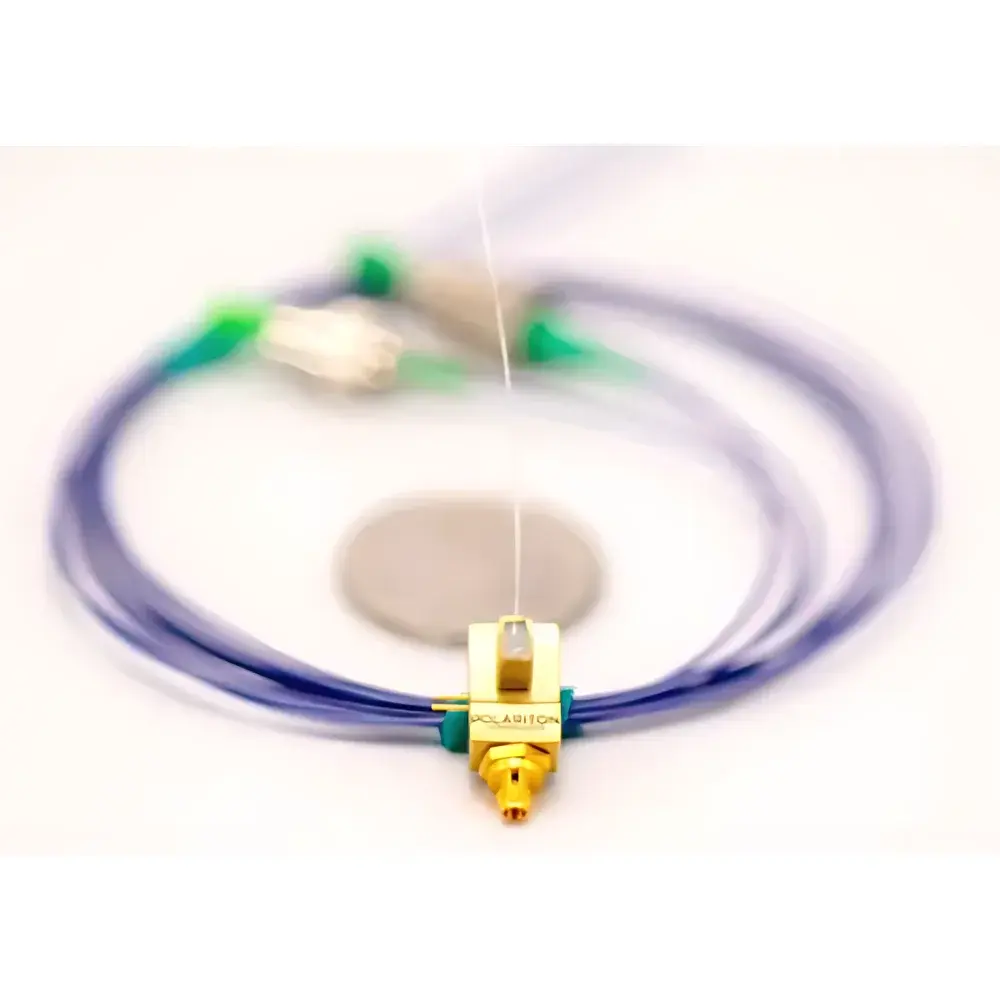
| Packaging Options | Chip-level, fiber-pigtailed module, benchtop evaluation kit |
| Compliance | RoHS-compliant packaging |
Overview
The Auniontech 70–145 GHz Plasmonic Electro-Optic Modulator is a high-frequency photonic integrated device engineered for ultra-broadband optical signal modulation in next-generation communication, quantum photonics, and precision metrology systems. Leveraging hybrid silicon-plasmonic waveguide architectures, it exploits the enhanced electric field confinement of surface plasmon polaritons (SPPs) to significantly reduce electrode capacitance and propagation loss—enabling electro-optic bandwidths far exceeding conventional lithium niobate or silicon rib-based modulators. The device operates via the linear electro-optic (Pockels) effect in doped silicon-plasmonic heterostructures, where applied RF voltage induces refractive index changes in sub-micron active regions. This enables direct intensity, phase, and complex-field modulation across O-band (1260–1360 nm) and C-band (1530–1565 nm) windows, supporting both intensity-modulation/direct-detection (IM/DD) and coherent detection schemes. Its monolithic integration capability aligns with industry trends toward co-packaged optics (CPO) and photonic IC scalability.
Key Features
- Three configurable modulation topologies: Ring Resonator Modulator (RRM), Mach-Zehnder Modulator (MZM), and In-Phase/Quadrature Modulator (IQM), all fabricated on a unified silicon-plasmonic platform.
- Bandwidth scalability from 70 GHz to 145 GHz—with RRM variants experimentally verified up to 170 GHz under small-signal conditions—meeting IEEE 802.3df and ITU-T G.698.2 requirements for 800G/1.6T optical interconnects.
- Wavelength-tunable bias-free operation: RRM and unbalanced MZM designs eliminate the need for DC bias control by exploiting resonant spectral features—laser wavelength tuning replaces static voltage adjustment.
- Differential drive architecture optimized for commercial RF drivers: IQM supports true differential input (signal + inverted copy), minimizing common-mode noise and enhancing modulation efficiency.
- Thermo-optic phase shifters integrated into balanced MZM arms enable precise spectral alignment and dynamic operating point stabilization without external bias tees or feedback loops.
- Low insertion loss (20 dB for RRM/MZM) achieved through optimized plasmonic mode coupling and adiabatic tapering at fiber-to-chip interfaces.
Sample Compatibility & Compliance
The modulator is compatible with standard single-mode fiber (SMF-28) and polarization-maintaining fiber (PM1550) pigtails using FC/APC or LC/PC connectors. Chip-level variants support flip-chip bonding to III-V laser sources or integration with silicon nitride (SiN) delay lines for hybrid photonic circuits. All modules comply with RoHS Directive 2011/65/EU and meet IEC 61300-2-40 (fiber optic connector durability) and Telcordia GR-1209-CORE (reliability under thermal cycling). Device-level performance data—including S21 frequency response, eye diagram jitter, and ER stability over temperature—is traceable to NIST-traceable optical calibration standards. While not certified for medical or aerospace use out-of-box, the platform supports customization for GLP/GMP-aligned test environments upon request.
Software & Data Management
Auniontech provides a Python-based SDK (compatible with Windows/Linux/macOS) enabling automated characterization via VNA synchronization, laser wavelength sweeping, and real-time eye diagram capture using third-party oscilloscopes (Keysight DSOX90000A, Tektronix DPO70000SX). The software implements IEEE 1687 (IJTAG) boundary-scan protocols for embedded diagnostics and supports export of S-parameter files (.s2p), CSV waveform logs, and PNG/SVG visualization outputs. For system integrators, DLL and LabVIEW driver packages are available. All firmware updates follow secure signed-binary delivery, and audit trails for calibration events comply with FDA 21 CFR Part 11 requirements when deployed in regulated QC/QA workflows.
Applications
- High-speed optical interconnects: 800G ZR/ZR+ coherent transceivers, analog radio-over-fiber (RoF) links for 5G/6G fronthaul, and microwave photonics signal processing (e.g., true-time-delay beamforming).
- Quantum information systems: Low-jitter phase modulators for time-bin qubit encoding, homodyne detection local oscillator control, and entangled photon pair generation timing gates.
- Advanced test & measurement: Vector network analyzer (VNA) optical extensions, photonic-assisted ADC/DAC calibration, and ultrafast pulse shaping for attosecond science setups.
- Defense & sensing: LIDAR waveform modulation, secure free-space optical comms, and distributed fiber sensing interrogators requiring sub-picosecond temporal resolution.
FAQ
What is the maximum guaranteed bandwidth for production units?
The guaranteed small-signal 3-dB bandwidth is 145 GHz for IQM and balanced MZM configurations; RRM devices are guaranteed to 110 GHz, with 170 GHz demonstrated in lab validation per Auniontech Application Note AN-PLASMO-2023-04.
Can this modulator be used with non-telecom wavelengths?
Yes—custom designs support extended C+L band (1530–1625 nm) and near-IR (1064 nm) operation upon request, subject to waveguide dispersion compensation and plasmonic mode optimization.
Is thermal stabilization required during operation?
Passive thermal management suffices for most benchtop applications; however, active TEC control is recommended for long-term bias point stability in field-deployed coherent systems.
Do you provide driver amplifiers matched to these modulators?
Auniontech partners with leading RFIC vendors to supply broadband GaAs MMIC drivers (DC–145 GHz) with impedance-matched 50-Ω output and integrated bias tees—available as bundled evaluation kits.
How is calibration traceability maintained across production lots?
Each modulator batch undergoes wafer-level RF/optical probing with calibrated VNA and optical spectrum analyzers; full test reports include S21 magnitude/phase, ER, IL, and P1dB data referenced to NIST-traceable standards.