
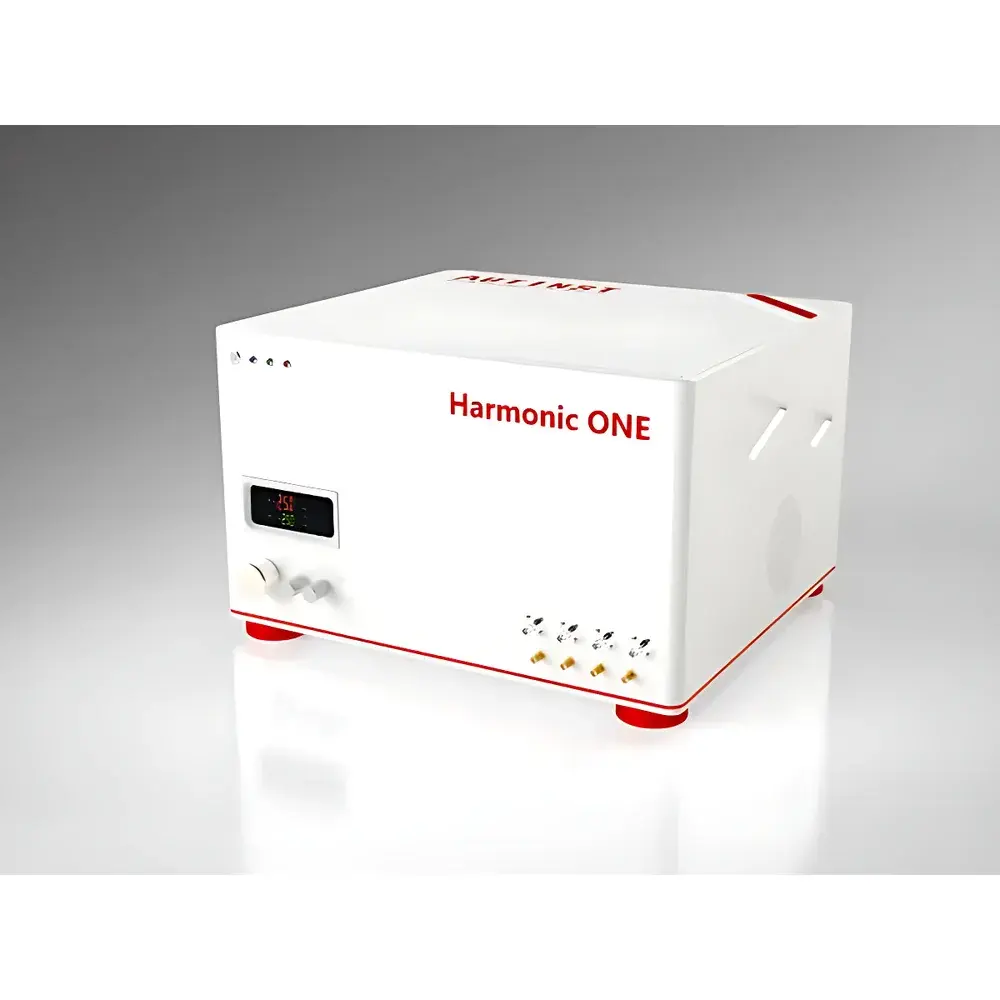
Harmonic-ONE 3ω Harmonic Thermal Property Analyzer
| Brand | Auniontech |
|---|---|
| Origin | Shanghai, China |
| Model | Harmonic-ONE 3ω |
| Measurement Principle | 3ω Harmonic Detection |
| Sample Types | Bulk, Powder, Liquid, Nanofluid, Thin Film, Fiber |
| Thermal Conductivity Range | 0.015–3400 W/m·K |
| Temperature Range | −30 to +75 °C |
| Temperature Control Accuracy | ±0.1 °C |
| Vacuum Chamber Volume | ≥5 cm radius × 10 cm height |
| Ultimate Vacuum | ≤1 Pa |
| DC Bias Voltage Tunability | Full Frequency & Amplitude Range |
Overview
The Harmonic-ONE 3ω Harmonic Thermal Property Analyzer is a precision benchtop instrument engineered for quantitative, contact-based thermal transport characterization using the well-established 3ω harmonic detection method. Rooted in the thermo-electric coupling between resistive heating and temperature-dependent resistance, this system enables direct measurement of thermal conductivity (κ), interfacial thermal conductance (G), and thermal diffusivity (α) across diverse material classes—including anisotropic thin films, porous media, nanofluids, powders, and bulk solids—without requiring absolute calibration standards. The core transduction mechanism relies on a microfabricated metal strip (typically Pt or Ni) that serves simultaneously as heater and sensor. When driven by a sinusoidal current at angular frequency ω, Joule heating generates a 2ω thermal wave within the sample. The resulting periodic temperature oscillation modulates the strip’s resistance at 2ω, and the product of this resistance variation with the drive current yields a voltage component at 3ω—the signature signal used for inverse thermal modeling. By acquiring amplitude and phase of the 3ω voltage response across a broad excitation frequency sweep (typically 0.1–100 kHz), the instrument extracts thermal parameters via slope analysis, differential fitting, or full numerical inversion of the heat diffusion equation under appropriate boundary conditions.
Key Features
- Multi-method thermal analysis: Supports 3ω slope method, 3ω differential method, and full 3ω curve-fitting algorithms—each optimized for specific sample geometries and thermal regimes.
- Universal probe architecture: Compatible with surface-contact, embedded, and sputter-deposited configurations; accommodates roughness-tolerant measurements without polishing or planarization.
- Integrated environmental control: Sealed vacuum chamber (≥5 cm radius × 10 cm height; ≤1 Pa base pressure) minimizes convective and radiative heat loss, enabling high-fidelity low-conductivity measurements down to 0.015 W/m·K.
- Precise thermal regulation: Peltier-based stage with ±0.1 °C stability over −30 to +75 °C, supporting temperature-dependent thermal transport studies under controlled ambient conditions.
- Flexible excitation electronics: Fully tunable DC bias superimposed on AC drive—enabling optimization of signal-to-noise ratio and linearization of resistance-temperature response across material systems.
- Modular design: Probe head, vacuum enclosure, lock-in amplifier, and temperature controller are mechanically and electrically decoupled to minimize ground loops and thermal crosstalk.
Sample Compatibility & Compliance
The Harmonic-ONE accepts samples ranging from freestanding nanofibers (diameter >50 nm) and ultrathin films (thickness ≥10 nm) to granular powders (particle size <1 mm), viscous liquids, and macroscopic bulk specimens (≥5 × 5 mm² footprint). No electrical continuity or optical transparency is required. Surface preparation is minimal: flatness tolerance up to 5 µm RMS; no metallization needed for non-conductive samples when using external probe contact. All hardware and firmware comply with IEC 61000-6-3 (EMC emission limits) and IEC 61010-1 (safety requirements for electrical equipment for measurement). Data acquisition workflows support audit-trail generation per FDA 21 CFR Part 11 when integrated with validated LIMS or ELN platforms.
Software & Data Management
The proprietary HarmonicSuite™ software provides real-time lock-in monitoring, automated frequency sweeps, batch processing of multi-sample datasets, and export of raw V3ω(f) spectra in HDF5 or CSV formats. Thermal parameter extraction modules implement published analytical models (e.g., Cahill’s thin-film solution, Zhang’s multilayer formalism) and allow user-defined boundary condition constraints. All analysis steps—including baseline correction, phase unwrapping, and uncertainty propagation—are fully traceable. Exported reports include metadata (date/time, operator ID, environmental conditions), raw spectra, fitted curves, confidence intervals, and compliance flags for ISO/IEC 17025 traceability frameworks.
Applications
- Thermal interface material (TIM) development: Quantification of Kapitza resistance at polymer/metal, dielectric/metal, and 2D-material heterojunctions.
- Nanocomposite R&D: Correlation of filler dispersion, aspect ratio, and interfacial bonding with effective κ in polymer nanocomposites and ceramic matrix composites.
- Energy materials: In-situ thermal conductivity mapping of battery electrode coatings during drying, calendaring, and cycling.
- Microelectronics packaging: Cross-plane κ of low-k dielectrics, thermal anisotropy in layered TMDs, and phonon scattering mechanisms in epitaxial nitride films.
- Geothermal & building materials: Moisture-dependent thermal transport in porous cementitious systems and aerogels under controlled humidity/vacuum.
FAQ
What materials require metallization prior to measurement?
None. The 3ω method operates via resistive heating and sensing; insulating samples (e.g., SiO₂ films, polymers) are measured using external probe contact or embedded heater geometry.
Can the system measure anisotropic thermal conductivity?
Yes—by rotating the sample relative to the heater stripe orientation and performing directional 3ω sweeps, in-plane vs. cross-plane κ ratios can be extracted for aligned nanofibers or layered crystals.
Is vacuum operation mandatory for all measurements?
No—ambient air measurements are supported for high-κ materials (>10 W/m·K); vacuum is recommended for low-κ samples (<1 W/m·K) or when eliminating convection-induced artifacts is critical.
How is calibration performed?
The system uses reference materials with certified thermal properties (e.g., fused quartz, Pyrex, sapphire) for verification; no routine recalibration is required due to self-referencing nature of the 3ω signal.
Does the software support custom model integration?
Yes—HarmonicSuite™ exposes Python API hooks for importing user-defined heat diffusion solvers or machine learning surrogate models for parameter inversion.



