
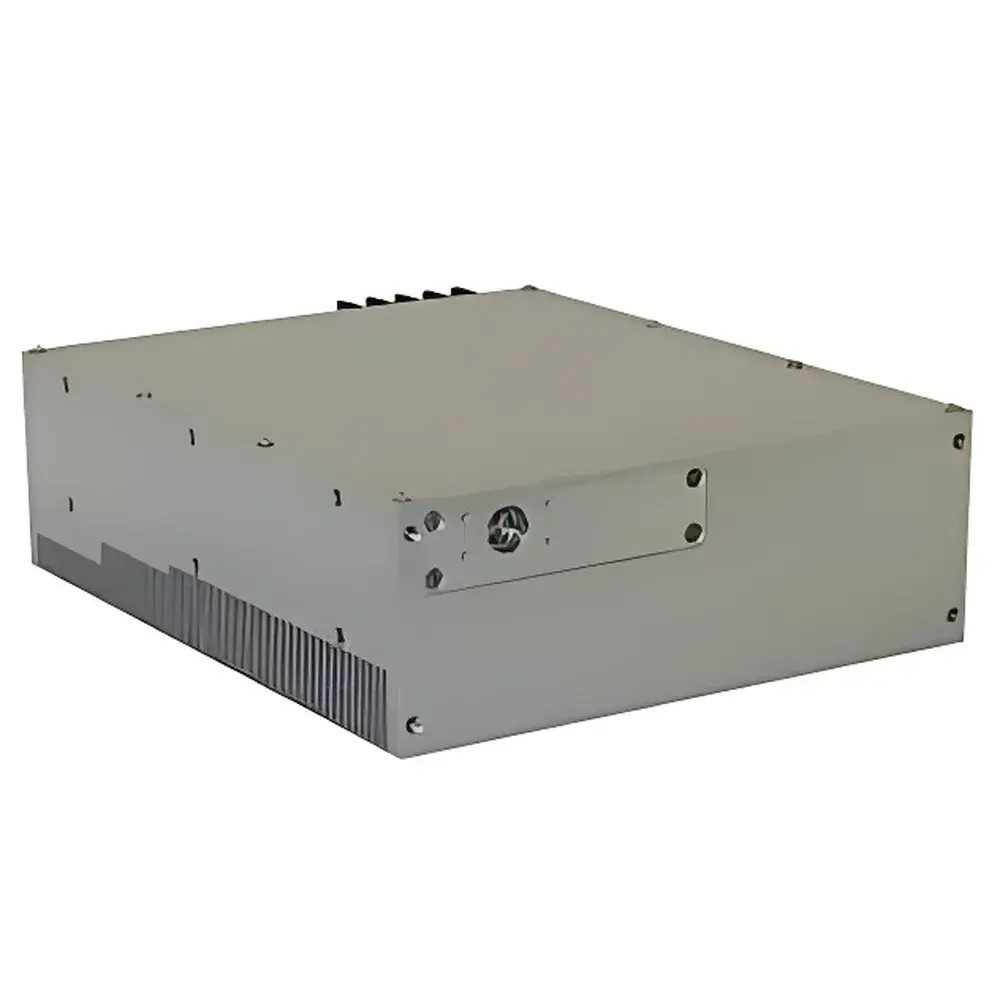
Bright Solutions PicoXGreen High-Power Sub-Nanosecond & Picosecond DPSS Laser System
| Brand | Bright Solutions |
|---|---|
| Origin | Italy |
| Type | Diode-Pumped Solid-State (DPSS) Q-Switched Laser |
| Model | PicoXGreen |
| Average Output Power | 5–10 W (at 532 nm), 6–10 W (at 1064/355 nm) |
| Wavelength | 1064 nm / 532 nm / 355 nm |
| Repetition Rate | Up to 500 kHz (standard), optional range: single-shot to 10 kHz |
| Pulse Width | 100–200 ps (PicoXGreen), 300–900 ps (XGreen) |
| Polarization | Linear (>100:1) |
| Beam Quality (M²) | <1.2 (PicoXGreen), <1.3 (XGreen) |
| Cooling | Water-cooled (PicoXGreen) |
| Power Supply | 24 V DC |
| Dimensions & Weight | 32 × 26 × 10 cm, 12 kg (PicoXGreen) |
Overview
The Bright Solutions PicoXGreen is a high-performance, diode-pumped solid-state (DPSS) Q-switched laser system engineered for industrial and scientific applications requiring precise temporal control, high peak power, and exceptional beam fidelity. Operating in the sub-nanosecond (100–200 ps) and picosecond (300–900 ps) regimes, this laser leverages passively Q-switched Nd:YAG or Nd:YVO₄ gain media combined with intracavity harmonic generation to deliver stable, diffraction-limited output at 1064 nm, 532 nm, and 355 nm. Its design emphasizes robustness for 24/7 integration into automated manufacturing lines—particularly laser micromachining, thin-film ablation, LIBS (Laser-Induced Breakdown Spectroscopy), and time-resolved fluorescence lifetime imaging. Unlike conventional nanosecond lasers, the PicoXGreen’s ultra-short pulse duration minimizes thermal diffusion into surrounding material, enabling clean, sub-micron feature resolution with negligible heat-affected zones (HAZ). The system complies with IEC 60825-1:2014 for Class 4 laser safety and integrates mechanical interlocks and emission indicators aligned with EN 61496-1.
Key Features
- Sub-nanosecond to picosecond pulse widths (100–900 ps), selectable per model variant (PicoXGreen vs. XGreen)
- High average power output: up to 10 W at 532 nm and 1064 nm; 5 W at 355 nm
- Repetition rate flexibility: standard operation up to 500 kHz; optional low-rep-rate mode (single-shot to 10 kHz) for synchronization-critical experiments
- Diffraction-limited beam quality (M² < 1.2), ensuring optimal focusability and energy density consistency across focal planes
- Integrated thermal management: water-cooling for high-duty-cycle operation (PicoXGreen); forced-air with thermostatically regulated fans for compact deployment (XGreen)
- Compact, monolithic housing with vibration-damped optical bench—designed for OEM integration and factory-floor resilience
- 24 V DC input compatibility simplifies power infrastructure requirements and supports battery-backed operation in mobile or field-deployable setups
Sample Compatibility & Compliance
The PicoXGreen laser is compatible with a broad spectrum of optically transparent and absorbing materials—including silicon wafers, sapphire, fused silica, polyimide, copper, stainless steel, and ceramic substrates—enabling high-precision drilling, cutting, surface texturing, and selective layer removal. Its short pulse duration ensures minimal nonlinear threshold effects in transparent dielectrics while maintaining sufficient photon flux for efficient multi-photon absorption in wide-bandgap materials. The system meets CE marking requirements under the EU Machinery Directive 2006/42/EC and Electromagnetic Compatibility Directive 2014/30/EU. For regulated environments (e.g., medical device manufacturing or aerospace component processing), full traceability documentation—including calibration certificates traceable to NIST standards—and optional FDA 21 CFR Part 11–compliant audit logs are available upon request.
Software & Data Management
Bright Solutions provides the proprietary LaserControl Suite—a Windows-based GUI supporting real-time monitoring of pulse energy, repetition rate, temperature stability, and beam pointing drift via integrated photodiode and thermal sensors. The software enables remote configuration of operating parameters through USB 2.0 or RS-232 interfaces and exports timestamped measurement data in CSV and HDF5 formats for post-processing in MATLAB, Python (NumPy/Pandas), or LabVIEW. Optional SDKs support custom integration with PLCs (Siemens S7, Allen-Bradley ControlLogix) and motion controllers (Aerotech, Newport). All firmware updates follow ISO/IEC 17025-aligned version control protocols, with change logs archived for GLP/GMP audit readiness.
Applications
- Laser-induced forward transfer (LIFT) of functional inks in printed electronics fabrication
- Micro-via drilling in HDI PCBs and flexible circuit substrates
- Surface cleaning and oxide removal in semiconductor packaging
- Time-of-flight (ToF) LIDAR transmitter modules for autonomous vehicle sensing
- Excitation source for time-correlated single-photon counting (TCSPC) systems
- Seed laser for chirped-pulse amplification (CPA) chains in ultrafast science laboratories
- Calibration reference for streak camera temporal response characterization
FAQ
What distinguishes sub-nanosecond lasers from traditional nanosecond lasers in material processing?
Sub-nanosecond pulses reduce thermal conduction time scales below the characteristic phonon relaxation period in most solids, suppressing melt formation and collateral damage—resulting in sharper edges, higher aspect ratios, and improved repeatability in micromachining.
Can the PicoXGreen be synchronized with external triggers or motion stages?
Yes—the system features TTL-compatible sync inputs (rising-edge triggered) with jitter < 1 ns and programmable delay (0–10 ms, 100 ps resolution), fully compatible with industry-standard motion controllers and data acquisition systems.
Is harmonic generation internal or external to the laser head?
All harmonic wavelengths (532 nm, 355 nm) are generated internally using non-linear crystals (LBO, BBO) mounted on kinematic mounts within the sealed laser cavity—ensuring long-term alignment stability and minimal maintenance.
Does the laser support pulse-on-demand (PoD) operation?
Yes—via external TTL trigger, the system operates in burst-mode or single-pulse mode without degradation in pulse-to-pulse energy stability (< ±1.5% RMS over 10⁶ shots).
What maintenance intervals are recommended for continuous industrial use?
No scheduled optical alignment is required; periodic verification of cooling fluid conductivity (for water-cooled models) and fan filter inspection (for air-cooled variants) every 6 months suffices under typical 8,000-hour/year duty cycles.



