
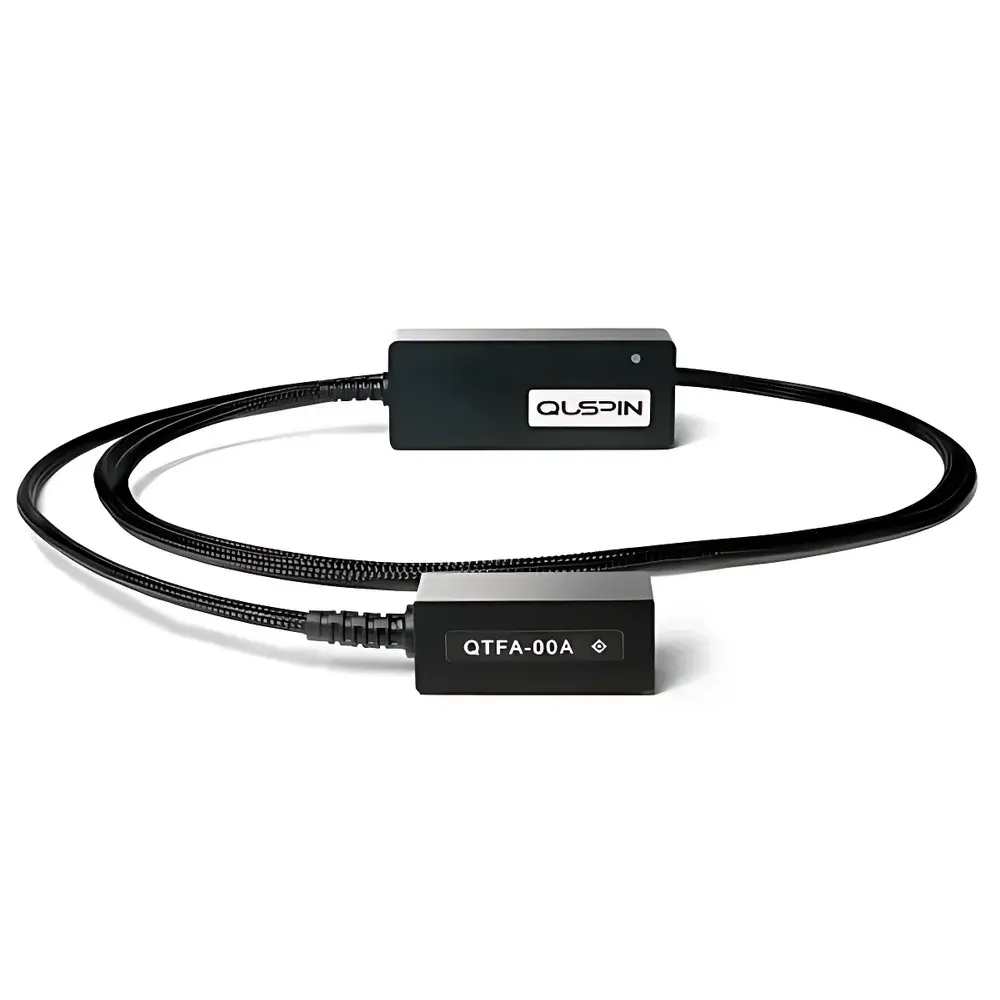
Auniontech QZFM/QTFM Atomic Magnetometer
| Brand | Auniontech |
|---|---|
| Model | QZFM (Zero-Field Magnetometer) / QTFM (Total-Field Magnetometer) |
| Atomic Species | Rubidium |
| Zero-Field Sensitivity | <15 fT/√Hz (3–100 Hz, typical 7–10 fT/√Hz) |
| Total-Field Sensitivity | <1 pT/√Hz (0.1–100 Hz) |
| Dynamic Range (QZFM) | ±5 nT |
| Dynamic Range (QTFM) | 1000–100,000 nT |
| Measurement Axes (QZFM) | Single-axis (Z or Y) or dual-axis (Z & Y simultaneous) |
| Standoff Distance | 6.5 mm |
| Calibration | Internal automated reference |
| Signal Outputs | Analog voltage + USB digital interface |
| Sensor Dimensions | 12.4 × 16.6 × 24.4 mm |
| Electronics Dimensions | 31 × 110 × 165 mm |
| Total Power Consumption | 5 W (sensor head: 0.7 W) |
| Operating Temperature | −30 °C to +60 °C |
| Slew Rate (QTFM) | 10,000 nT/s |
| Max Spatial Gradient Tolerance (QTFM) | 1000 nT/cm |
| Max Sampling Rate (QTFM) | 400 Hz |
| Deadzone (QTFM) | ±7° equatorial plane |
| Heading Error (QTFM) | <3 nT (uncompensated) |
Overview
The Auniontech QZFM/QTFM Atomic Magnetometer is a quantum-optical sensor system based on optical pumping and magnetic resonance of rubidium vapor in a glass microcell. It operates on the principle of spin-precession spectroscopy: circularly polarized laser light optically pumps Rb atoms into a coherent spin state; external magnetic fields induce Larmor precession of the atomic spins, which modulates the transmission of a probe beam through the vapor cell. This modulation is detected by a photodiode and converted into a high-fidelity analog or digitized magnetic field signal. Unlike fluxgate or SQUID magnetometers, this device requires no cryogenic cooling and delivers femtotesla-level sensitivity at room temperature. The QZFM variant is optimized for ultra-low-field environments (e.g., magnetically shielded rooms), while the QTFM is engineered for robust scalar field measurement across geophysically relevant field ranges — making the platform uniquely suited for both biomagnetic and field-deployable applications.
Key Features
- Quantum-limited sensitivity: QZFM achieves <15 fT/√Hz noise floor in the 3–100 Hz band (typical performance 7–10 fT/√Hz), enabling detection of neural and fetal cardiac magnetic fields without shielding.
- Self-calibrating architecture: Integrated optical reference path and automated zero-field resonance lock eliminate manual calibration drift and support long-term stability under thermal and mechanical stress.
- Compact, low-power design: Sensor head volume <5 cm³; total system power draw ≤5 W — compatible with battery-powered mobile platforms including UAVs, handheld survey tools, and wearable MEG prototypes.
- Dual operational modes: QZFM provides vector-capable, directional field measurement (Z/Y axes); QTFM delivers true scalar field magnitude with inherent insensitivity to orientation within its ±7° deadzone.
- Ruggedized packaging: Hermetically sealed vapor cell, vibration-damped optics mount, and industrial-grade electronics housing rated for operation from −30 °C to +60 °C.
- Real-time output flexibility: Simultaneous analog (±5 V, 100 kHz bandwidth) and USB 2.0 digital streaming (up to 400 Hz for QTFM, 1 kHz for QZFM post-processing) ensure compatibility with existing DAQ systems and custom software stacks.
Sample Compatibility & Compliance
The QZFM/QTFM magnetometer does not require physical contact with samples and imposes no electromagnetic interference on adjacent instrumentation. Its passive, non-invasive sensing modality supports measurements on living tissue (e.g., fetal torso, human scalp), conductive geological formations, and magnetically labeled nanoparticles in suspension. The system complies with IEC 61000-6-3 (EMC emission limits) and meets mechanical shock/vibration requirements per MIL-STD-810G Method 516.6. While not certified as a medical device under FDA 21 CFR Part 820 or ISO 13485, its performance specifications align with ASTM F2503 (standard guide for biomagnetic measurements) and support GLP-compliant data acquisition when paired with audit-trail-enabled software (e.g., LabVIEW with DIAdem or Python-based acquisition frameworks with timestamped HDF5 logging).
Software & Data Management
Auniontech provides a cross-platform SDK (Windows/Linux/macOS) supporting C/C++, Python, MATLAB, and LabVIEW APIs. Raw sensor outputs include time-stamped magnetic field magnitude (QTFM) or orthogonal component voltages (QZFM), with optional real-time FFT spectral analysis and noise-floor monitoring. Data files are saved in IEEE-compliant binary format with embedded metadata (sensor ID, temperature, gain setting, timestamp accuracy ±10 µs via internal TCXO). For regulated environments, third-party integration with 21 CFR Part 11–compliant electronic lab notebooks (e.g., LabArchives, Benchling) is supported via CSV/JSON export with cryptographic hash verification. Firmware updates preserve traceability via signed version logs and rollback capability.
Applications
- Neuromagnetism: Multi-channel magnetoencephalography (MEG) arrays using QZFM sensors enable portable, high-density cortical mapping without cryogenics.
- Fetal magnetocardiography (fMCG): Non-invasive detection of fetal heart rhythm anomalies with sub-nanotesla resolution at standoff distances up to 6.5 mm through maternal tissue.
- Geophysical surveying: QTFM units deployed in drone-mounted gradiometer configurations support high-resolution magnetic anomaly mapping for mineral prospecting and UXO detection.
- Nanoparticle tracking: Real-time monitoring of magnetic nanoparticle dispersion and binding kinetics in microfluidic channels or tissue phantoms.
- Fundamental physics: Precision tests of Lorentz symmetry violation, exotic spin-dependent interactions, and dark matter coupling models in laboratory-scale experiments.
FAQ
What is the fundamental difference between QZFM and QTFM operation modes?
The QZFM operates in near-zero-field conditions (<1 nT residual field) and measures vector components via Zeeman-split resonance shifts; the QTFM operates across full Earth-field ranges (1 µT–100 µT) and measures scalar magnitude via field-dependent spin precession frequency — independent of sensor orientation except near its equatorial deadzone.
Can the QZFM be used outside a magnetically shielded room?
Yes — with active field cancellation (e.g., three-axis coil compensation) achieving <10 nT background, QZFM maintains sub-20 fT/√Hz sensitivity. Performance degrades linearly above 50 nT ambient field.
Is the vapor cell replaceable or field-serviceable?
No — the Rb vapor cell is permanently sealed and hermetically bonded during manufacturing. Lifetime exceeds 10 years under continuous operation at 45 °C.
Does the system support synchronized multi-sensor acquisition?
Yes — via TTL-triggered start/stop and PPS-synchronized clocks across up to 32 units using daisy-chained USB hubs with dedicated timing controllers.
What is the minimum detectable field gradient for QTFM in gradiometer configuration?
When paired with matched QTFM units at 5 cm baseline, spatial gradient resolution reaches 200 nT/cm RMS in 1 Hz bandwidth — sufficient for near-surface archaeological feature detection.





