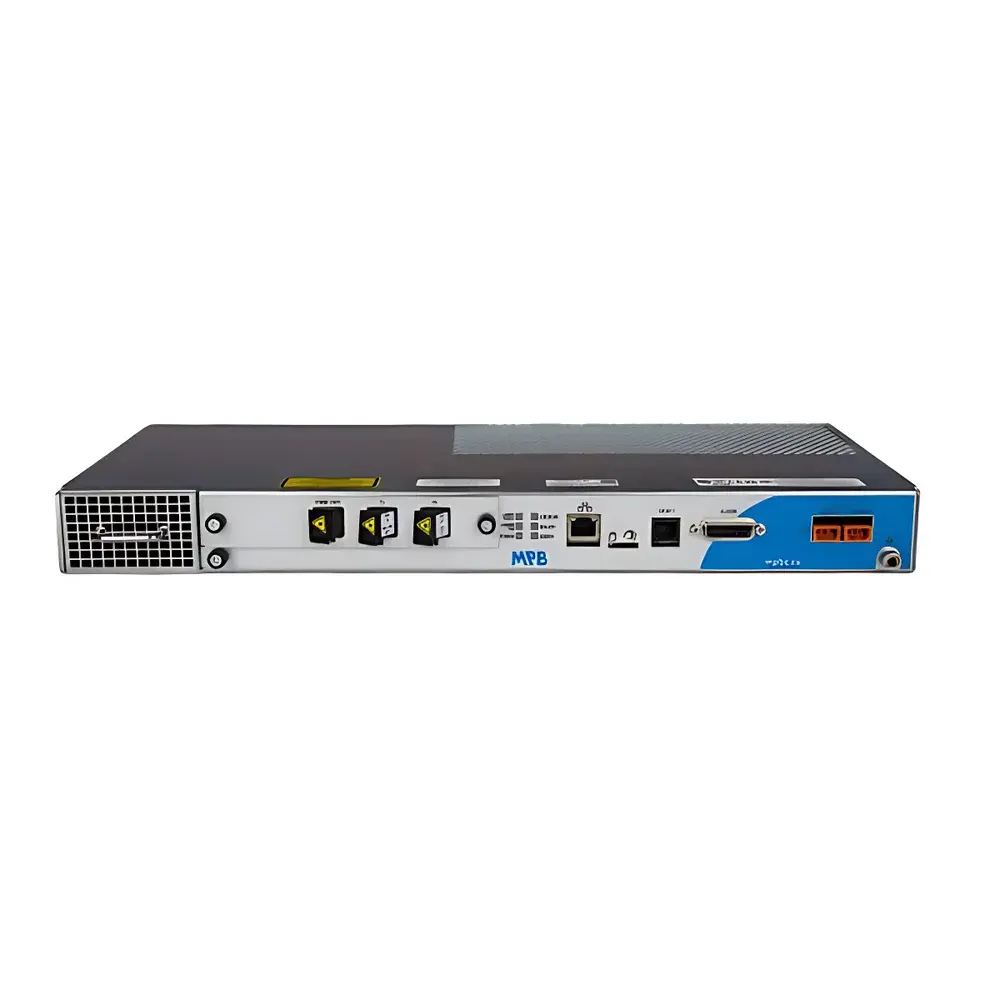
MPBC ROPA Pump and VERSA2 Raman Pump
| Brand | MPBC |
|---|---|
| Origin | Canada |
| Product Type | Raman Pump Module for Distributed Optical Amplification |
| Model | MPBC ROPA Pump (2RU & VERSA2 Form Factors) |
| Output Wavelengths | 127x nm, 142x nm, 148x nm, 1390 nm, 1405 nm, 1430 nm |
| Max Output Power | ≤5 W (Cascaded 3rd-Order ROPA), ≤850 mW (VERSA2 Co/Counter-Pumps), ≤500–550 mW (S+C+L Multiband) |
| Signal Passband | 1460–1610 nm (S+C+L), 1500–1568 nm (C-Band) |
| Insertion Loss | 1.6–4.4 dB |
| Polarization Degree | <10% (ROPA), 4% (VERSA2) |
| OSC Wavelength | 1574 nm, 1610 nm, 1624.01 nm |
| OSC Optical Reach | up to 85 dB |
| Compliance | NEBS Level 3 (with optional kit), GR-3108 Level 1 |
| Interface | SNMP v2c/v3, Web-based Craft Terminal (HTTPS/TLS), APC mode control |
| Connectors | E-2000 PS (high-power pump output), LC/PC (control/signal) |
Overview
The MPBC ROPA Pump and VERSA2 Raman Pump are high-reliability, telecom-grade optical pump modules engineered for distributed Raman amplification in long-haul, metro, and access fiber-optic networks. These devices operate on the principle of stimulated Raman scattering (SRS), where high-power pump light transfers energy to lower-frequency signal photons via vibrational modes in the silica fiber core—enabling broadband, low-noise gain without requiring active gain media. Unlike erbium-doped fiber amplifiers (EDFAs), Raman amplification is inherently bit-rate transparent and supports flexible channel spacing across the S-, C-, and L-bands (1460–1610 nm). The ROPA (Raman Optical Parametric Amplifier) architecture employs second- or third-order cascaded pumping schemes to extend effective pump reach and suppress nonlinear penalties, while the VERSA2 platform integrates co-propagating, counter-propagating, and multi-wavelength S+C+L pump configurations into a compact, field-deployable module. Designed for integration with MPBC’s VERSA2 chassis and 2RU rack-mount systems—and interoperable with third-party line systems—the pumps deliver deterministic gain profiles, precise power stabilization, and real-time fiber integrity monitoring.
Key Features
- Bit-rate and modulation-format agnostic operation—fully compatible with 10G, 100G, 400G, and coherent DP-QPSK/DP-16QAM systems
- Dual-mode control: Automatic Power Control (APC) with ±0.1 dB setpoint accuracy and manual current regulation
- Web-based Craft Terminal interface accessible via HTTPS with TLS 1.2 encryption and role-based authentication
- Fiber-integrity monitoring with automatic laser shutdown upon loss-of-signal (LOS) detection and safe auto-restart after recovery
- Compliance with Telcordia GR-3108-CORE (Level 1) and NEBS Level 3 requirements (with optional NEBS L3 kit)
- High-power E-2000 PS connectors rated for >5 W continuous output; LC/PC interfaces for management and OSC channels
- OSC (Optical Supervisory Channel) support at 1574 nm, 1610 nm, or 1624.01 nm with >82 dB optical reach for end-to-end span monitoring
- Multi-wavelength S+C+L pump configuration enabling uniform gain flattening across 150 nm bandwidth
Sample Compatibility & Compliance
The MPBC ROPA Pump and VERSA2 Raman Pump are qualified for deployment in carrier-class optical transport networks operating under ITU-T G.652.D, G.655, and G.656 fiber standards. They meet IEC 60825-1:2014 Class 4 laser safety requirements and incorporate redundant thermal and current protection circuits per IEC 62368-1. For regulated environments, the modules support audit-ready logging—including timestamped pump power adjustments, fault events, and OSC status changes—aligned with GLP/GMP traceability principles. SNMP v3 implementation enables secure integration into existing OSS/BSS platforms compliant with TM Forum NGOSS standards. All firmware versions undergo regression-tested validation against RFC 3411–3418 (SNMPv3 framework) and RFC 7512 (optical performance monitoring MIB extensions).
Software & Data Management
Configuration and monitoring are performed through a standards-compliant web GUI supporting IPv4/IPv6 dual-stack operation. The Craft Terminal implements RESTful API endpoints (GET/PUT) for integration with Python-based automation frameworks or Ansible playbooks. Critical operational parameters—including pump current, TEC temperature, photodiode feedback, and OSC RSSI—are logged locally with circular buffer retention (72-hour minimum) and exportable via SFTP or Syslog (RFC 5424). Firmware updates follow signed package verification using ECDSA P-256 signatures to prevent unauthorized modification. Audit trails record all user-initiated actions with source IP, timestamp, and privilege level—supporting compliance with NIST SP 800-53 AC-2 and ISO/IEC 27001 A.9.4.1 controls.
Applications
- Long-span OPGW (Optical Ground Wire) networks in utility infrastructure—validated in extreme environments including Siberian sub-zero (-55°C), Arabian Desert (>55°C ambient), and Amazonian tropical humidity (>95% RH)
- Capacity upgrades in legacy EDFA-based metro rings by inserting distributed Raman gain to offset span loss without replacing repeaters
- Subsea cable landing station pre-amplification where low-noise figure (<4.5 dB) and polarization-insensitive gain are critical
- Converged S+C+L-band DWDM systems requiring flat, wideband gain compensation across 1525–1625 nm
- Hybrid Raman/EDFA hybrid amplifiers for ultra-long-haul terrestrial links exceeding 400 km span length
FAQ
What distinguishes ROPA from conventional Raman pumps?
ROPA (Raman Optical Parametric Amplifier) uses cascaded second- or third-order pumping to generate longer-wavelength pumps in-fiber, enabling higher net gain and improved noise performance over single-stage counter-pumping—particularly in ultra-long spans exceeding 120 km.
Can the VERSA2 S+C+L pump operate independently of MPBC chassis?
Yes. While optimized for VERSA2 chassis integration, the module provides standalone operation via front-panel E-2000 PS pump output and LC/PC management ports, supporting interoperability with third-party ROADM and amplifier platforms.
Is OSC functionality mandatory for system deployment?
No—but strongly recommended. The OSC channel enables remote span loss estimation, pump health diagnostics, and automated gain tilt correction without interrupting live traffic.
How is laser safety enforced during maintenance?
All pump outputs feature interlocked E-2000 PS connectors: removal triggers immediate APC shutdown and latching fault state until manual reset via GUI or SNMP trap acknowledgment.
Does the 2RU ROPA Pump support GR-3108 Level 1 without optional hardware?
Yes. GR-3108 Level 1 compliance is built-in; NEBS Level 3 requires the separately certified NEBS L3 mechanical and thermal kit.