
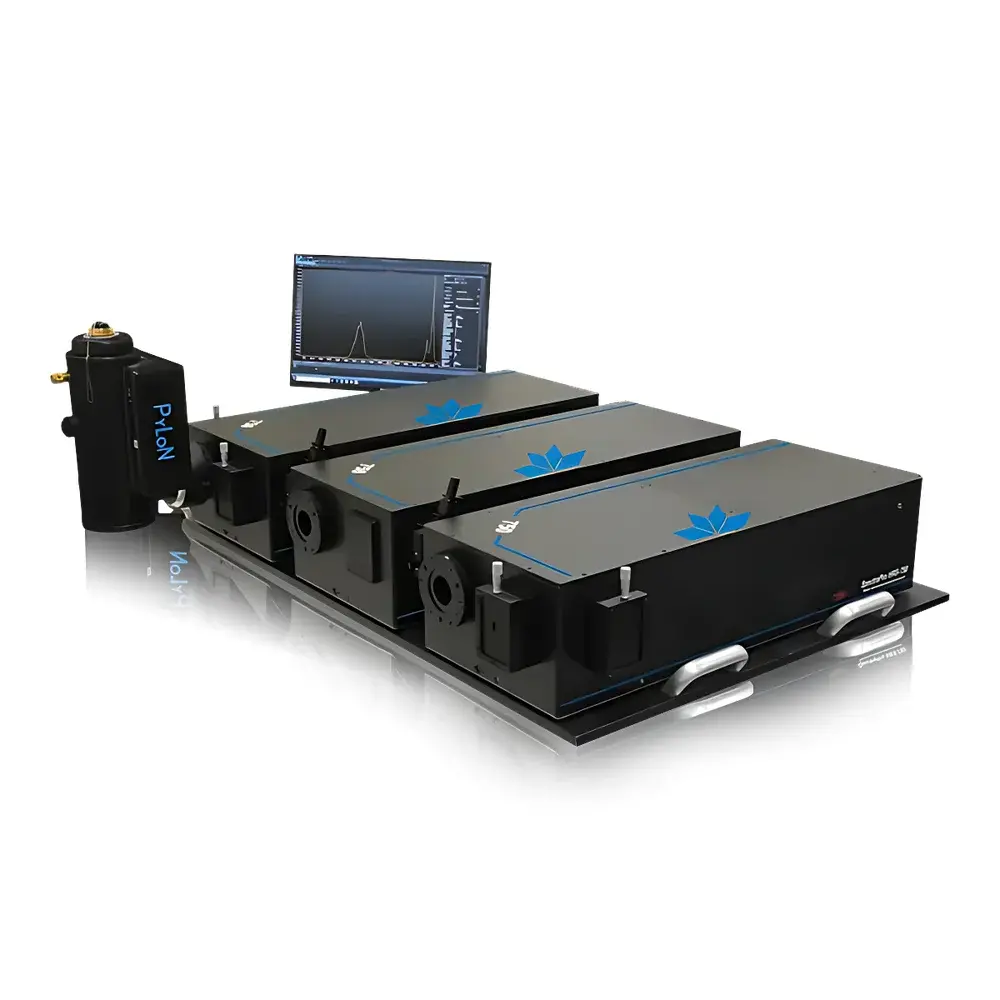
Princeton Instruments TriVista Triple Spectrometer System
| Brand | Princeton Instruments (Teledyne) |
|---|---|
| Model Series | TriVista |
| Wavelength Range | 200–2200 nm |
| Spectral Resolution | ≤0.13 cm⁻¹ (A-type, TR777 configuration) |
| Stray Light Suppression | <10⁻¹⁴ |
| Minimum Detectable Raman Shift | 5 cm⁻¹ (CCD), 2 cm⁻¹ (PMT/APD) |
| Input/Output Ports | 4 entrance + 4 exit ports |
| Grating Drive Technology | AccuDrive™ precision wavelength encoding |
| Compliance | ISO 9001:2015 certified manufacturing |
| Software Platform | VistaControl™ with multi-stage synchronization, GLP/GMP-ready audit trail support |
Overview
The Princeton Instruments TriVista Triple Spectrometer System is a high-performance, modular Czerny–Turner spectrograph architecture engineered for ultra-high-resolution Raman, photoluminescence (PL), and time-resolved spectroscopic applications across the ultraviolet to near-infrared (UV–NIR) spectral range (200–2200 nm). Unlike conventional single- or dual-stage spectrometers, the TriVista integrates three independently operable spectrograph stages—configured in series or parallel—enabling true triple-pass dispersion for sub-wavenumber resolution without reliance on edge or notch filters. Its optical design eliminates the need for external laser rejection filters by achieving intrinsic stray light suppression below 10⁻¹⁴, permitting direct detection of Raman features as close as 2 cm⁻¹ from the excitation line when coupled with photon-counting detectors (e.g., PMT or APD), or 5 cm⁻¹ with scientific-grade CCD/EMCCD arrays. This capability is critical for low-frequency THz-Raman studies, spin-flip scattering in magnetic materials, and phonon mode analysis in 2D heterostructures.
Key Features
- Triple-stage modular architecture supporting independent operation of all three spectrograph units for concurrent multi-modal experiments
- AccuDrive™ grating positioning system delivering wavelength accuracy ≤±0.005 nm and repeatability <±0.002 nm across full scan range
- Four interchangeable entrance slits and four exit ports enabling simultaneous coupling to multiple detectors—including back-illuminated CCDs, ICCDs, EMCCDs, InGaAs arrays, PMTs, and APDs
- Optimized optical path design with kinematic mirror mounts and thermally stable monolithic aluminum frame ensuring long-term alignment stability under laboratory conditions
- Interchangeable gratings (up to 6 per stage) with automatic recognition and calibration via encoded drive mechanism
- Integrated motorized filter wheels and shutter control synchronized with acquisition timing for automated dark-current correction and background subtraction
Sample Compatibility & Compliance
The TriVista system supports solid, liquid, and gaseous samples across diverse experimental configurations including confocal micro-Raman, macro-Raman, fiber-coupled remote sensing, and cryogenic (<4 K) measurements using compatible sample stages and environmental chambers. It meets international regulatory requirements for analytical instrumentation used in regulated environments: fully compliant with ISO 9001:2015 quality management standards; software architecture supports 21 CFR Part 11 compliance through VistaControl™’s role-based user access, electronic signatures, and immutable audit trails for instrument parameter changes and data acquisition logs. All optical coatings—including custom Acton Optics broadband anti-reflection and high-reflectivity dielectric stacks—are manufactured under controlled cleanroom conditions and traceably documented per ISO 10110 specifications.
Software & Data Management
VistaControl™ is a native Windows-based application developed specifically for Princeton Instruments spectroscopy platforms. It provides real-time spectral preview, multi-stage wavelength synchronization, automated grating selection, and detector gain/offset optimization. Advanced features include hyperspectral mapping control (XY/Z stage integration), time-resolved decay fitting (multi-exponential convolution), batch processing with customizable ROI extraction, and export to HDF5, ASCII, and vendor-neutral JCAMP-DX formats. The software supports scripting via Python API (PyVista) for integration into automated workflows compliant with GLP and GMP laboratory practices. Raw spectral data includes embedded metadata: excitation wavelength, grating groove density, slit width, integration time, detector temperature, and calibration certificate ID.
Applications
- Low-frequency Raman spectroscopy of quantum materials, topological insulators, and magnons in antiferromagnetic systems
- Resonant Raman characterization of transition metal dichalcogenides (TMDs), graphene derivatives, and carbon nanotubes
- Time-resolved photoluminescence decay kinetics in perovskite solar cell absorbers and quantum dot emitters
- Ultra-low wavenumber vibrational modes (<10 cm⁻¹) in soft matter, polymers, and biological macromolecules
- Magnetic Raman scattering studies requiring polarization-resolved detection at cryogenic temperatures
- Hyperspectral imaging of semiconductor wafer defects using line-scan or area-mapping modalities
FAQ
Can the TriVista operate without external notch or edge filters?
Yes. Its triple-stage dispersion and optimized optical coating stack provide intrinsic laser rejection exceeding conventional filter performance, enabling direct detection within 2 cm⁻¹ of the excitation line.
Is it possible to run two stages simultaneously for different detectors?
Yes. Each spectrograph stage has independent motorized drives and optical paths; up to four detectors can be engaged concurrently via configurable input/output port routing.
Does VistaControl support automated calibration traceability?
Yes. Every wavelength calibration event is timestamped, logged with reference lamp spectrum, and linked to NIST-traceable spectral standards stored in the instrument database.
What cooling options are available for the detector interface?
The system interfaces with Princeton Instruments’ deep-cooled CCD/EMCCD cameras (–80°C to –100°C), InGaAs arrays (–80°C), and thermoelectrically cooled PMT modules, all managed via unified thermal setpoint control in VistaControl.
How is mechanical stability ensured during extended acquisitions?
The monolithic aluminum baseplate, vibration-damped optical bench, and zero-backlash harmonic drive mechanisms collectively maintain optical alignment stability better than ±0.001 pixels/hour over 24-hour acquisitions.



