
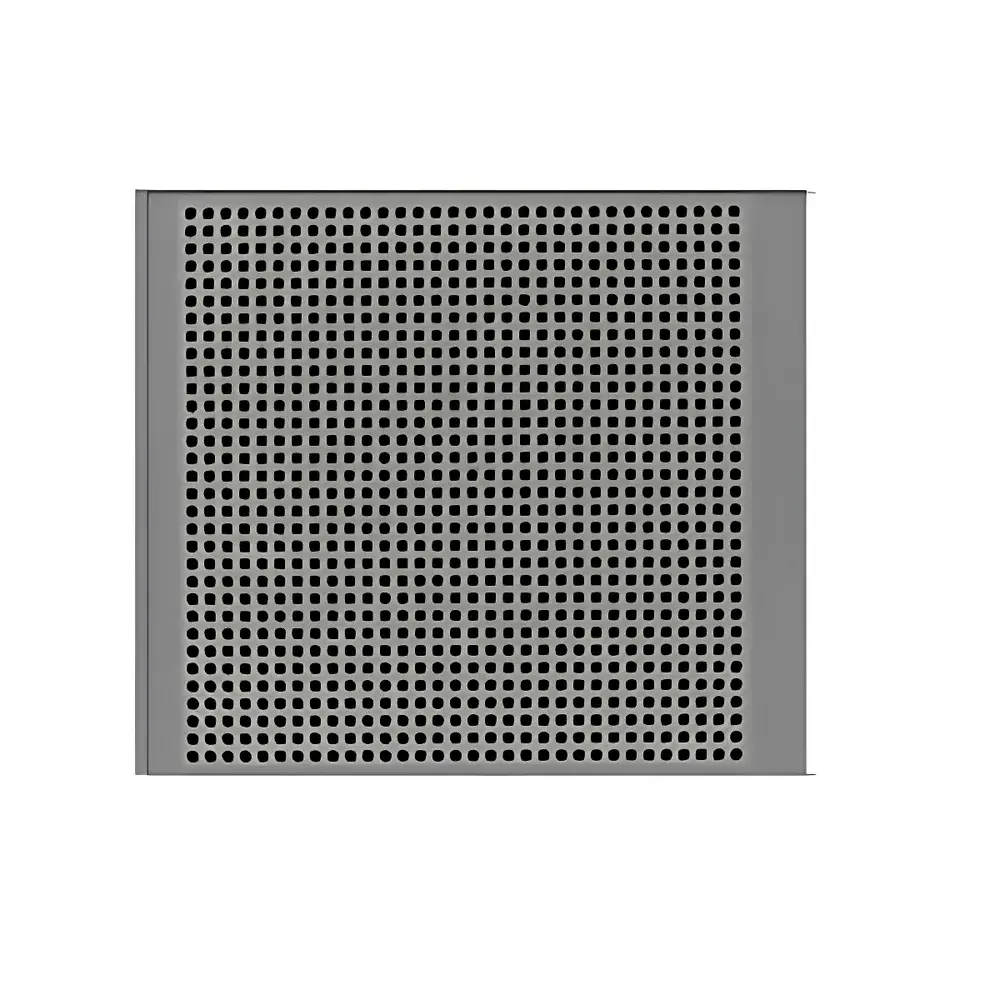
Auniontech TEM Silicon Nitride Support Grids
| Brand | Auniontech |
|---|---|
| Origin | Shanghai, China |
| Manufacturer Type | Authorized Distributor |
| Product Origin | Domestic (China) |
| Model Designation | TEM Support Grids with SiN Membranes |
| Pricing | Available Upon Request |
Overview
Auniontech TEM Silicon Nitride Support Grids are precision-engineered consumables designed for high-resolution transmission electron microscopy (TEM) applications. These grids serve as ultra-thin, mechanically stable substrates for specimen support during electron beam interrogation. Constructed from low-stress silicon nitride (SiNx) membranes suspended over standard 3.0 mm diameter TEM grid frames—available in circular or octagonal configurations—the grids provide exceptional electron transparency and thermal/chemical stability. The membrane thickness options (5 nm, 10 nm, 30 nm, 50 nm, and 100 nm) enable tailored selection based on imaging resolution requirements, electron dose sensitivity, and mechanical integrity needs. Each SiN membrane is centered within a square window array defined by a 200 µm-thick single-crystal silicon frame, ensuring dimensional consistency and compatibility with automated stage navigation and high-tilt tomography workflows.
Key Features
- Low-stress, stoichiometric silicon nitride membranes fabricated via LPCVD for uniform thickness and minimal intrinsic strain
- Standardized 3.0 mm outer diameter grid geometry compatible with all major TEM holders (Gatan, JEOL, FEI/Thermo Fisher)
- Five calibrated membrane thickness options (5–100 nm) to balance electron transparency, structural rigidity, and sample adhesion
- Position-marked variants available: micron-scale fiducial markers etched along both X- and Y-edges of the porous membrane region for precise coordinate referencing during tilt-series acquisition and correlative imaging
- Pre-packaged in inert 2″ × 2″ static-dissipative boxes (10 grids per box), sealed under nitrogen to prevent oxidation and contamination
- Each grid undergoes post-fabrication plasma cleaning and SEM inspection to verify membrane continuity and absence of pinholes or particulates
Sample Compatibility & Compliance
These grids support a broad range of nanoscale specimens including biological macromolecules (e.g., vitrified proteins, virus particles), 2D materials (graphene, TMDCs), metallic nanoparticles, and soft matter assemblies. Their hydrophilic surface chemistry (tunable via O2 plasma treatment) facilitates uniform ice-layer formation in cryo-TEM and improves colloidal dispersion stability. All grids meet ISO 9001-certified manufacturing controls. While not classified as medical devices, they are routinely employed in GLP-compliant structural biology pipelines and referenced in peer-reviewed methodologies conforming to EMDB and PDB deposition standards. No animal-derived components or REACH-restricted substances are used in fabrication.
Software & Data Management
Though hardware-based, these grids integrate seamlessly with industry-standard TEM data acquisition platforms—including SerialEM, Leginon, and EPU—enabling automated multi-location imaging and drift-corrected time-lapse series. The position-marked variants are fully compatible with machine-vision alignment algorithms used in cryo-EM single-particle analysis (SPA) and subtomogram averaging (STA). Fiducial marker coordinates can be imported into IMOD, Dynamo, or RELION for reference-based stage calibration and coordinate mapping across datasets. Audit trails for grid lot numbers and membrane specifications are maintained in digital batch records aligned with laboratory information management system (LIMS) metadata schemas.
Applications
- Cryo-electron microscopy (cryo-EM) of membrane proteins and large complexes
- In situ TEM studies of catalytic nanoparticles under gas or liquid environments
- High-angle annular dark-field scanning TEM (HAADF-STEM) of ultrathin 2D heterostructures
- Nanopore sensing substrate development for DNA translocation studies
- Quantitative electron tomography requiring fiducial-based reconstruction fidelity
- Correlative light and electron microscopy (CLEM) where grid-based coordinate anchoring is critical
FAQ
Are these grids compatible with FIB-SEM lamella preparation?
Yes—low-stress SiN membranes withstand focused ion beam milling without delamination; recommended for lift-out support when combined with copper or gold TEM grids.
Do you offer custom membrane thickness or window patterning?
Custom SiN thicknesses (down to 3 nm) and non-square window geometries (e.g., hexagonal arrays, tapered pores) are available under NDA for R&D partnerships.
What is the typical shelf life and storage recommendation?
Store unopened boxes at room temperature (15–25°C), <30% RH, away from UV exposure; usable for ≥24 months from manufacture date.
Can these grids be plasma-cleaned in-house prior to use?
Yes—O2 or Ar/O2 plasma treatment (5–30 W, 30–60 s) is recommended immediately before sample loading to restore hydrophilicity and remove adventitious carbon.
Is lot-to-lot thickness variation controlled and documented?
Each production lot undergoes cross-sectional TEM and ellipsometry verification; certified thickness deviation is ≤±1.5 nm for 5–30 nm membranes and ≤±3 nm for thicker variants.




