
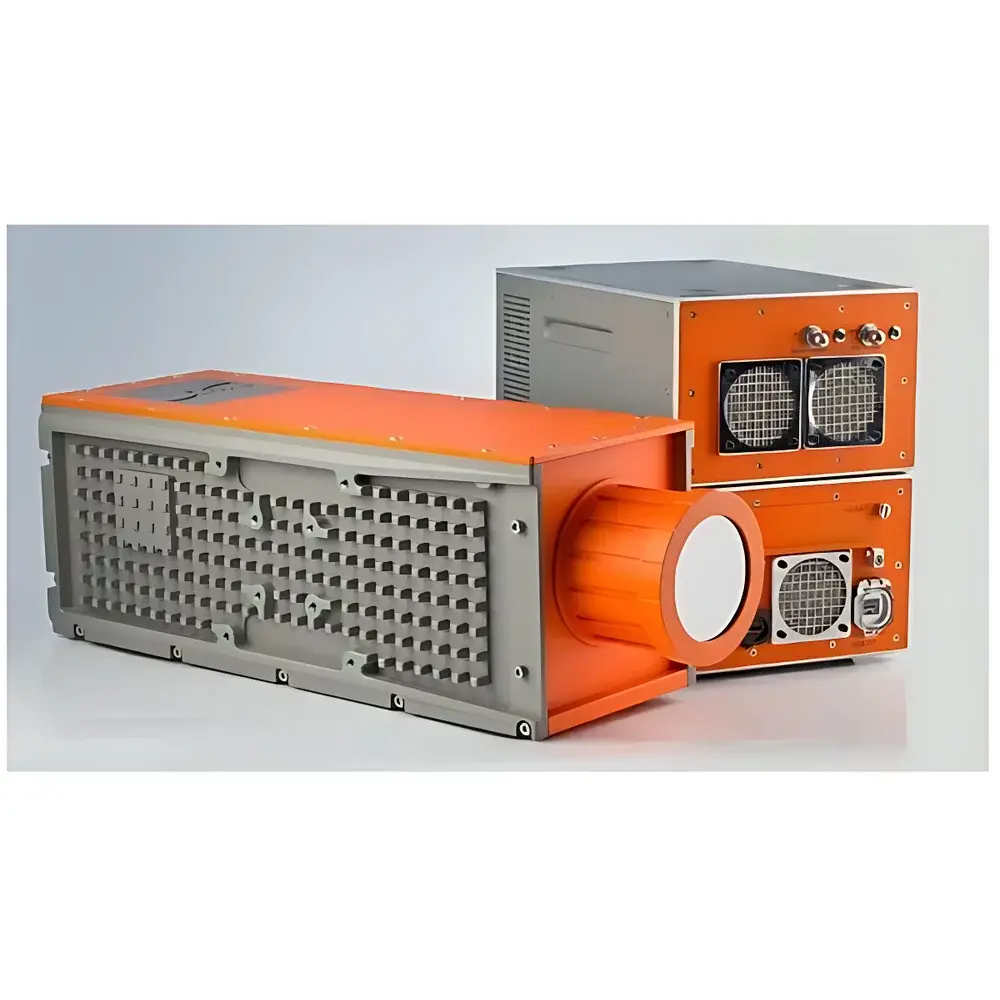
Specim SWIR Hyperspectral Camera (1000–2500 nm)
| Brand | Specim (Finland) |
|---|---|
| Origin | Finland |
| Model | SPECIM SWIR |
| Spectral Range | 1000–2500 nm |
| Spatial Pixels | 384 |
| Frame Rate | up to 450 fps (via Camera Link) |
| Enclosure Rating | IP54 |
| Power Consumption | 50 W (nominal) |
| Optical Stability | Thermally stabilized optics |
| Data Output Format | ENVI, MATLAB, R-compatible hypercube |
| Interface | Camera Link |
| Software Development Kit (SDK) | Available |
Overview
The Specim SWIR Hyperspectral Camera (1000–2500 nm) is a high-performance, thermally stabilized push-broom imaging spectrometer engineered for quantitative chemical mapping in the short-wave infrared (SWIR) spectral region. Based on precision diffraction grating spectroscopy and linear InGaAs sensor architecture, it captures full spectral signatures at every spatial pixel across a 384-pixel line, enabling pixel-wise material identification and compositional analysis. Unlike broadband or multispectral systems, this camera delivers contiguous spectral sampling—critical for resolving overlapping absorption features of water, lipids, proteins, cellulose, and mineral hydroxyl groups. Its optical design incorporates active thermal stabilization to minimize wavelength drift and radiometric variation, ensuring measurement repeatability under variable ambient conditions—from climate-controlled laboratories to field-deployed outdoor setups.
Key Features
- High spatial resolution with 384-pixel linear array optimized for SNR and spectral fidelity in the 1000–2500 nm range
- Real-time acquisition at up to 450 frames per second via Camera Link interface, supporting high-throughput conveyor-based inspection and dynamic scene capture
- IP54-rated ruggedized enclosure for reliable operation in industrial environments, including humidity, dust, and temperature fluctuations
- Thermally stabilized optical bench and detector assembly—reducing calibration frequency and improving long-term spectral accuracy
- Low power consumption (50 W nominal), facilitating integration into mobile platforms, UAV-mounted systems, and energy-constrained field instrumentation
- Modular hardware expansion support: interchangeable fore-optics, fiber-coupled inputs (SMA), scanning mirrors, rotary stages, and X-stage sample movers
Sample Compatibility & Compliance
The Specim SWIR camera is compatible with solid, semi-solid, and particulate samples—including pharmaceutical tablets, agricultural grains, food products, geological specimens, forensic evidence, and cultural heritage artifacts. It operates non-destructively and requires no sample preparation beyond standard illumination (e.g., halogen or quartz-tungsten-halogen sources). The system complies with ISO/IEC 17025 guidelines for analytical instrument qualification when deployed in GLP- or GMP-regulated environments. While not intrinsically FDA 21 CFR Part 11 compliant, its SDK and metadata-rich ENVI-format output enable traceable data workflows when integrated with validated LIMS or ELN platforms. Calibration traceability is maintained through NIST-traceable reflectance standards (e.g., Spectralon®) and optional onboard shutter-based dark current correction.
Software & Data Management
Data are acquired as calibrated radiance or reflectance hypercubes (x × y × λ), stored natively in ENVI .hdr/.bin format—fully interoperable with MATLAB, Python (scikit-image, hsi), R (hyperSpec), and commercial chemometric packages (Unscrambler®, Pirouette®). The included SDK provides C/C++, Python, and LabVIEW APIs for custom acquisition control, real-time preprocessing (e.g., dark/flat-field correction, spectral resampling), and embedded classification logic. All metadata—including integration time, lens F-number, calibration timestamps, and environmental sensor readings (optional)—are embedded in the header, supporting audit-ready documentation per ISO 14644-1 and ASTM E2927-21 requirements for hyperspectral method validation.
Applications
- Pharmaceutical Quality Assurance: Quantitative mapping of API distribution, excipient homogeneity, and moisture content in tablet coatings using PLS regression models trained on reference NIR-SWIR libraries
- Food Safety & Authenticity: Detection of adulteration (e.g., olive oil dilution), fat/water/protein spatial distribution in meat and dairy, and crystallinity assessment of sucrose in confectionery
- Agricultural Phenotyping: In-field estimation of nitrogen status, water stress indices (NDWI, WI), and lignin/cellulose ratios in leaves and stems
- Mineralogical Mapping: Identification of clay species (kaolinite, smectite), carbonates, sulfates, and metal oxides in core scans and outcrop surveys
- Recycling & Waste Sorting: Real-time polymer identification (PET, PVC, PP) and contaminant detection based on C–H, O–H, and C=O vibrational overtones
- Cultural Heritage Analysis: Non-invasive pigment identification, underdrawing visualization, and binding medium differentiation beneath varnish layers
FAQ
What spectral sampling interval does the Specim SWIR provide?
The native spectral sampling depends on the configured slit width and grating; typical configurations yield ~5–10 nm FWHM resolution across the 1000–2500 nm range. Exact values are specified in the instrument’s calibration certificate.
Can the camera be used with existing laboratory illumination sources?
Yes—it is designed for compatibility with standard SWIR-optimized broadband sources (e.g., tungsten-halogen lamps with quartz envelopes) and supports external triggering for synchronized illumination control.
Is radiometric calibration included with the system?
Each unit ships with factory-applied radiometric and spectral calibration coefficients. Optional annual recalibration services are available through Specim-certified labs with NIST-traceable reference standards.
How is geometric distortion corrected during data acquisition?
Pixel-level spatial nonlinearity and keystone distortion are pre-characterized and corrected in real time via embedded firmware using polynomial correction models derived from rigorous optical testing.
Does the system support real-time classification or anomaly detection?
While the base firmware performs raw data capture only, the SDK enables integration of user-defined machine learning pipelines (e.g., SVM, CNN, or PCA-based thresholding) for edge deployment or streaming analytics.




