

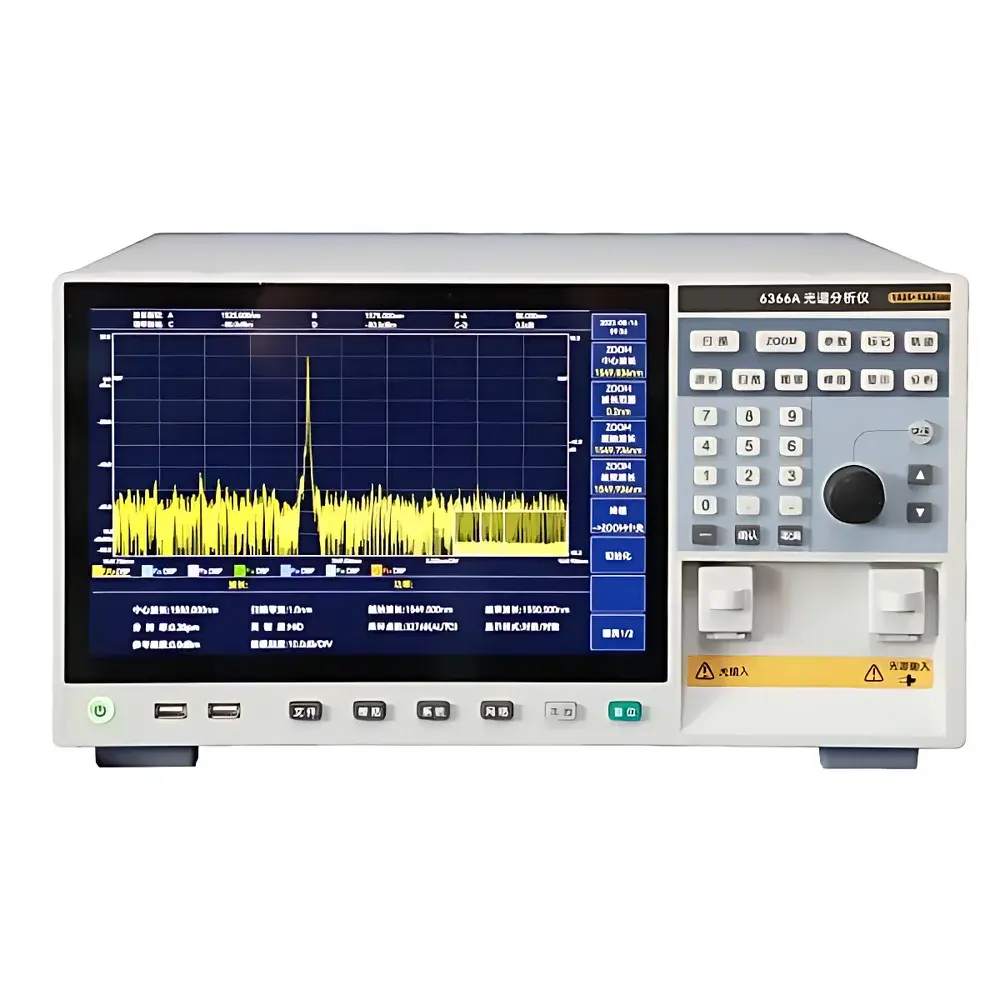
Auniontech 6366A C-Band Precision Optical Spectrum Analyzer (1525–1565 nm)
| Brand | Auniontech |
|---|---|
| Origin | Shanghai, China |
| Model | 6366A |
| Spectral Range | 1525–1565 nm (C-band) |
| Spectral Resolution | < 0.3 pm |
| Spurious-Free Dynamic Range | > 50 dB |
| Wavelength Sampling Resolution | 5 MHz |
| Wavelength Accuracy | ±2 pm |
| Power Measurement Range | –70 dBm to +13 dBm |
| Power Accuracy | ±0.5 dB |
| Calibration Reference | Integrated C₁₂H₄N (HCN) gas cell |
| Measurement Principle | Coherent detection via stimulated Brillouin scattering (SBS) in optical fiber with tunable laser sweep |
| Polarization-Resolved Capability | Yes |
| Complex Spectral Reconstruction | Amplitude, phase, chirp, and temporal waveform |
| Input Interface | Single-mode fiber (FC/APC or SC/APC optional) |
Overview
The Auniontech 6366A C-Band Precision Optical Spectrum Analyzer is a high-fidelity, coherent-domain spectrometer engineered for metrology-grade characterization of optical signals in the 1525–1565 nm wavelength window—the industry-standard C-band for dense wavelength division multiplexing (DWDM) and high-speed coherent optical communication systems. Unlike conventional diffraction-grating or interferometric optical spectrum analyzers (OSAs), the 6366A employs a fundamentally different measurement architecture based on stimulated Brillouin scattering (SBS) in single-mode fiber, combined with precision tunable laser sweeping and heterodyne detection. This approach enables true complex spectral analysis—simultaneously resolving amplitude, phase, instantaneous frequency (chirp), polarization-dependent response, and time-domain waveform without reliance on modulation format or external reference sources. The instrument delivers sub-picometer spectral resolution ( 50 dB spurious-free dynamic range—making it suitable for R&D validation, production test, and field-deployable spectral monitoring in next-generation optical infrastructure.
Key Features
- Full C-band coverage (1525–1565 nm) with continuous, gap-free spectral acquisition
- Coherent SBS-based detection architecture enabling real-time complex spectral reconstruction (amplitude + phase)
- Spectral resolution better than 0.3 pm (equivalent to ~37.5 MHz at 1550 nm), supporting ultra-narrow linewidth laser characterization
- Wavelength sampling resolution of 5 MHz—sufficient for precise OFDM subcarrier alignment and coherent receiver calibration
- Integrated C12H4N (hydrogen cyanide) gas reference cell for in-situ wavelength calibration and long-term drift compensation
- Polarization-resolved spectral analysis capability for evaluating polarization-dependent loss (PDL), polarization mode dispersion (PMD), and vectorial device response
- Input power handling from –70 dBm to +13 dBm with ±0.5 dB absolute power accuracy across the full dynamic range
- Native support for chirp, group delay, and instantaneous frequency mapping—critical for modulator linearity assessment and dispersion-compensated link validation
- Fully optical front-end with no photodetector saturation or electronic bandwidth limitations; no aliasing or folding artifacts
Sample Compatibility & Compliance
The 6366A is optimized for single-mode fiber-coupled inputs (FC/APC or SC/APC interfaces standard). It supports both continuous-wave (CW) and modulated signals—including QPSK, 16-QAM, 64-QAM, OFDM, and PDM formats—without signal conditioning or external demodulation. Its measurement methodology complies with key industry standards governing optical component testing, including ITU-T G.694.1 (DWDM channel spacing), IEC 61280-2-9 (optical amplifier noise figure), and Telcordia GR-1073-CORE (fiber optic device reliability). For regulated environments, raw spectral data includes timestamped metadata, full audit trail of calibration events, and user-accessible traceability logs—supporting GLP/GMP-aligned workflows and FDA 21 CFR Part 11-compliant data integrity when paired with validated laboratory information management systems (LIMS).
Software & Data Management
The instrument ships with Auniontech’s SpectraView Pro software suite, a Windows-based application offering real-time spectral visualization, automated pass/fail reporting per ITU channel masks, and export of complex-valued spectral datasets (I/Q, magnitude/phase, or time-domain E-field) in HDF5, MATLAB .mat, and CSV formats. API support includes SCPI over TCP/IP and native Python bindings (via PyVISA), enabling integration into automated test sequences using LabVIEW, Python, or TestStand. All measurements are stored with embedded calibration state, environmental sensor readings (temperature, humidity), and operator annotations. Software updates are delivered via secure HTTPS with SHA-256 signature verification, and firmware revisions maintain backward compatibility with legacy spectral archives.
Applications
- Characterization of narrow-linewidth lasers, optical frequency combs, and stabilized tunable sources for metrology and quantum optics
- End-to-end validation of coherent transceivers—including IQ modulator linearity, laser phase noise, and receiver DSP performance
- Passive component testing: insertion loss, return loss, PDL, and spectral ripple of filters, AWGs, couplers, and isolators
- DWDM system commissioning and troubleshooting: channel power uniformity, OSNR estimation, and nonlinear crosstalk quantification
- Fiber sensing applications requiring distributed or point-wise phase-sensitive interrogation (e.g., Φ-OTDR, BOTDA)
- Research in optical signal processing, microwave photonics, and photonic analog-to-digital conversion
- Manufacturing test of high-speed modulators, integrated photonic circuits (PICs), and silicon photonics devices
FAQ
Does the 6366A require external wavelength references for routine operation?
No. The integrated HCN gas absorption cell provides autonomous, in-situ wavelength calibration before each measurement sequence, eliminating dependency on external wavemeters or stabilized reference lasers.
Can the 6366A measure optical signal-to-noise ratio (OSNR) accurately in the presence of amplified spontaneous emission (ASE)?
Yes. Its coherent detection architecture and >50 dB spurious-free dynamic range enable direct separation of signal and ASE components in the complex spectral domain, supporting ITU-T G.957-compliant OSNR calculation without polynomial fitting or interpolation assumptions.
Is polarization diversity supported during spectral acquisition?
Yes. The instrument includes a built-in polarization controller and dual-channel coherent receiver, allowing simultaneous orthogonal polarization-state-resolved spectral acquisition for full Stokes parameter reconstruction.
What is the minimum measurable linewidth for CW lasers?
With 0.3 pm resolution and Fourier-limited processing, the system resolves laser linewidths down to < 100 kHz (FWHM) under optimal SNR conditions, subject to input power and integration time.
How is traceability to SI units maintained?
Wavelength scale traceability is anchored to the HCN rovibrational transition at 1542.245 nm (64.95 THz), which is internationally recognized and listed in the NIST Atomic Spectra Database; calibration certificates include uncertainty budgets per ISO/IEC 17025 requirements.





