
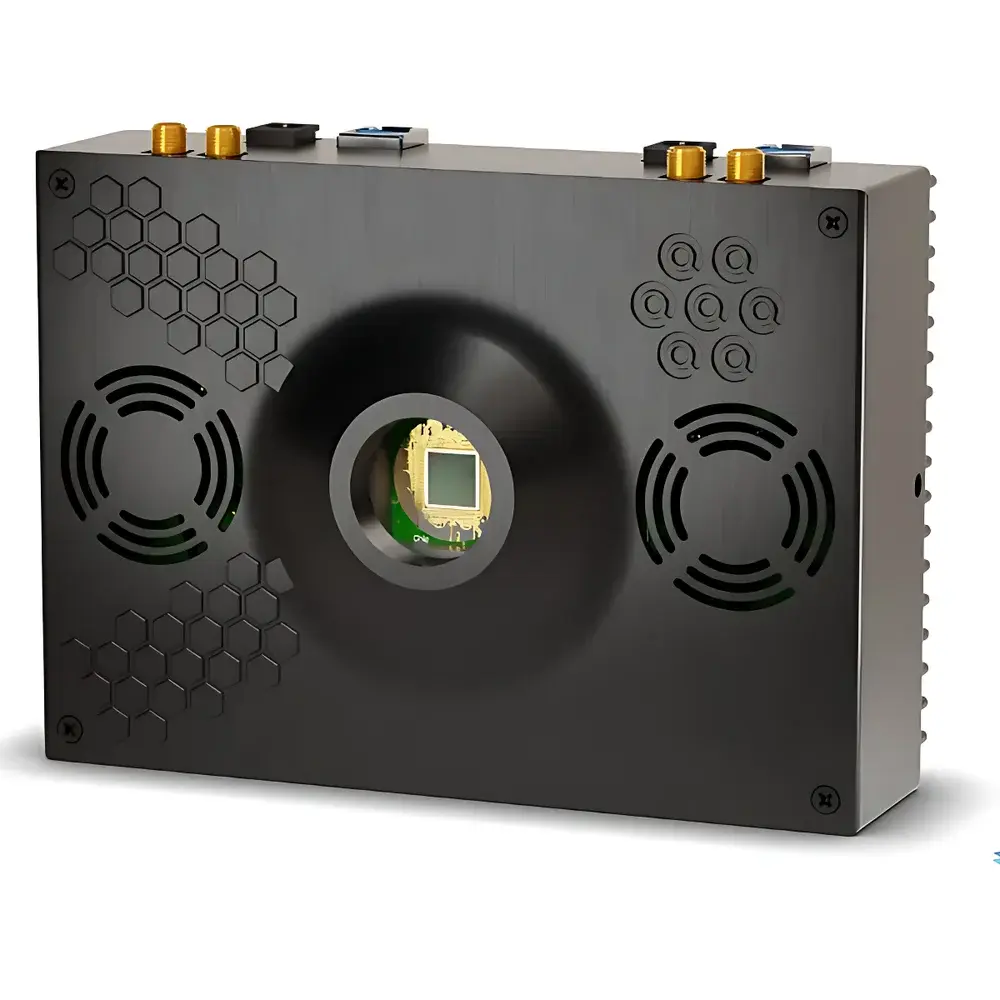
Auniontech SPAD Alpha High-Speed Single-Photon Imaging Camera
| Brand | Auniontech |
|---|---|
| Origin | Shanghai, China |
| Manufacturer Type | Authorized Distributor |
| Product Origin | Domestic (China) |
| Model | SPAD Alpha |
| Frame Rate (1-bit burst) | 73,000 fps |
| Pixel Array | 1024 × 1024 SPAD pixels |
| Wavelength Range | 400–900 nm |
| Pixel Pitch | 16 µm |
| Dark Count Rate (typ.) | <100 cps |
| Minimum Gating Width | 6 ns |
| Timing Jitter (exposure offset) | 17 ps |
| System Bandwidth (dual USB 3.0) | 6 Gbps |
| Bit Depth Modes | 1-bit (burst), 4-bit (semi-continuous), 8-bit (continuous) |
| Power Consumption | 5–10 W |
| Cooling | Peltier + air hybrid |
| Interface | Dual USB 3.2 Gen 1, TCP/IP, SMA trigger (frame/gate/laser clock) |
| Optical Mount | C/CS-mount |
| Housing | Rugged aluminum enclosure with protective window |
Overview
The Auniontech SPAD Alpha High-Speed Single-Photon Imaging Camera is a scientific-grade time-resolved imaging platform engineered for quantitative photon counting at video-rate speeds. Built around a monolithic 1024 × 1024 silicon single-photon avalanche diode (SPAD) array with integrated RGB color filtering, the camera operates on the principle of digital photon detection—each pixel functions as an independent, time-stamped photon counter with zero readout noise and true global shutter behavior. Its sub-nanosecond temporal resolution (minimum gate width: 6 ns; timing jitter: 17 ps) enables precise time-of-arrival measurement across the full field of view, making it uniquely suited for widefield fluorescence lifetime imaging microscopy (FLIM), time-gated luminescence mapping, quantum optical correlation experiments, and ultra-low-light dynamic scene capture. As the first commercially available successor to the SPAD 512 platform, the SPAD Alpha extends both spatial scale and temporal fidelity while maintaining compatibility with standard optical bench infrastructure.
Key Features
- Monolithic 1024 × 1024 SPAD sensor with per-pixel photon counting and timestamping capability
- RGB-filtered pixel architecture enabling spectral discrimination in single-photon counting mode
- True global shutter with 17 ps exposure timing precision and programmable gating from 6 ns to seconds
- Dual USB 3.2 Gen 1 interface delivering up to 6 Gbps aggregate bandwidth for sustained high-throughput acquisition
- Hybrid thermal management combining thermoelectric (Peltier) and forced-air cooling for stable dark count performance (<100 cps typical)
- C/CS-mount optical interface and M4 mechanical mounting points for seamless integration into inverted, upright, or custom optical setups
- Flexible synchronization via SMA connectors supporting frame trigger, gate trigger, and external laser clock input
Sample Compatibility & Compliance
The SPAD Alpha is designed for use with standard fluorescence-labeled biological specimens, quantum dot emitters, organic phosphors, and time-resolved scintillators. Its 400–900 nm spectral response covers common fluorophores (e.g., GFP, mCherry, Cy5) and near-infrared probes. The system complies with CE marking requirements for laboratory instrumentation and meets IEC 61000-6-3 (EMC emission) and IEC 61000-6-2 (immunity) standards. While not certified for clinical diagnostics, its deterministic photon counting architecture supports GLP-aligned data acquisition workflows. Timestamped photon lists are stored in HDF5 format with embedded metadata (exposure parameters, trigger timestamps, sensor temperature), facilitating traceability and audit readiness in regulated research environments.
Software & Data Management
The SPAD Alpha ships with Auniontech’s cross-platform acquisition software (Windows/Linux/macOS), providing intuitive control over gating windows, bit-depth selection, ROI binning, and real-time histogram visualization. All core functionality—including dynamic gate adjustment, multi-channel time-correlated acquisition, and RGB channel separation—is accessible via GUI or Python API (PySPAD). Raw photon event data is streamed in real time over TCP/IP, enabling direct ingestion into third-party analysis frameworks such as MATLAB, Python (NumPy/SciPy), or custom CUDA-accelerated processing pipelines. Acquisition logs include ISO 8601 timestamps, hardware serial numbers, and calibration checksums—supporting reproducible experiment documentation under FAIR principles.
Applications
- Widefield FLIM: Full-frame lifetime decay fitting at up to 287 fps (8-bit continuous mode) or gated stack acquisition at 4,883 fps (4-bit semi-continuous) for rapid screening of cellular metabolism or protein interactions
- Time-gated reflectance imaging: Suppression of ballistic vs. scattered photons in turbid media for biomedical or industrial inspection
- Quantum optics: HBT interferometry, intensity correlation (g²(τ)) measurements, and entanglement verification using synchronized pump-probe configurations
- Ultrafast combustion diagnostics: Nanosecond-resolved chemiluminescence mapping in flame front studies
- Low-light behavioral imaging: Tracking neural activity in freely moving organisms under dim illumination without image intensifiers
FAQ
What is the effective quantum efficiency across the 400–900 nm range?
QE peaks at ~35% at 550 nm and remains above 15% at 850 nm; spectral response is characterized per production batch and supplied with calibration certificates.
Can the camera operate in free-running mode without external triggering?
Yes—the internal oscillator supports autonomous acquisition at user-defined frame rates up to the maximum sustainable bandwidth for the selected bit depth.
Is timestamp precision affected by frame rate or ROI size?
No—timing jitter (17 ps) and minimum gate width (6 ns) are intrinsic to the SPAD array and independent of acquisition configuration.
Does the system support hardware-based background subtraction or dark frame correction?
Dark count maps are acquired during idle periods and applied in real time; no post-hoc correction is required due to zero-read-noise operation.
How is firmware updated, and is remote update supported?
Firmware updates are delivered via signed binary packages through the TCP/IP interface and validated using SHA-256 checksums prior to installation.



