
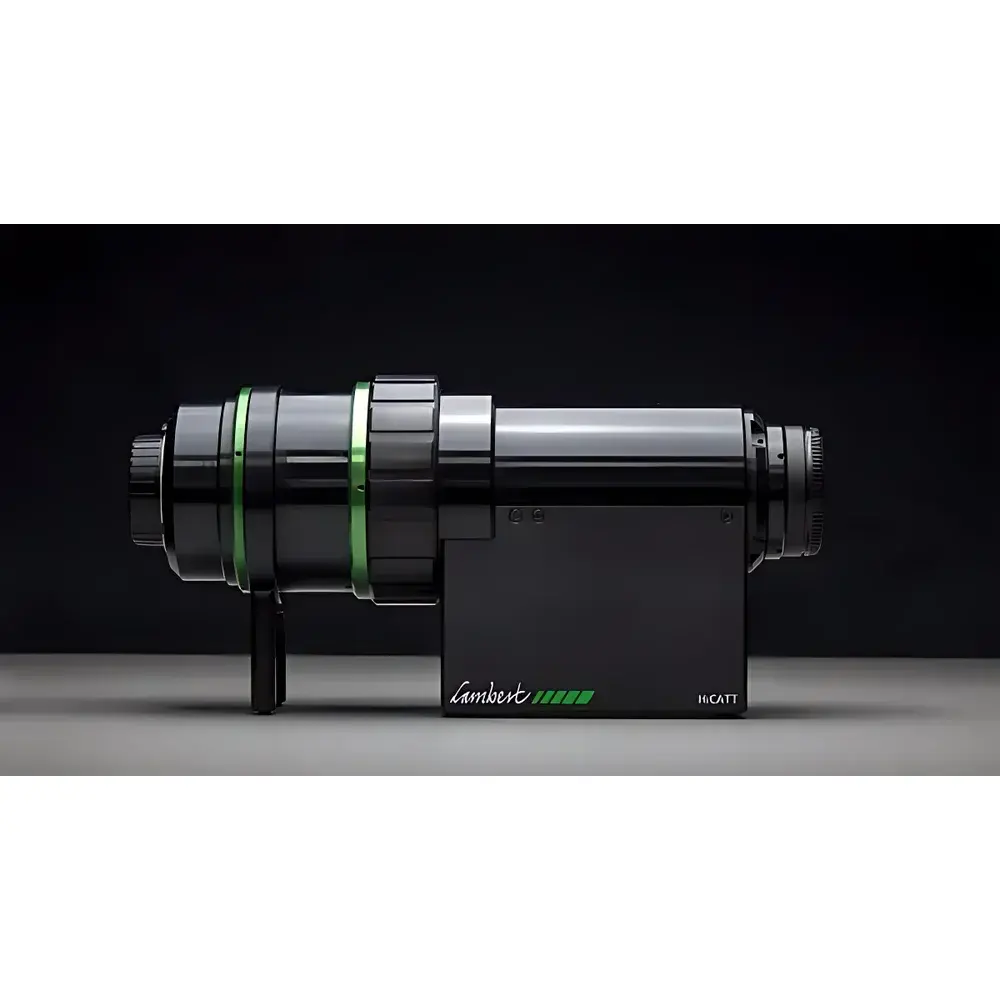
Auniontech HiCATT High-Speed Image Intensifier
| Brand | Auniontech |
|---|---|
| Model | HiCATT |
| Origin | Imported |
| Type | Gated Image Intensifier Module for High-Speed CCD/CMOS Cameras |
| Maximum Gating Frequency | 1 MHz (10 MHz in burst mode) |
| Minimum Gating Width | 3 ns |
| Quantum Efficiency (QE) | Up to 50% (wavelength-dependent, configurable photocathode options) |
| Output Coupling | Fiber-optic or lens-coupled via relay optics (TRiCATT-compatible) |
| Compliance | Designed for integration into ISO/IEC 17025-compliant optical measurement systems |
Overview
The Auniontech HiCATT High-Speed Image Intensifier is a gated microchannel plate (MCP)-based intensifier module engineered for synchronization with high-speed scientific cameras—primarily CCD and sCMOS sensors. It operates on the principle of photon-electron-photon conversion: incident photons strike a photocathode, generating photoelectrons accelerated through a high-voltage potential across a microchannel plate; secondary electron multiplication occurs within the MCP pores, and the amplified electron cloud impinges upon a phosphor screen to emit intensified visible light, relayed onto the camera sensor. This architecture enables time-resolved imaging at temporal resolutions unattainable by conventional shutter mechanisms—down to 3 ns gate width—and supports framing rates up to 1 MHz continuous or 10 MHz in short bursts. The HiCATT extends the effective dynamic range of high-speed imaging systems by decoupling exposure control from sensor readout limitations, making it indispensable for applications requiring both nanosecond-scale temporal fidelity and single-photon-level sensitivity.
Key Features
- Sub-3 ns optical gating capability: Enables motion-free imaging of supersonic combustion fronts, plasma expansion, or laser-induced shockwaves without motion blur.
- High quantum efficiency photocathodes: Available with S20, GaAs, or solar-blind Cs-Te variants to match spectral requirements from UV (115 nm) to NIR (900 nm), with peak QE up to 50%.
- Microchannel plate with >10⁶ gain uniformity: Ensures spatially consistent amplification across the active area, critical for quantitative intensity mapping in LIF and chemiluminescence studies.
- Low timing jitter (<50 ps RMS): Achieved via precision high-voltage pulsing circuitry, essential for phase-locked acquisition in pump-probe or synchronized PIV/LIF experiments.
- Modular mechanical interface: Compatible with TRiCATT relay optics for 1:1 or demagnified image transfer to standard C-mount or F-mount camera sensors; customizable fiber-optic tapers available for pixel-matched coupling.
- Robust vacuum-sealed ceramic/MCP housing: Rated for continuous operation under laboratory ambient conditions with <1×10⁻⁷ mbar internal pressure stability over 10,000 hours MTBF.
Sample Compatibility & Compliance
The HiCATT integrates seamlessly with commercial high-speed cameras (e.g., Phantom v2512, Shimadzu HPV-X2, Specialised Imaging SIM) and custom-built optical diagnostics platforms. Its electrical trigger input accepts TTL/PECL signals with adjustable delay (0–10 µs, 10 ps resolution) and width modulation, supporting synchronization with Q-switched lasers, spark gaps, or RF plasma sources. For regulated environments, the system design adheres to electromagnetic compatibility standards per IEC 61326-1 and supports audit-ready operation when paired with cameras compliant with FDA 21 CFR Part 11 (via third-party timestamped metadata logging). While the HiCATT itself is not a standalone measuring instrument, its use in combustion diagnostics conforms to ASTM E1317 (laser-based flame structure analysis) and ISO 9241-307 (optical measurement system validation protocols) when calibrated with NIST-traceable photometric references.
Software & Data Management
HiCATT operation is controlled via a dedicated USB 3.0 interface using Auniontech’s Intensifier Control Suite (ICS v4.x), which provides real-time monitoring of high-voltage rail status, MCP current draw, and gate timing parameters. ICS exports configuration logs in CSV/JSON format and supports scripting via Python API for integration into LabVIEW, MATLAB, or Python-based experiment orchestration frameworks (e.g., PycroManager, Micro-Manager). All acquired image sequences retain embedded EXIF-style metadata—including exact gate width, delay, photocathode bias voltage, and phosphor decay constant—enabling traceable post-processing in accordance with GLP/GMP documentation requirements. Raw intensifier output images are stored as 16-bit TIFF stacks with lossless compression, preserving full dynamic range for quantitative radiometric analysis.
Applications
The HiCATT serves as a core enabling component in time-resolved optical diagnostics across multiple disciplines:
- Combustion science: OH*/CH*/CH₂O* chemiluminescence and laser-induced fluorescence (LIF) imaging in gas turbine combustors, rotating detonation engines, and shock tubes—enabling megahertz-rate velocimetry (e.g., PLEET/PIV) and near-blowoff dynamics mapping.
- Plasma physics: Sub-nanosecond resolved imaging of plasma jet propagation, arc discharge evolution, and meteorite ablation spectra in plasma wind tunnels.
- Ultrafast microscopy: Time-gated fluorescence lifetime imaging (FLIM) and FRAP recovery kinetics in live-cell assays, where 3 ns gates suppress autofluorescence background.
- Ballistics and hypersonics: Schlieren and shadowgraph imaging of Mach 4–8 flowfields with simultaneous species-specific emission detection.
- Microfluidics: Nanosecond-synchronized visualization of droplet breakup, cavitation bubble collapse, and electrokinetic transport phenomena.
FAQ
What is the minimum detectable signal level with HiCATT?
The system achieves single-photon detection capability under optimal conditions (e.g., GaAs photocathode, cooled phosphor screen), with signal-to-noise ratio >5:1 for isolated photon events at 532 nm. Absolute sensitivity depends on photocathode QE, MCP gain setting, and camera read noise.
Can HiCATT be used with CMOS cameras?
Yes—HiCATT is compatible with global-shutter sCMOS cameras when operated in external trigger mode; relay optics must be selected to match sensor pixel pitch and fill factor to avoid aliasing or vignetting.
Is HiCATT suitable for vacuum or UHV environments?
The standard unit is designed for atmospheric operation; however, vacuum-compatible versions with metal-ceramic feedthroughs and differential pumping ports are available upon request for integration into beamline or plasma chamber setups.
How is calibration performed for quantitative intensity measurements?
NIST-traceable photometric calibration requires concurrent measurement of intensifier gain (photons-in vs. photons-out) using a calibrated photodiode and monochromator; Auniontech provides calibration templates and uncertainty budgets aligned with ISO/IEC 17025 Annex A.
What maintenance is required during routine operation?
No field-serviceable consumables exist; periodic verification of high-voltage stability and gate timing accuracy using oscilloscope-based test pulses is recommended every 6 months per ISO 17025 quality assurance protocols.




