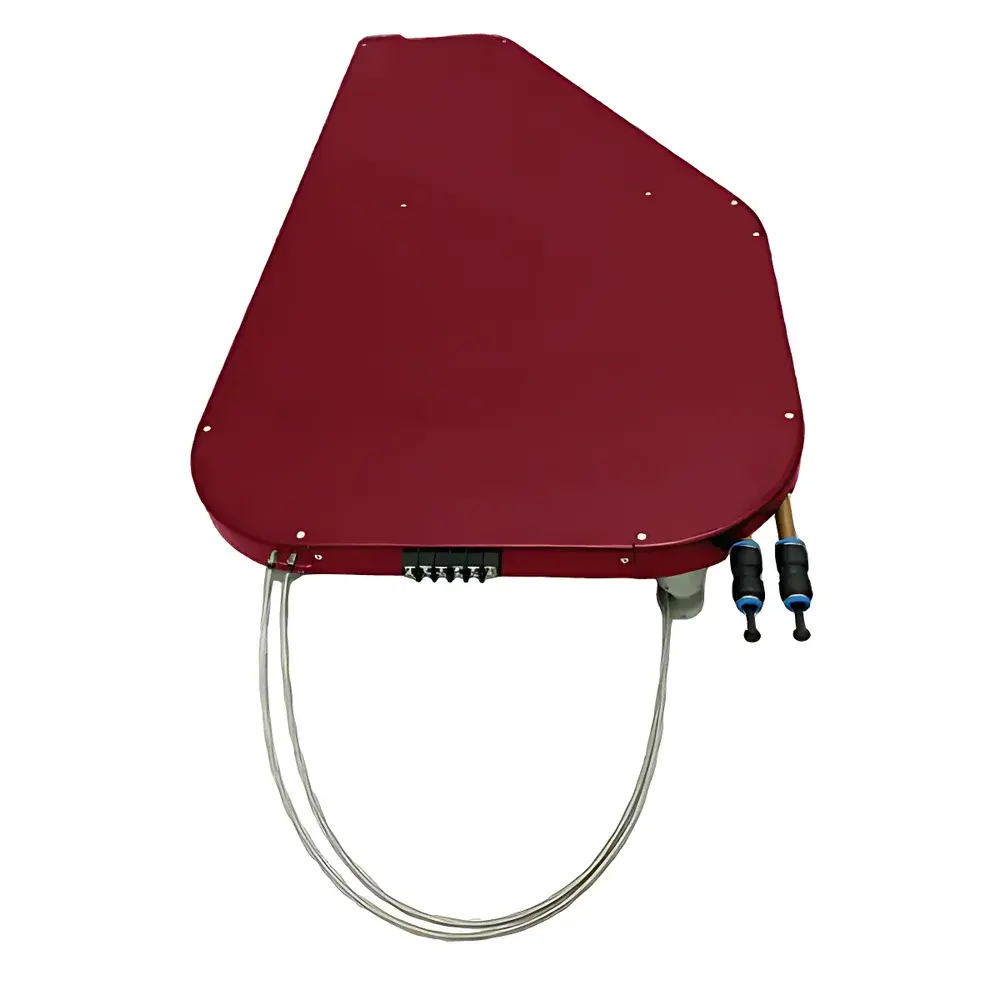
Auniontech 500W Picosecond Fiber Laser Amplifier
| Brand | Auniontech |
|---|---|
| Origin | Shanghai, China |
| Type | Scientific-grade picosecond fiber amplifier |
| Wavelength Range | 1030–1050 nm |
| Seed Input | 20–60 mW |
| Pump Wavelength | 976 nm or 915 nm |
| Pump Fiber | 200/220 µm, NA 0.22 |
| Output Power | Up to 500 W (at 50 ps, 20 MHz) |
| Gain Medium | Tapered Double-Clad Fiber (T-DCF), core ~92 µm, NA 0.08 |
| Beam Quality | M² < 1.4 |
| Packaging | Modular OEM-ready chassis |
| Compliance | Designed for lab integration and industrial OEM deployment |
Overview
The Auniontech 500W Picosecond Fiber Laser Amplifier is a high-average-power, all-fiber master oscillator power amplifier (MOPA) system engineered for demanding scientific and industrial applications requiring ultrashort pulse durations and exceptional beam fidelity. Operating in the 1030–1050 nm spectral window, the amplifier leverages a polarization-maintaining tapered double-clad fiber (T-DCF) with a large mode area (~92 µm core diameter, NA 0.08) to enable efficient, nonlinear-free power scaling while preserving picosecond temporal integrity and near-diffraction-limited beam quality (M² < 1.4). Unlike bulk-optic amplifiers, this fully fiber-integrated architecture eliminates free-space alignment, minimizes thermal lensing, and delivers long-term stability under continuous operation. The system accepts low-power seed input (20–60 mW) from an external mode-locked oscillator—typically a Yb-doped fiber laser—and amplifies it via forward-pumped, cladding-pumped configuration using 976 nm or 915 nm pump diodes delivered through standard 200/220 µm, NA 0.22 multimode pump fibers. Its modular, plug-and-play design allows seamless integration into custom laser systems, making it suitable for both benchtop research platforms and embedded industrial subsystems.
Key Features
- Polarization-maintaining large-mode-area tapered double-clad fiber gain medium (core Ø ≈ 92 µm, NA 0.08) optimized for high-energy picosecond pulse amplification
- Scalable output up to 500 W average power at repetition rates of 20 MHz and pulse widths of 50 ps
- High beam quality with M² < 1.4, enabling tight focusing for precision material interaction
- Modular OEM chassis with standardized fiber pigtails: FC/APC signal input, SMA or QBH-compatible pump input interfaces
- No active cooling required beyond standard conduction-cooled heatsinking—designed for ambient lab or factory-floor deployment
- Robust all-fiber construction with fusion-spliced internal connections, minimizing optical loss and environmental sensitivity
Sample Compatibility & Compliance
This amplifier is compatible with commercially available Yb-doped mode-locked oscillators emitting in the 1030–1050 nm range and delivering 20–60 mW average power at pulse durations ≤ 50 ps. It supports both 915 nm and 976 nm pump diode modules with 200/220 µm, NA 0.22 delivery fibers. While not certified to specific regulatory standards as a standalone component, the amplifier’s design adheres to fundamental safety and performance principles outlined in IEC 60825-1 (Laser Product Safety) and ISO 11554 (Laser Beam Parameters). Its stable, low-noise output enables compliance with GLP-aligned measurement protocols in materials science labs and satisfies key requirements for Class 4 laser system integration per ANSI Z136.1. As a core subsystem, it supports traceable calibration workflows when paired with NIST-traceable power meters and autocorrelators.
Software & Data Management
The amplifier operates as a hardware-only module without embedded firmware or user interface. System-level monitoring and control—including pump current regulation, temperature feedback, and interlock status—are implemented externally via analog voltage inputs (0–5 V or 0–10 V) and TTL-compatible digital signals. Integration with LabVIEW, Python (PyVISA), or MATLAB is straightforward using standard DAQ hardware. For traceable operation in regulated environments, users may implement audit trails by logging analog monitor outputs (e.g., photodiode feedback, thermistor readings) alongside pulse energy and repetition rate metadata. While the device itself does not provide FDA 21 CFR Part 11-compliant electronic records, its deterministic analog interface enables full compliance when embedded within validated host systems meeting GMP/GLP data integrity requirements.
Applications
- Precision micromachining of transparent dielectrics (e.g., fused silica, sapphire) and wide-bandgap semiconductors (GaN, SiC)
- High-throughput surface texturing and selective laser ablation for functionalized biomaterials and medical device substrates
- Optical parametric chirped-pulse amplification (OPCPA) front-end pumping and mid-IR generation via difference-frequency mixing
- Time-resolved spectroscopy setups requiring high-flux, transform-limited picosecond pulses
- OEM integration into industrial laser processing heads for automotive battery welding and display repair systems
- Secondary source development for ultrafast electron diffraction (UED) and X-ray free-electron laser (XFEL) synchronization experiments
FAQ
What seed laser specifications are required to drive this amplifier?
A mode-locked Yb-fiber oscillator delivering 20–60 mW average power, 1030–1050 nm center wavelength, pulse duration ≤ 50 ps, and repetition rate of 20 MHz is recommended. Higher-repetition-rate seeds (e.g., 40–80 MHz) may be used with appropriate gain saturation management.
Is water cooling required?
No—thermal management is achieved via passive conduction through the baseplate; forced air cooling is optional for extended duty cycles above 80% of rated power.
Can the amplifier be operated with variable repetition rates?
Yes, provided the seed laser supports repetition rate tuning and pump power is adjusted accordingly to maintain optimal small-signal gain and avoid SRS onset.
Does the output retain the polarization state of the seed?
Yes—the entire signal path is polarization-maintaining, ensuring >20 dB PER (polarization extinction ratio) at full output power.
What is the typical pulse energy and peak power at 500 W / 20 MHz / 50 ps?
Pulse energy ≈ 25 µJ; peak power ≈ 500 kW—values scale linearly with average power and inversely with pulse width and repetition rate.