
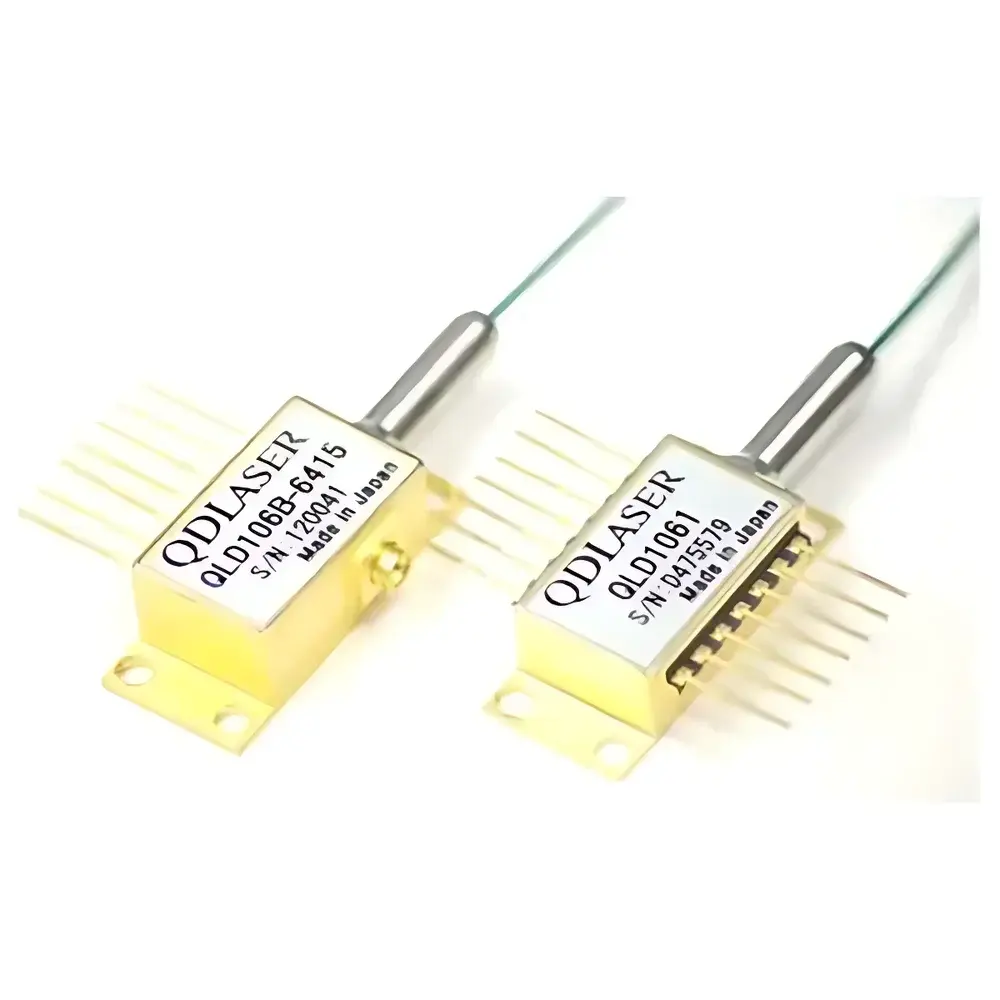
Auniontech 018-1188nm Wavelength-Selectable Ultra-Compact DFB Laser Module
| Brand | Auniontech |
|---|---|
| Origin | Shanghai, China |
| Type | Distributed Feedback (DFB) Laser Diode |
| Operation Mode | CW or Pulsed (ns/ps) |
| Wavelength Range | 1018–1188 nm (1 nm step, discrete selection) |
| Output Power | Up to 400 mW peak @ 1 ns pulse |
| Package | 14-pin butterfly or 7-pin SMPM (high-frequency compatible) |
| Compliance | RoHS-compliant |
| Customization | Single-wavelength configuration, driver integration options |
Overview
The Auniontech 018-1188nm Wavelength-Selectable Ultra-Compact DFB Laser Module is a precision-engineered semiconductor laser source designed for demanding applications requiring high spectral purity, narrow linewidth, and stable single-longitudinal-mode (SLM) emission. Based on distributed feedback (DFB) grating technology, this device delivers intrinsic wavelength stability without external cavity stabilization—making it ideal as a seed source in frequency-doubled (SHG) and frequency-tripled (THG) systems. Its emission range spans 1018–1188 nm in 1 nm increments, covering key industrial and scientific bands including 1030 nm (Yb-fiber amplifier pumping), 1053 nm (Nd:glass systems), 1064 nm (standard Nd:YAG fundamental), 1080 nm (high-power fiber laser seeding), 1120 nm (mid-IR pump cascades), and 1180–1188 nm (water absorption sensing windows). The module supports both continuous-wave (CW) and nanosecond/picosecond pulsed operation, with peak optical power up to 400 mW under 1 ns pulses—enabling efficient nonlinear conversion in bulk or waveguide-based harmonic generation stages.
Key Features
- Ultra-compact form factor optimized for integration into space-constrained OEM systems—including LiDAR transceivers, semiconductor inspection platforms, and micro-machining tooling.
- Wavelength-selectable architecture: discrete single-wavelength configuration across 1018–1122 nm and 1172–1188 nm ranges; no mode-hopping within operating temperature and current ranges.
- High side-mode suppression ratio (SMSR) >50 dB ensures clean SLM output essential for coherent detection and interferometric metrology.
- 14-pin butterfly or 7-pin SMPM packaging with integrated thermoelectric cooler (TEC) and monitor photodiode—designed for RF-compatible modulation up to several hundred MHz.
- Flexible drive interface supporting both analog current modulation (for direct intensity control) and TTL-triggered pulsing—enabling seamless integration with standard laser drivers and arbitrary waveform generators.
- Hermetically sealed housing with industry-standard footprint ensures long-term reliability under thermal cycling and mechanical vibration typical in industrial environments.
Sample Compatibility & Compliance
This DFB laser module is compatible with standard nonlinear optical crystals such as LBO, BBO, and KTP for second-harmonic generation (SHG) at 532 nm (from 1064 nm input) and third-harmonic generation (THG) at 355 nm. Its narrow linewidth (<2 MHz typical) and low relative intensity noise (RIN < −145 dB/Hz) meet the coherence requirements for high-efficiency intracavity and external-cavity frequency conversion. The device complies with RoHS Directive 2011/65/EU and meets IEC 60825-1:2014 Class 3B laser safety standards when operated within specified optical power limits. While not certified to ISO 13485 or FDA 21 CFR Part 11, its performance parameters are traceable to NIST-calibrated reference spectrometers and power meters—supporting GLP/GMP-aligned validation protocols in regulated R&D and manufacturing settings.
Software & Data Management
The module does not include embedded firmware or proprietary GUI software. Instead, it is designed for OEM integration with third-party laser controllers (e.g., ILX Lightwave LDC-3900 series, Thorlabs ITC4000) that support analog voltage/current control, temperature setpoint regulation, and real-time monitoring of photodiode feedback. All operational parameters—including drive current, TEC voltage, case temperature, and monitor diode output—are accessible via standard analog outputs or optional digital interfaces (I²C or RS-232 upon request). For automated test systems, the device supports SCPI-compliant command sets when paired with compatible driver electronics—facilitating audit-ready data logging, calibration history tracking, and version-controlled configuration management per ISO/IEC 17025 guidelines.
Applications
- Laser Seed Sources: Primary oscillator for MOPA fiber laser systems operating in the 1–1.2 µm band, where precise wavelength matching to gain fiber absorption peaks improves pump efficiency and beam quality.
- Time-of-Flight LiDAR: Nanosecond-pulsed operation enables sub-centimeter ranging resolution in autonomous vehicle and UAV-based topographic mapping systems.
- Semiconductor Metrology: Used in photoluminescence excitation (PLE) and deep-level transient spectroscopy (DLTS) setups targeting defect characterization in GaAs, InP, and SiC wafers.
- Gas Sensing: Targeted absorption spectroscopy of H2O, CO, and NH3 in the 1172–1188 nm window—leveraging high-resolution tunability and low-amplitude noise for ppm-level detection limits.
- Biophotonics Research: Pump source for optical parametric oscillators (OPOs) generating mid-infrared radiation (2–5 µm) used in label-free tissue imaging and vibrational spectroscopy.
FAQ
What is the typical spectral linewidth of this DFB laser?
The full-width-at-half-maximum (FWHM) linewidth is typically ≤2 MHz under CW operation at constant temperature and current—measured using delayed self-heterodyne interferometry.
Can the laser be modulated at GHz frequencies?
No—this DFB module is optimized for DC to ~300 MHz analog modulation bandwidth. For GHz-range direct modulation, an external Mach-Zehnder modulator is recommended.
Is wavelength calibration provided with each unit?
Yes—each shipped module includes a factory-measured wavelength certificate traceable to NIST standards, recorded at 25°C case temperature and nominal drive current.
What thermal management is required for continuous operation?
Active cooling via the integrated TEC is mandatory for stable wavelength and power output; ambient temperature must be maintained between 15–35°C, and heatsink thermal resistance should not exceed 0.5 K/W.
Are custom driver boards available?
Yes—Auniontech offers application-specific driver modules supporting TTL triggering, analog modulation, and closed-loop temperature/power control, subject to NRE and MOQ terms.




