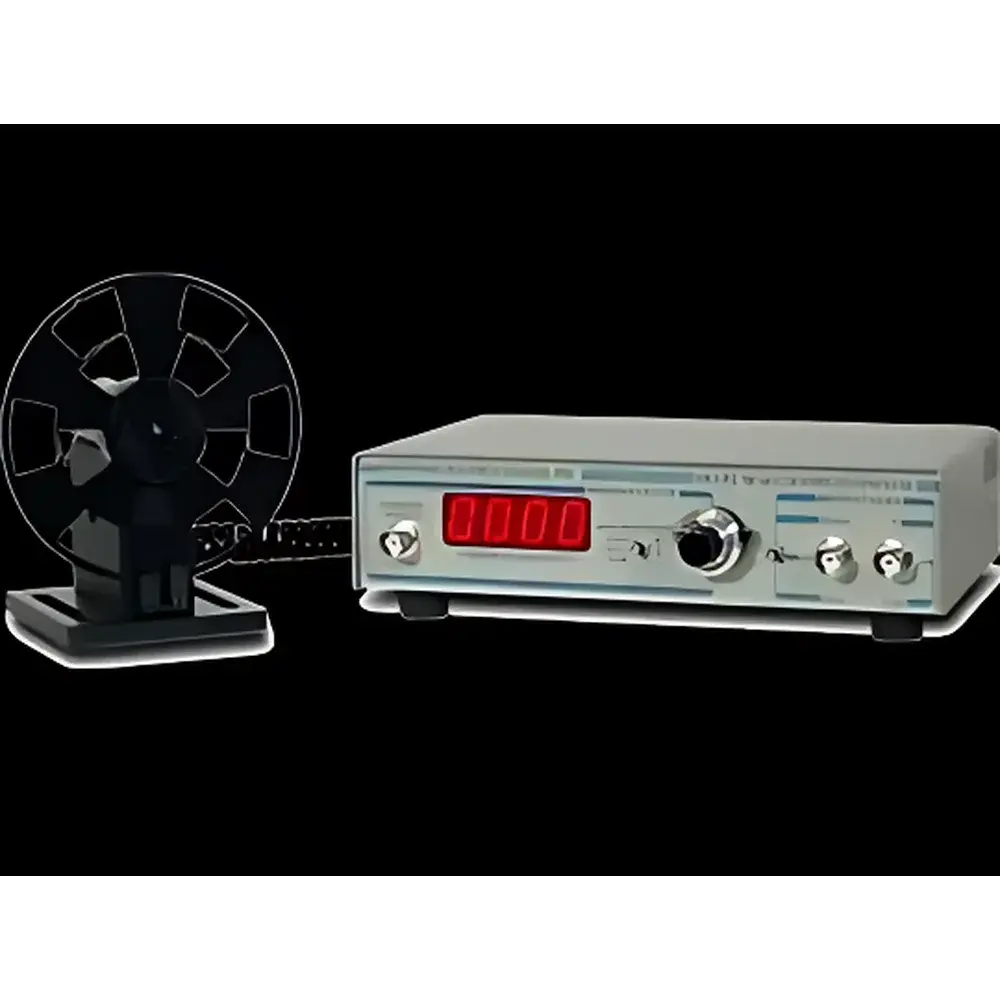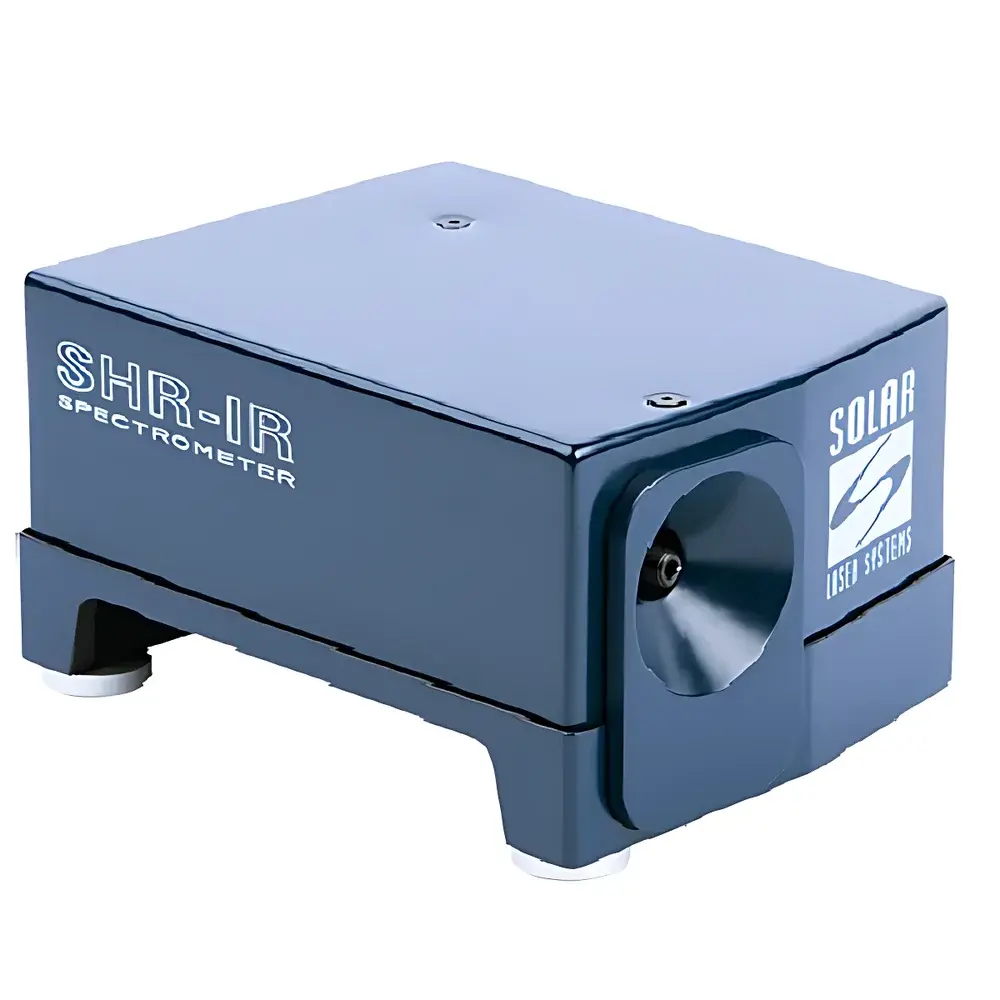
Auniontech SHR-IR Near-Infrared Laser Wavelength Meter & Spectrometer
| Brand | Auniontech |
|---|---|
| Model | SHR-IR |
| Wavelength Range | 600–1800 nm |
| Wavelength Accuracy | ±0.02 nm |
| Spectral Resolution (λ/Δλ, FWHM) | 4000 |
| Resolution Bandwidth | 0.15 nm @ 600 nm to 0.48 nm @ 1800 nm |
| Optical Architecture | Czerny-Turner |
| Focal Length | 150 mm |
| f-number | 1:12 |
| Input Interface | SMA-905 quartz multimode fiber (600 µm core, 1 m length) |
| Power & Control | USB 2.0 |
| Operating Modes | Continuous or Pulsed (externally triggered) |
| Weight | 1.2 kg |
| Dimensions (L×W×H) | 142 × 110 × 80 mm |
| Software | WLMeter |
Overview
The Auniontech SHR-IR is a compact, high-stability near-infrared laser wavelength meter and spectrometer engineered for precision metrology of continuous-wave (CW) and pulsed laser sources across the 600–1800 nm spectral range. Unlike scanning monochromators requiring mechanical grating movement, the SHR-IR employs a fixed-optics Czerny-Turner spectrometer architecture with no moving parts—enabling true real-time spectral acquisition without temporal delay or mechanical drift. Its design leverages an optimized 150 mm focal length optical bench and high-efficiency infrared-optimized diffraction grating, coupled with a thermoelectrically stabilized InGaAs or Si-based linear array detector (model-dependent), delivering calibrated wavelength accuracy of ±0.02 nm and spectral resolution defined by λ/Δλ = 4000 (FWHM). This resolution translates to 0.15 nm at 600 nm and 0.48 nm at 1800 nm—sufficient to resolve narrow-linewidth semiconductor lasers, fiber lasers, and diode-pumped solid-state (DPSS) sources in R&D, production test, and system alignment workflows.
Key Features
- Fixed-optics Czerny-Turner monochromator with zero moving components—ensuring long-term mechanical stability and immunity to vibration-induced misalignment
- Real-time spectral acquisition at frame rates up to 10 Hz (software-configurable), enabling dynamic monitoring of wavelength drift, mode hopping, or linewidth broadening during laser warm-up or modulation
- Integrated spectral analysis engine for simultaneous extraction of center wavelength, full-width-at-half-maximum (FWHM) linewidth, peak intensity, and spectral shape metrics
- USB 2.0 interface providing both power and bidirectional communication—no external power supply or controller required
- Optimized input coupling via SMA-905 connector and included 600 µm core multimode quartz fiber with integrated diffuser attenuator for safe, low-noise measurement of high-power lasers
- Factory-calibrated wavelength scale traceable to NIST-traceable reference lines; no user calibration needed under standard operating conditions
- Compact footprint (142 × 110 × 80 mm) and lightweight (1.2 kg) design suitable for integration into optical tables, OEM modules, or portable field test stations
Sample Compatibility & Compliance
The SHR-IR supports direct free-space or fiber-coupled input from CW lasers, Q-switched or mode-locked pulsed lasers (with external TTL trigger synchronization), laser diodes, superluminescent LEDs (SLEDs), and broadband NIR sources with spectral radiance exceeding 1 µW/nm. It accommodates input power levels from 10 nW to 50 mW (with optional attenuation), provided the source linewidth does not exceed 3125 cm⁻¹ (equivalent to ~4 nm at 600 nm and ~40 nm at 1800 nm) to maintain spectral fidelity. The instrument complies with IEC 61326-1:2013 for electromagnetic compatibility (EMC) and IEC 61010-1:2010 for electrical safety. While not certified for use in regulated GMP environments out-of-the-box, its deterministic data acquisition, timestamped spectra, and software audit log functionality in WLMeter support alignment with GLP and FDA 21 CFR Part 11 requirements when deployed with appropriate procedural controls.
Software & Data Management
The SHR-IR is operated exclusively via the WLMeter application—a native Windows platform tool supporting x64 architecture and .NET Framework 4.8. WLMeter provides live spectral visualization, multi-cursor wavelength/linewidth annotation, batch export of spectra in CSV, TXT, and HDF5 formats, and programmable API access via COM interface for integration into LabVIEW, MATLAB, or Python-based automated test systems (e.g., using PyWin32 or win32com). All acquired spectra include embedded metadata: acquisition timestamp (UTC), exposure time, trigger status, fiber coupling status, and hardware serial number. Raw detector frames are accessible for advanced users performing custom line-shape fitting or background subtraction. Exported data files retain full traceability for quality documentation and internal audit purposes.
Applications
- Wavelength stabilization feedback loop verification for tunable external cavity diode lasers (ECDLs) and distributed feedback (DFB) lasers
- Linewidth validation of narrow-linewidth fiber lasers used in coherent LIDAR, optical sensing, and quantum optics experiments
- Routine QC testing of laser diode bars and single-emitter devices during wafer-level and package-level burn-in
- Characterization of supercontinuum sources and OCT broadband light engines in the NIR window
- Alignment and commissioning of NIR spectroscopy systems, including FT-NIR and dispersive NIR setups
- Academic and industrial research involving ultrafast laser pulse characterization where central wavelength and chirp estimation are critical
FAQ
What laser types are compatible with the SHR-IR?
CW lasers, nanosecond-pulsed lasers (with external TTL trigger), picosecond and femtosecond sources (when averaged over multiple pulses), laser diodes, VCSELs, and fiber lasers emitting between 600 nm and 1800 nm.
Does the SHR-IR require periodic recalibration?
No. The instrument is factory calibrated against primary spectral standards and maintains calibration stability under ambient temperature variations of ±5 °C. Recalibration is only recommended after physical shock or extended operation outside specified environmental limits (15–30 °C, <70% RH non-condensing).
Can the SHR-IR measure absolute optical power?
No. It is a relative-intensity spectrometer—not a calibrated radiometer. Absolute power measurement requires integration with a NIST-traceable power meter.
Is fiber input mandatory?
No. Free-space input is supported via the front-panel slit, though fiber coupling is strongly recommended for reproducible alignment, beam conditioning, and operator safety when measuring collimated high-power beams.
How is spectral resolution defined for the SHR-IR?
Resolution is specified as λ/Δλ = 4000 (FWHM), consistent with ISO 14644-1 and ASTM E275-20 definitions. Measured Δλ values are 0.15 nm at 600 nm and 0.48 nm at 1800 nm, verified using low-pressure gas discharge lamps (e.g., Ne, Ar) and stabilized HeNe lasers.