
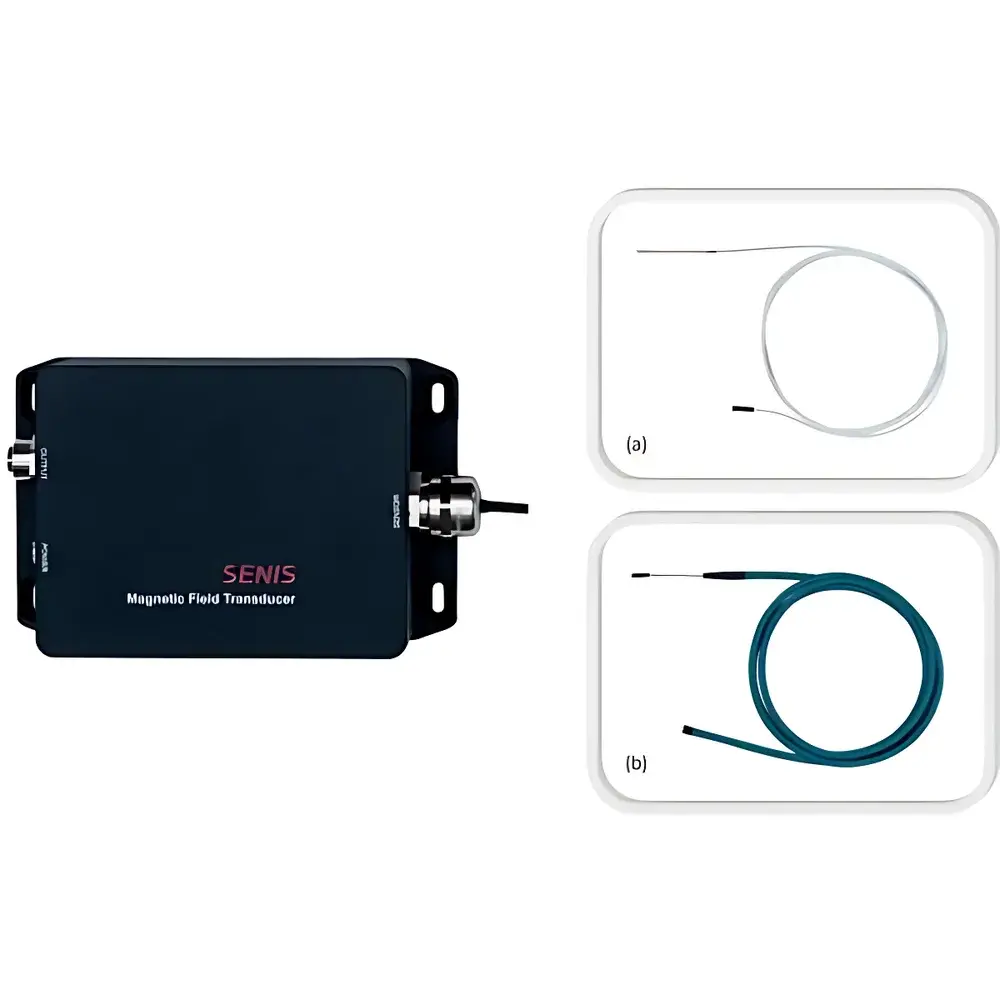
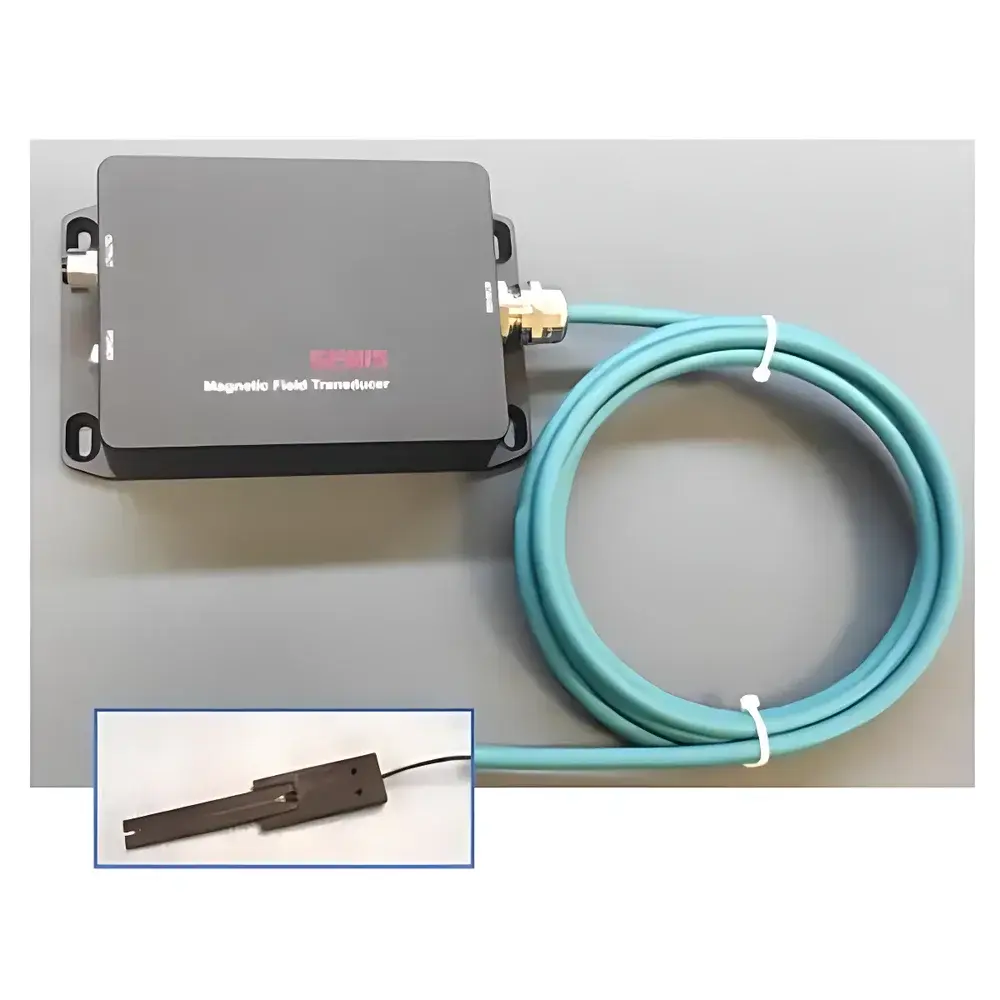
Auniontech F3A/F3B Integrated 3-Axis Analog Hall Effect Gaussmeter System
| Brand | Auniontech |
|---|---|
| Origin | Shanghai, China |
| Model | F3A (Sensor Module H + Control Module E) / F3B (Complete Analog Gaussmeter System) |
| Sensor Type | Monolithic CMOS Triaxial Hall Probe |
| Output | Differential Voltage per Axis (Bx, By, Bz) + Temperature-Sensed Voltage |
| Bandwidth | DC to 25 kHz (–3 dB) |
| Orthogonality Error | < ±1° |
| Angular Accuracy | < 0.1° |
| Spatial Resolution (Type A) | 0.03 × 0.005 × 0.03 mm³ |
| Operating Temperature Range (Type C) | –40 °C to +155 °C |
| Probe-to-Tip Distance (Type A) | 1.0 ± 0.1 mm |
| Probe-to-Tip Distance (Type C) | 0.45 ± 0.05 mm |
| Hall Element Area | 150 × 150 µm² |
Overview
The Auniontech F3A/F3B is a precision-engineered analog magnetic field measurement system designed for high-fidelity, real-time vector magnetometry in research laboratories, industrial R&D, and production environments. Unlike conventional three-sensor triaxial gaussmeters—where discrete Hall elements are physically separated and mounted orthogonally on a shared substrate—the F3A/F3B employs a monolithic CMOS-integrated triaxial Hall probe. This architecture places all three orthogonal Hall sensing elements (Bx, By, Bz) on a single silicon die with sub-150 µm² active area per element, ensuring true point-like spatial resolution and eliminating vector reconstruction error caused by positional offset between axes. The system operates on the principle of planar and vertical Hall effect detection within a single semiconductor structure, enabling simultaneous, phase-coherent acquisition of all three magnetic flux density components at a single geometric point. Its analog output architecture—delivering differential voltage signals proportional to B-field magnitude per axis—ensures minimal latency, no quantization noise, and compatibility with high-speed data acquisition systems requiring deterministic timing (e.g., lock-in amplifiers, oscilloscopes, or custom DAQ hardware). The integrated on-chip temperature sensor provides continuous thermal feedback for real-time gain and offset compensation, critical for maintaining stability across ambient and operational thermal gradients.
Key Features
- Monolithic CMOS triaxial Hall probe with co-located Bx, By, and Bz sensing elements—eliminates inter-axis positional uncertainty inherent in hybrid probe assemblies.
- Ultra-high angular accuracy: orthogonality error < ±1°; calibrated angular deviation < 0.1°—validated per ISO/IEC 17025-accredited procedures.
- Differential analog voltage output per axis (±5 V full scale typical), plus dedicated temperature-sensing output (10 mV/°C)—enabling direct interfacing with industrial PLCs, analog oscilloscopes, and legacy DAQ systems without digitization overhead.
- DC–25 kHz bandwidth (–3 dB), supporting dynamic field characterization including pulsed magnets, rotating machinery harmonics, and transient coil excitation waveforms.
- Five interchangeable probe variants (Types A, C, H, K, L) optimized for mechanical integration: from ruggedized surface-mount (Type A) to ultra-thin high-temperature (Type C, up to +155 °C) and ultra-miniature micro-probes (Type L, cross-section 0.64 × 0.28 mm).
- Negligible parasitic inductance and capacitive coupling on probe head—essential for high-frequency fidelity and immunity to EMI in electric motor and power electronics test benches.
Sample Compatibility & Compliance
The F3A/F3B system is compatible with static and time-varying magnetic fields generated by permanent magnets, electromagnets, solenoids, current-carrying conductors, and rotating electrical machines. Its compact, non-magnetic probe housings (stainless steel or ceramic, depending on variant) ensure minimal field distortion during near-field mapping. All probe types comply with IEC 61000-4-3 (radiated immunity) and IEC 61000-4-6 (conducted immunity) standards for electromagnetic compatibility in industrial settings. While the F3A sensor module (H+E) is intended for OEM integration into custom instrumentation, the F3B configuration—as a complete analog gaussmeter—supports traceable calibration against NIST-traceable reference magnetometers. Calibration certificates include uncertainty budgets per ISO/IEC 17025 requirements, covering linearity (< ±0.25% FS), temperature drift (< ±50 ppm/°C), and zero-point stability (< 10 nT/h at 23 °C).
Software & Data Management
The F3A/F3B is fundamentally an analog signal source; it does not include embedded firmware, USB connectivity, or proprietary software. This design philosophy prioritizes signal integrity, determinism, and long-term interoperability. Users integrate the system using standard analog interfaces: BNC or LEMO connectors for differential B-field outputs, and a separate analog channel for temperature monitoring. For digital acquisition, the system is fully compatible with third-party platforms compliant with IEEE 1057 (digitizer specifications) and adhering to FDA 21 CFR Part 11 requirements when used in regulated environments (e.g., medical device magnet testing). When paired with validated DAQ hardware (e.g., National Instruments PXIe-4309 or Keysight 34972A), the full measurement chain—including analog signal conditioning, digitization, timestamping, and audit-trail logging—can be configured to meet GLP and GMP documentation requirements. Auniontech provides detailed pinout schematics, voltage-to-field conversion coefficients, and temperature compensation polynomials in its technical documentation suite.
Applications
- Characterization and QC of NdFeB, SmCo, and ferrite permanent magnets—including remanence mapping, gradient analysis, and dipole moment verification.
- Development and validation of magnetic circuits in electric motors, generators, actuators, and magnetic bearings—especially for torque ripple analysis and air-gap field uniformity assessment.
- High-resolution 2D/3D magnetic field mapping of PCB traces, wireless charging coils, and MRI shimming arrays using automated XYZ stages.
- In-line monitoring of magnetization processes in production lines (e.g., multi-pole rotor magnetization verification).
- Fundamental physics experiments involving time-varying fields, eddy current imaging, and spintronic device characterization where sub-microsecond temporal resolution is required.
FAQ
Is the F3A/F3B compatible with existing data acquisition systems?
Yes—its differential analog voltage outputs conform to industry-standard ±5 V or ±10 V full-scale ranges and are impedance-matched for connection to any high-impedance (>10 kΩ) analog input channel.
Does the system require external power or biasing?
Yes—the control module (E) requires a stable ±15 V DC dual-rail supply; power consumption is ≤150 mW per channel.
Can the probe be calibrated independently of the control module?
No—calibration is performed as a matched pair (probe H + module E) due to tight gain and offset coupling between on-die amplifiers and sensor elements.
What is the maximum measurable field range?
Field range is determined by the selected probe variant and external signal conditioning; standard configurations support ±300 mT (Type A) to ±2 T (custom high-range variants), with linearity maintained across full scale.
Are calibration certificates provided with each unit?
Yes—each shipped F3B system includes a factory calibration report traceable to national metrology institutes, with documented uncertainty, environmental conditions, and verification points per axis.



