
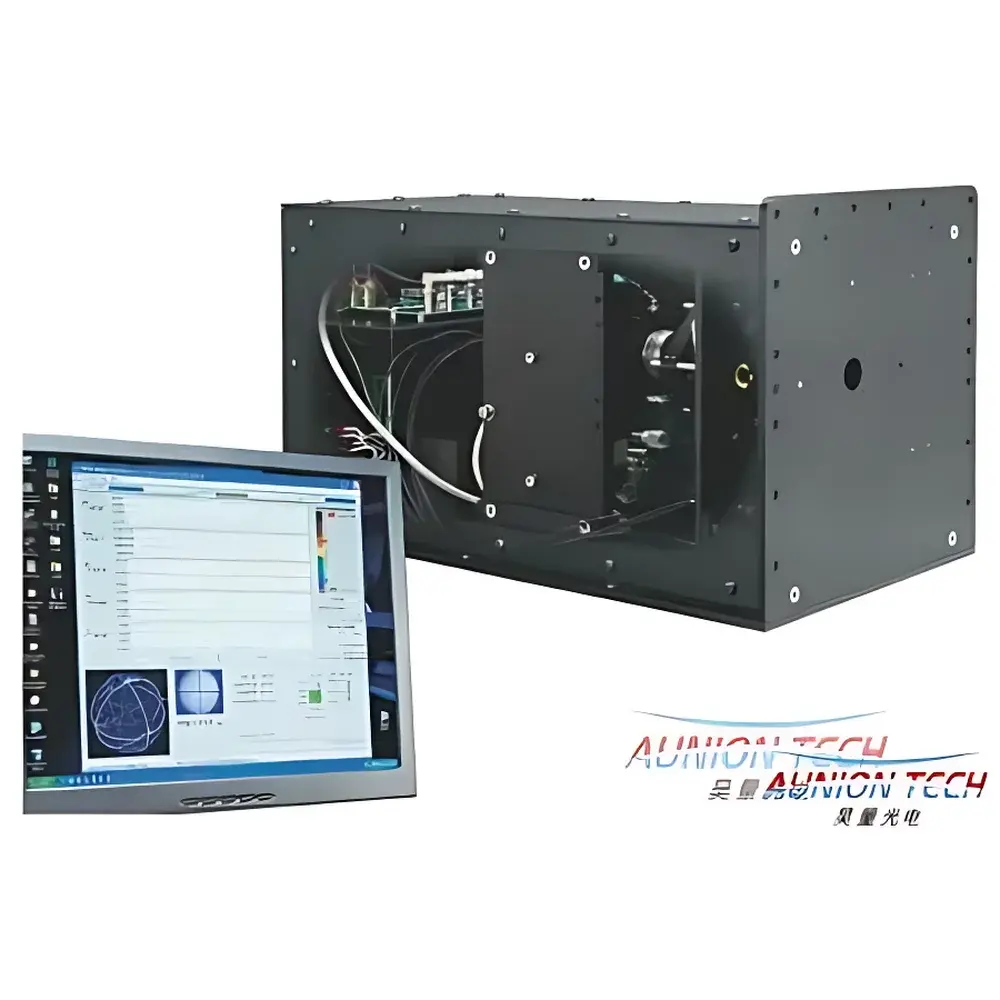
Hinds Instruments PEM-1000 High-Precision Stokes Polarimetry System
| Brand | Hinds Instruments |
|---|---|
| Origin | USA |
| Model | PEM-1000 |
| Wavelength Range | 400–700 nm (expandable to 130 nm – 18 µm) |
| Stokes Parameter Accuracy | <1% |
| Stokes Parameter Sensitivity | 0.0001 |
| Measurement Rate | up to 100 complete Stokes vector sets per second (400 individual Stokes parameter values) |
| Detector Sensitivity | sub-pW optical power detection |
| Compliance | Designed for ISO/IEC 17025-aligned optical metrology labs |
Overview
The Hinds Instruments PEM-1000 High-Precision Stokes Polarimetry System is a research-grade, photoelastic modulator (PEM)-based polarimeter engineered for absolute, real-time measurement of the full four-element Stokes vector (S₀, S₁, S₂, S₃). Unlike conventional rotating-waveplate or liquid-crystal-based polarimeters, the PEM-1000 leverages resonant electro-optic modulation at precisely controlled frequencies (typically 50 kHz), enabling phase-sensitive synchronous detection with exceptional common-mode noise rejection. This architecture delivers intrinsic immunity to intensity fluctuations and thermal drift—critical for long-duration measurements in vacuum chambers, cryogenic environments, or high-stability laser systems. The system operates natively across the visible spectrum (400–700 nm) and supports modular spectral extension—from deep ultraviolet (130 nm, requiring MgF₂ optics and solar-blind detectors) through near-infrared (NIR) to mid- and far-infrared (up to 18 µm, using ZnSe or KRS-5 PEM elements and DTGS or MCT detectors). Its fundamental design adheres to first-principles radiometric traceability, making it suitable for primary calibration laboratories and national metrology institutes.
Key Features
- Photoelastic modulator (PEM) core with thermally stabilized resonant drive electronics ensuring <±0.005% frequency stability over 8-hour continuous operation
- Stokes parameter sensitivity of 0.0001 (1×10⁻⁴)—enabling detection of minute polarization perturbations induced by sub-nanometer thin films or weak magneto-optic effects
- Measurement throughput of up to 100 full Stokes vectors per second (400 scalar outputs), synchronized to external triggers via TTL/USB-C timing interface
- Modular optical head design supporting free-space, fiber-pigtailed (FC/APC, SMA905), or vacuum-compatible (CF-63 flange) configurations
- Integrated reference photodiode with NIST-traceable responsivity calibration for absolute irradiance normalization of S₀
- Real-time dual-channel lock-in acquisition with 120 dB dynamic range and 24-bit ADC resolution per channel
Sample Compatibility & Compliance
The PEM-1000 accommodates diverse sample geometries—including bulk optics, coated substrates, anisotropic crystals, fiber pigtails, and beam-delivered synchrotron radiation—without mechanical reconfiguration. It meets the optical alignment and stability requirements defined in ASTM E275 for spectrophotometric polarization characterization and supports compliance workflows aligned with ISO/IEC 17025:2017 Clause 6.4.1 (Equipment Verification) and Clause 7.7 (Uncertainty of Measurement). When deployed in regulated environments (e.g., semiconductor process control or aerospace optical testing), the system’s firmware logs all calibration events, detector gain settings, and PEM amplitude corrections with timestamped audit trails—facilitating GLP/GMP documentation and FDA 21 CFR Part 11 electronic record readiness when paired with validated LIMS integration.
Software & Data Management
Control and analysis are performed via Hinds’ PolarSoft™ v5.2—a platform-independent application built on Qt and Python 3.11, with native support for Windows 10/11, Linux (RHEL 8+, Ubuntu 22.04 LTS), and macOS 13+. PolarSoft provides real-time Stokes vector visualization (Poincaré sphere projection, Mueller matrix inversion, degree-of-polarization mapping), batch processing of time-series datasets (CSV/HDF5 export), and scripting interfaces (Python API, MATLAB COM wrapper). All raw lock-in quadrature data (X, Y, R, θ) and derived Stokes parameters are stored with embedded metadata: wavelength, PEM amplitude/voltage, detector bias, ambient temperature/humidity (via optional environmental sensor module), and user-defined sample ID. Data files conform to the HDF5-based PolarData Standard v1.3, ensuring interoperability with third-party tools such as Python’s SciPy, MATLAB’s Optics Toolbox, and LabVIEW-based test automation frameworks.
Applications
- Thin-film metrology: Quantification of birefringence, dichroism, and depolarization in multilayer dielectric stacks used in EUV lithography masks and AR/HR coatings
- Material science: In-situ monitoring of stress-induced birefringence during thermal cycling or mechanical loading of polymers, glasses, and composite laminates
- Quantum optics: Characterization of polarization entanglement fidelity and decoherence dynamics in photon-pair sources and integrated photonic circuits
- Astronomical instrumentation: Calibration of polarization modulators and retarders in ground-based solar telescopes (e.g., DKIST) and space-borne coronagraphs
- Fiber-optic sensing: Detection of distributed polarization mode dispersion (PMD) and twist-induced circular birefringence in specialty fibers under strain or temperature gradients
- Biomedical optics: Quantitative assessment of collagen fiber orientation and structural anisotropy in ex vivo tissue sections via Mueller matrix decomposition
FAQ
What wavelength ranges require hardware modification?
Deep-UV (130–200 nm) and mid-to-far-IR (3–18 µm) configurations necessitate PEM crystal substitution (CaF₂ or MgF₂ for UV; ZnSe or CdTe for IR), antireflection-coated optics, and detector upgrades—available as factory-installed options with full spectral calibration certificates.
Can the PEM-1000 measure time-varying polarization states at microsecond resolution?
While the base system acquires full Stokes vectors at ≤10 ms intervals (100 Hz), its analog front-end supports external high-speed digitization (up to 1 MS/s) for transient event capture—provided users supply compatible DAQ hardware and implement custom synchronization logic.
Is Mueller matrix reconstruction supported in real time?
Yes—PolarSoft includes a real-time Mueller matrix calculator for samples under sequential polarization state modulation, with options for linear least-squares or maximum-likelihood estimation based on instrument-specific error models.
How is calibration traceability maintained across spectral modules?
Each PEM head and detector assembly ships with a NIST-traceable calibration report covering wavelength-dependent retardance, extinction ratio, and responsivity—updated annually via Hinds’ Certified Recalibration Service (CRS-PEM).





