
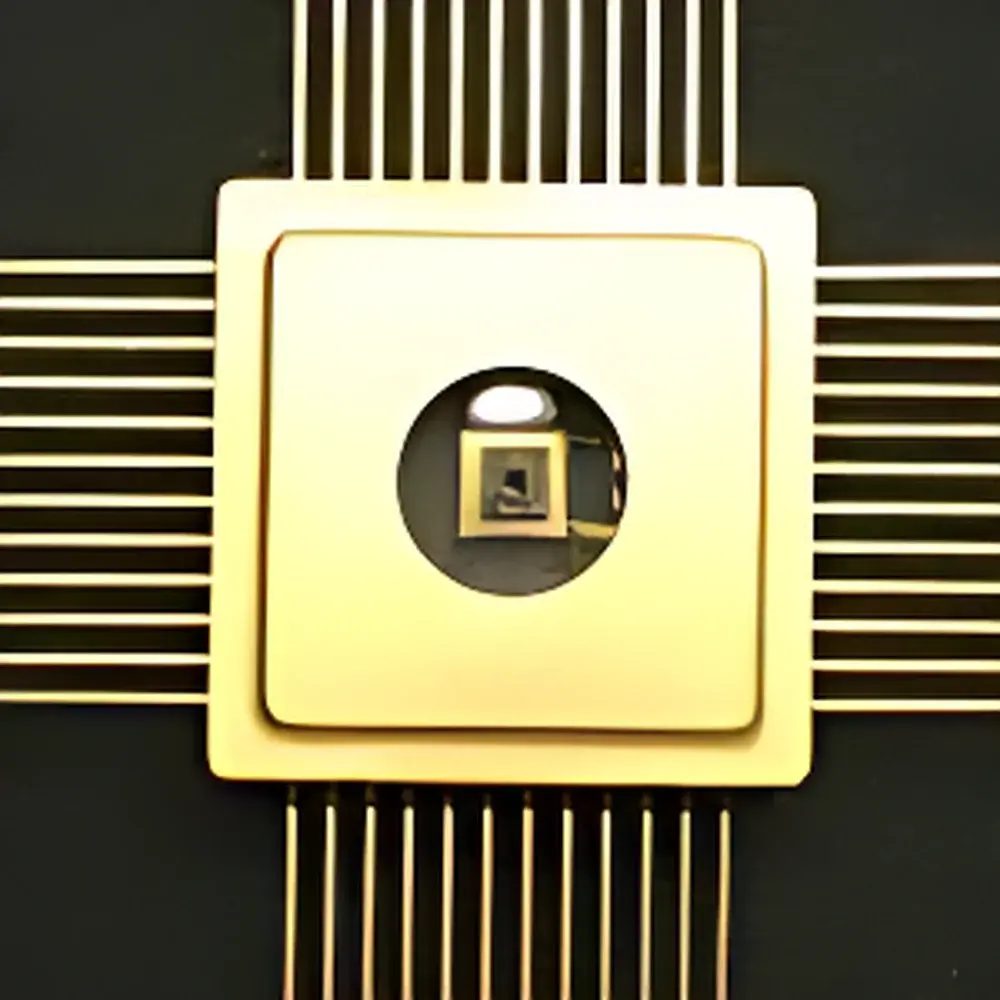
Auniontech DAPD-1550 5×5 InGaAs Discrete Amplification Photon Detector Array
| Brand | Auniontech |
|---|---|
| Origin | Shanghai, China |
| Model | DAPD-1550 Series |
| Spectral Range | 950–1650 nm |
| Pixel Pitch | 100 µm |
| Active Area per Pixel | 90 × 90 µm² |
| Total Pixels | 25 |
| Photon Detection Efficiency (PDE) @ 1064 nm | 115% |
| Gain (M) | 1 × 10⁵ |
| Excess Noise Factor | < 1.05 |
| Rise Time (10–90%) | < 600 ps |
| Dark Count Rate (per pixel) | 4 MHz |
| Operating Bias Voltage | 50–70 V |
| Recovery Time (per channel, at −35 °C) | 50 ns |
| Package | Hermetic KOVAR with Dual-Stage TEC and Thermistor |
| Operating Junction Temperature | −50 °C |
| Damage Threshold | 0.5 nJ |
| Single-Photon Output Compatibility | 50 Ω RF-coupled, no transimpedance matching required |
Overview
The Auniontech DAPD-1550 5×5 InGaAs Discrete Amplification Photon Detector Array is a high-performance, thermoelectrically cooled photodetector module engineered for single-photon detection in the near-infrared (NIR) spectrum. Based on discrete amplification architecture—distinct from conventional analog or digital avalanche photodiode (APD) arrays—the DAPD-1550 integrates monolithic negative-feedback avalanche gain stages across each of its 25 independent In0.47Ga0.53As pixels. This design enables deterministic internal signal amplification prior to readout, delivering stable gain (~1 × 10⁵), sub-1.05 excess noise factor, and sub-nanosecond temporal response. Unlike gated or free-running Geiger-mode SPADs, the DAPD operates in linear analog mode under constant reverse bias, supporting both pulsed (0.5–20 ns pulse width) and continuous-wave detection regimes without quenching circuitry. Its spectral coverage (950–1650 nm) aligns with key telecom and eye-safe LIDAR wavelengths—including 1064 nm, 1310 nm, and 1550 nm—making it suitable for time-resolved photon counting, time-of-flight (ToF) measurement, and low-flux spectroscopic applications requiring high dynamic range and minimal afterpulsing.
Key Features
- 25-pixel 5×5 array with individual anode access and shared cathode configuration—enabling flexible readout topologies (e.g., quadrant grouping, full-array summation, or pixel-wise acquisition)
- Hermetically sealed KOVAR package incorporating a low-power dual-stage thermoelectric cooler (TEC) and integrated thermistor for precise junction temperature control down to −50 °C
- High photon detection efficiency (115% @ 1064 nm), including contribution from afterpulsing—validated under standardized cryogenic bias conditions
- Rise time < 600 ps (10–90%) and channel recovery time of 50 ns at −35 °C—optimized for high-repetition-rate (up to 50 MHz) pulsed laser systems
- 50 Ω RF-compatible output impedance—eliminates need for transimpedance amplification and simplifies integration with commercial digitizers, oscilloscopes, and FPGA-based time-correlated single-photon counting (TCSPC) platforms
- Stable bias voltage operation (50–70 V) with low dark count rate (4 MHz/pixel) and negligible gain drift over extended thermal cycling
Sample Compatibility & Compliance
The DAPD-1550 array is compatible with standard NIR optical interfaces, including fiber-pigtailed coupling (FC/PC or FC/APC), free-space collimated beam illumination, and lensed configurations using anti-reflection coated optics. Each pixel’s 90 × 90 µm² active area supports spatially resolved detection while maintaining high fill factor within the 100 µm pitch layout. The device complies with JEDEC J-STD-020 moisture sensitivity level (MSL) 3 specifications for surface-mount handling and meets MIL-STD-883 mechanical shock and vibration requirements when mounted per datasheet guidelines. While not certified to ISO/IEC 17025 calibration standards out-of-box, the detector’s linearity, PDE traceability, and thermal stability support GLP-compliant validation protocols when integrated into qualified measurement systems. It is routinely deployed in R&D environments aligned with IEEE 1789-2015 (flicker safety), IEC 60825-1:2014 (laser product safety), and ASTM E2912-22 (LIDAR system performance testing) frameworks.
Software & Data Management
The DAPD-1550 operates as a hardware-agnostic analog front-end: raw outputs are compatible with any digitization platform supporting DC-coupled 50 Ω inputs and ≥1 GS/s sampling. Auniontech provides reference LabVIEW and Python SDKs—including timing synchronization templates for multi-channel TCSPC—and application notes for integration with National Instruments PXIe digitizers, Keysight U5303A, or SPAD-focused platforms such as Becker & Hickl SPC-150NX. All firmware-independent acquisition workflows support audit-trail logging, timestamped metadata embedding (temperature, bias voltage, ambient pressure), and HDF5-formatted export—facilitating compliance with FDA 21 CFR Part 11 requirements when used in regulated analytical instrumentation. No proprietary drivers or closed firmware are required; detector bias and TEC setpoints are controlled via external precision voltage sources and PID controllers.
Applications
- Eye-safe 1550 nm LIDAR receivers for autonomous vehicle perception, UAV-based topographic mapping, and atmospheric aerosol profiling
- Time-resolved fluorescence lifetime imaging (FLIM) and upconversion luminescence detection in biological tissue studies
- Quantum optics experiments requiring spatially multiplexed NIR single-photon discrimination—e.g., entanglement verification, boson sampling, and quantum key distribution (QKD) receiver modules
- Low-light spectroscopy in process analytical technology (PAT), including NIR absorption monitoring of pharmaceutical granules or polymer melt dynamics
- Pulsed laser scatterometry for semiconductor wafer defect inspection and thin-film thickness metrology
- Multi-pixel coincidence counting in positron emission tomography (PET) prototype development and scintillation light readout
FAQ
What is the difference between DAPD and conventional InGaAs APD arrays?
DAPD employs monolithic discrete amplification per pixel—separate gain stages with integrated negative feedback—whereas standard APD arrays rely on global bias-controlled avalanche multiplication. This yields superior gain uniformity, lower excess noise, and intrinsic RF compatibility without external amplifiers.
Can the DAPD-1550 be operated above −40 °C ambient?
Yes—the dual-stage TEC maintains the chip at −50 °C even in +40 °C ambient, though maximum cooling capacity decreases above 35 °C ambient; derating curves are provided in the thermal management appendix.
Is photon detection efficiency (PDE) measured with afterpulsing included?
Yes—PDE values reported (e.g., 115% @ 1064 nm) include statistically weighted afterpulse contributions per IEC 61314:2021 Annex B methodology.
Does the detector require gating or external quenching circuitry?
No—it operates continuously under constant bias and does not utilize active quenching; its discrete amplification architecture inherently suppresses runaway avalanche propagation.
How is pixel crosstalk characterized in the 5×5 layout?
Optical and electrical crosstalk are both < 0.8% at full-scale output, measured via focused spot scanning and adjacent-pixel injection tests per ISO 15739:2013 Annex F.





