
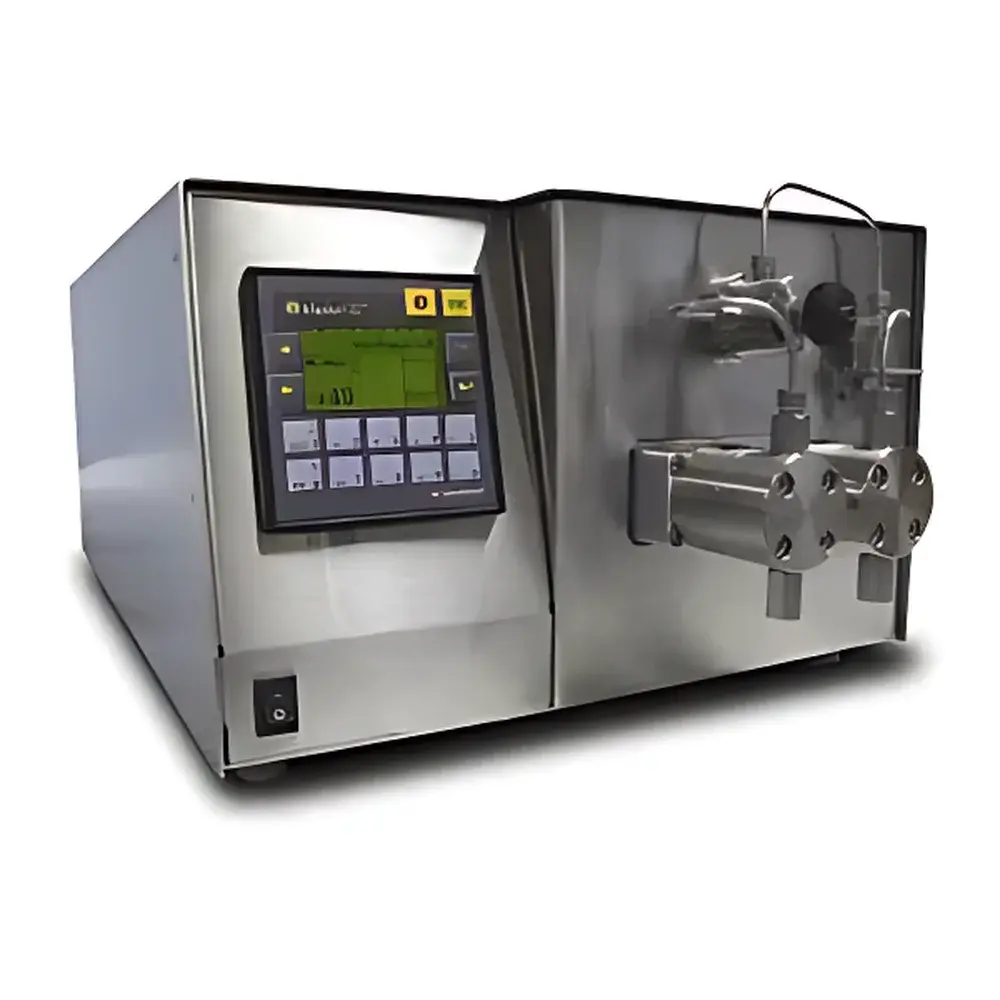
CoMetro CP 300 High-Pressure Preparative Pump
| Brand | CoMetro |
|---|---|
| Model | CP 300 |
| Flow Rate | 0.1–300 mL/min |
| Maximum Pressure | 10,000 psi (constant pressure mode), 8,500 psi (constant flow mode) |
| Flow Accuracy | ±5% of set point (≥5 mL/min, 1,000 psi, 80:20 water/IPA) |
| Flow Reproducibility | 0.5% RSD |
| Pulsation | ≤±5.0% @ 150 mL/min, 3,000 psi, 80:20 water/IPA |
| Piston Displacement | 452 µL |
| Wetted Materials | 316 Stainless Steel, Alumina, Zirconia, UHMWPE, PTFE, PEEK |
| Dimensions | 228 × 356 × 559 mm (W × H × D) |
| Weight | 22.7 kg |
| Power Supply | 100–240 VAC, 50–60 Hz, 700 W |
| Communication Interface | RS-232, TTL Run/Stop |
| Operating Temperature | 0–82 °C (liquid), 10–30 °C (ambient) |
| Humidity | 20–90% RH |
| Altitude Limit | ≤2000 m |
Overview
The CoMetro CP 300 High-Pressure Preparative Pump is an engineered solution for demanding liquid delivery applications in preparative chromatography, high-pressure synthesis, solvent extraction, and continuous-flow reaction systems. Designed around dual-head positive displacement plunger technology, the CP 300 delivers precise, pulse-dampened fluid transport under sustained high pressure—up to 10,000 psi in constant-pressure mode and 8,500 psi in constant-flow mode. Its dual-piston architecture enables uninterrupted operation through alternating stroke cycles, minimizing flow interruption and supporting extended run times without manual intervention. The pump’s core architecture integrates a self-flushing piston head design, eliminating the need for auxiliary wash systems while maintaining long-term seal integrity and reducing maintenance frequency. Unlike peristaltic or diaphragm-based alternatives, the CP 300 employs rigid ceramic- and metal-wetted components—including zirconia and alumina pump heads, 316 stainless steel fluid paths, and chemically inert PEEK, PTFE, and UHMWPE seals—to ensure compatibility with aggressive solvents (e.g., THF, chlorinated hydrocarbons, strong acids/bases) and elevated temperatures up to 82 °C.
Key Features
- Dual-plunger synchronized drive system enabling true continuous flow with ≤±5.0% pulsation at 150 mL/min and 3,000 psi (tested with 80:20 water/IPA)
- Full front-panel control via backlit LCD display and numeric keypad: real-time monitoring of flow rate, system pressure, alarm status, and parameter configuration
- Comprehensive operational flexibility: selectable control modes (local keypad, RS-232 serial command, or analog 0–5 V/0–10 V external signal input)
- User-configurable safety limits: independent upper/lower pressure thresholds, programmable flow rate bounds, and automatic shutdown on overpressure or motor stall
- Compression compensation algorithm to correct for solvent compressibility effects across pressure gradients—critical for accurate volumetric delivery above 3,000 psi
- Modular wetted path construction with traceable material certifications; all fluid-contact surfaces compliant with USP Class VI and FDA-relevant extractables profiles
- Integrated piston wash cycle activated automatically during idle periods or manually via menu navigation—no external pump or valve manifold required
Sample Compatibility & Compliance
The CP 300 accommodates a broad range of process liquids—from low-viscosity mobile phases (0.5 cP) to moderately viscous reagents (up to 10.8 cP) at operating temperatures between 0 °C and 82 °C. Its wetted materials portfolio meets stringent chemical resistance requirements defined in ASTM F2028 (for elastomer compatibility) and ISO 10993-5 (cytotoxicity screening). While not certified as intrinsically safe, the unit complies with IEC 61010-1:2010 for laboratory equipment safety, including pollution degree 2 and overvoltage category II ratings. It supports GLP/GMP workflows through audit-ready event logging (via RS-232), timestamped parameter changes, and non-volatile memory retention of calibration offsets and user-defined protocols. Though not pre-validated for 21 CFR Part 11 compliance, its firmware architecture permits integration with validated third-party data acquisition platforms that enforce electronic signature, role-based access, and immutable audit trails.
Software & Data Management
The CP 300 operates autonomously via its embedded microcontroller but interfaces seamlessly with external host systems using ASCII-based RS-232 protocol (9600 baud, N-8-1). Supported commands include flow rate setpoint adjustment, pressure limit configuration, run/stop control, status polling (flow, pressure, error codes), and firmware version query. All communication events are time-stamped and buffered in non-volatile memory for post-run diagnostics. Optional OEM SDKs enable integration into LabVIEW, Python (PySerial), or MATLAB environments for method automation, multi-pump synchronization, and closed-loop pressure/flow feedback control. No proprietary software installation is required; configuration files and operational logs export in plain-text CSV format for traceability and regulatory review.
Applications
- Preparative HPLC and flash chromatography systems requiring stable flow delivery at >5,000 psi with >100 mL/min throughput
- High-pressure hydrogenation and catalytic flow reactors where precise stoichiometric reagent dosing is critical
- Supercritical fluid processing (SFC) co-solvent delivery subsystems operating near CO₂ critical point (31 °C, 73.8 bar)
- Automated sample introduction modules for ICP-MS and LC-MS/MS platforms needing pulse-free, low-drift infusion
- Process analytical technology (PAT) setups integrating inline UV/Vis or conductivity sensors for real-time concentration monitoring
- Method development labs validating robustness of gradient elution protocols across wide pressure and viscosity ranges
FAQ
What is the minimum programmable flow rate increment?
The CP 300 supports 0.1 mL/min resolution across its full 0.1–300.0 mL/min range.
Can the pump operate continuously at maximum pressure and flow simultaneously?
No. Maximum pressure (10,000 psi) is rated at lower flow rates; performance curves define the pressure–flow envelope—e.g., 10,000 psi is sustainable up to ~250 mL/min under specified power and cooling conditions (see technical supplement).
Is remote firmware update supported?
Firmware updates require local connection via RS-232 and authorized service utility; no over-the-air or web-based update capability is provided.
Does the CP 300 support gradient mixing?
It is a single-solvent pump; gradient functionality requires external low-dead-volume mixing modules or integration with a dual-pump binary system.
What maintenance intervals are recommended for piston seals?
Under typical use (≤6,000 psi, aqueous/organic solvents), seal replacement is recommended every 6–12 months or after 5,000 operational hours—whichever occurs first—based on pressure decay rate and flow reproducibility trending.



