
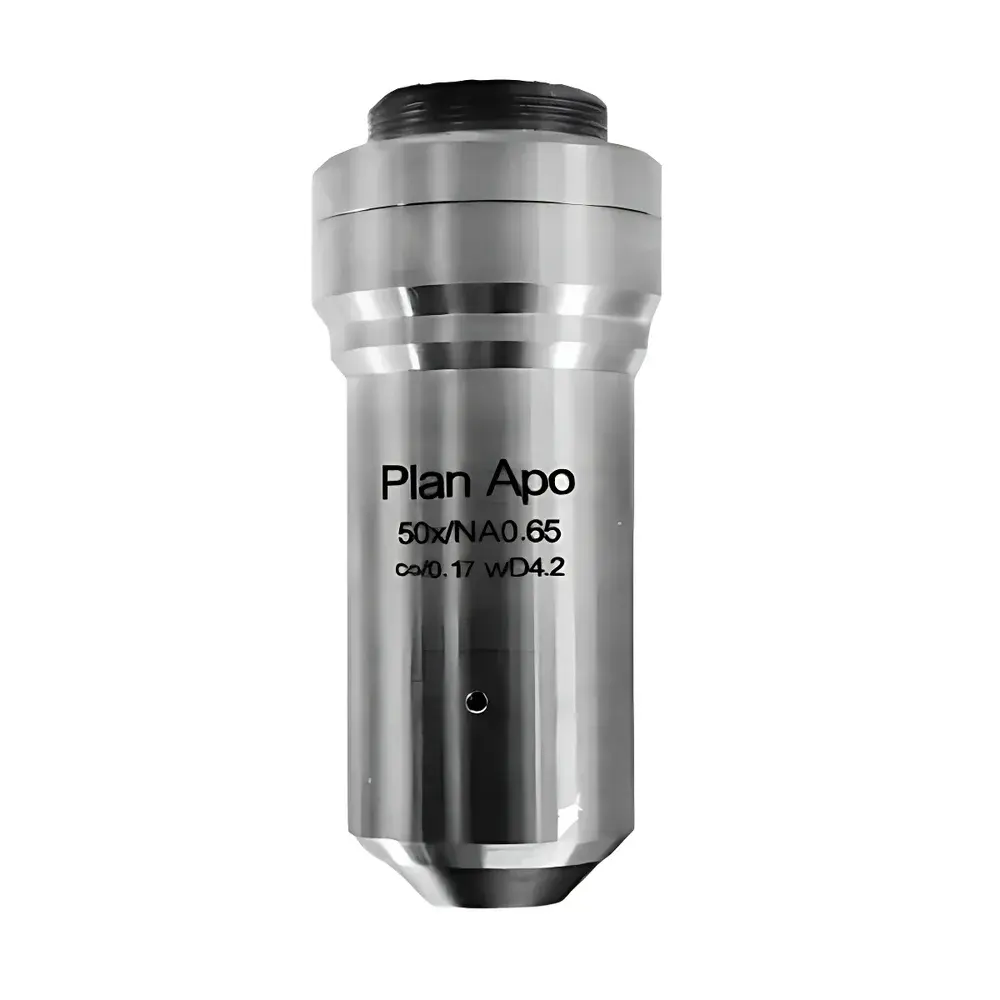
Auniontech AUT-PLANAPO Series 4K Cryogenic Plan Apochromatic Objective Lens
| Brand | Auniontech |
|---|---|
| Origin | Shanghai, China |
| Manufacturer Type | Authorized Distributor |
| Product Origin | Domestic (China) |
| Model | AUT-PLANAPO |
| Price | Upon Request |
| Working Temperature | <4 K |
| Numerical Aperture (NA) | 0.65 & 0.85 |
| Working Distance (WD) | 4.2 mm & 0.85 mm |
| Focal Length (AD) | 76.7 mm & 45 mm |
| Field Number (FN) | 130 |
| Transmission Range | 450–650 nm / 520–695 nm / 560–770 nm / 670–970 nm |
| Vacuum Compatibility | ≤10⁻⁵ mbar |
| Magnetic Field Tolerance | Up to 5 T |
| Lifetime | >5000 hours |
Overview
The Auniontech AUT-PLANAPO Series is a family of cryogenically optimized plan apochromatic objective lenses engineered for high-fidelity optical imaging and spectroscopy at ultra-low temperatures—specifically down to 4 K. Designed for integration into dilution refrigerator-based quantum experimental platforms, these objectives operate within extreme environmental constraints including high vacuum (≤10⁻⁵ mbar), strong static magnetic fields (up to 5 T), and thermal cycling between room temperature and liquid helium temperatures. Unlike conventional microscope objectives, the AUT-PLANAPO series employs a custom-compensated all-glass optical architecture with low-thermal-expansion materials and stress-relieved mounting to eliminate focal drift, axial chromatic shift, and field curvature under cryogenic conditions. The design fully corrects third-order spherical aberration, coma, astigmatism, and field curvature across the entire field of view, while simultaneously correcting axial chromatic aberration for three primary wavelengths (typically R, G, B or near-IR bands). This enables diffraction-limited performance across broad visible-to-NIR spectral windows—450–650 nm, 520–695 nm, 560–770 nm, and 670–970 nm—without requiring realignment during cooldown.
Key Features
- Cryogenic stability: Maintains optical alignment and focus integrity at <4 K with zero measurable focal shift or image plane tilt
- High numerical aperture: NA = 0.65 (WD = 4.2 mm) and NA = 0.85 (WD = 0.85 mm) variants support high collection efficiency and spatial resolution in confocal and single-photon detection setups
- Multi-band transmission: Optimized anti-reflection coatings enable broadband throughput across four discrete spectral ranges, facilitating multi-wavelength quantum state readout
- Vacuum- and magnet-compatible construction: Non-magnetic stainless steel housing, epoxy-free bonding, and outgassing-controlled materials compliant with UHV and high-field environments
- Plan-apochromatic correction: Full correction of axial chromatic aberration, lateral color, spherical aberration, astigmatism, and Petzval field curvature across FN = 130 field number
- Long operational lifetime: Rated for >5000 hours cumulative exposure to repeated thermal cycling without degradation in wavefront error or transmission
Sample Compatibility & Compliance
These objectives are routinely deployed in quantum laboratory infrastructure where sample access is constrained by cryostat cold-finger geometry, optical access ports, and electromagnetic interference requirements. They are compatible with standard RMS-threaded mounting interfaces and integrate seamlessly with commercial and custom-built confocal microscopes, Hanbury Brown–Twiss interferometers, and resonant cavity coupling stages. From a regulatory standpoint, mechanical and material specifications conform to ISO 10110-7 (surface imperfections), ISO 9022-3 (environmental testing for optical instruments), and ASTM F2633 (cryogenic compatibility of optical components). While not medical or industrial process-certified, the design supports GLP-aligned documentation protocols for traceable calibration and performance validation in research-grade quantum hardware characterization.
Software & Data Management
The AUT-PLANAPO lenses do not incorporate embedded electronics or active control; however, their deterministic optical behavior enables precise modeling within ray-tracing software suites such as Zemax OpticStudio and CODE V. When integrated into automated cryo-microscopy systems, lens parameters—including parfocal distance (76.7 mm and 45 mm), back focal length, and telecentricity deviation—are imported directly into instrument control frameworks (e.g., LabVIEW, Python-based PyVISA drivers, or MATLAB Instrument Control Toolbox) to synchronize stage motion, autofocus routines, and spectral acquisition timing. For auditability in federally funded quantum initiatives, configuration metadata (model, serial number, calibration date, thermal history log) can be embedded in HDF5 or TIFF-based image headers per NIH ImageJ/Fiji metadata standards.
Applications
- Quantum emitter characterization: High-NA, low-aberration imaging of NV centers in diamond, SiV in nanodiamonds, and quantum dots under 4 K magnetic fields
- Single-photon source optimization: Efficient collection of photons from solid-state emitters coupled to photonic crystal cavities or plasmonic nanostructures
- Quantum memory readout: Spatially resolved fluorescence detection from rare-earth-ion-doped crystals (e.g., Eu³⁺:Y₂SiO₅, Pr³⁺:Y₂SiO₅)
- Superconducting qubit probing: Optical interface to microwave-to-optical transducers operating inside dilution refrigerators
- Cryo-electron microscopy adjunct optics: Auxiliary illumination and alignment paths in hybrid EM-optical correlative platforms
FAQ
Are these objectives compatible with standard Nikon or Olympus microscope bodies?
No—these are specialized cryogenic objectives with non-standard mechanical tube length, parfocal distance, and mounting thread (RMS). They require custom optomechanical integration into cryostat feedthroughs or dedicated cold-stage microscope frames.
Can the NA = 0.85 version be used in immersion configurations?
No—AUT-PLANAPO objectives are dry (air-immersion) designs. Immersion operation would induce thermal stress fractures and refractive index mismatch under cryogenic thermal gradients.
Is there factory-provided wavefront error data at 4 K?
Yes—each unit ships with interferometric test reports (per ISO 10110-5) acquired at both 300 K and 4 K, showing RMS wavefront error ≤ λ/10 over full field at 633 nm.
What is the maximum allowable thermal ramp rate during cooldown?
To preserve long-term stability, Auniontech recommends ramp rates ≤ 1 K/min from 300 K to 77 K, and ≤ 0.5 K/min from 77 K to 4 K.
Do you provide installation and alignment support for cryogenic integration?
Yes—Auniontech’s technical support team offers remote and on-site assistance for optical train alignment, vacuum feedthrough sealing, and thermal anchoring verification per customer-specific cryostat geometry.





