
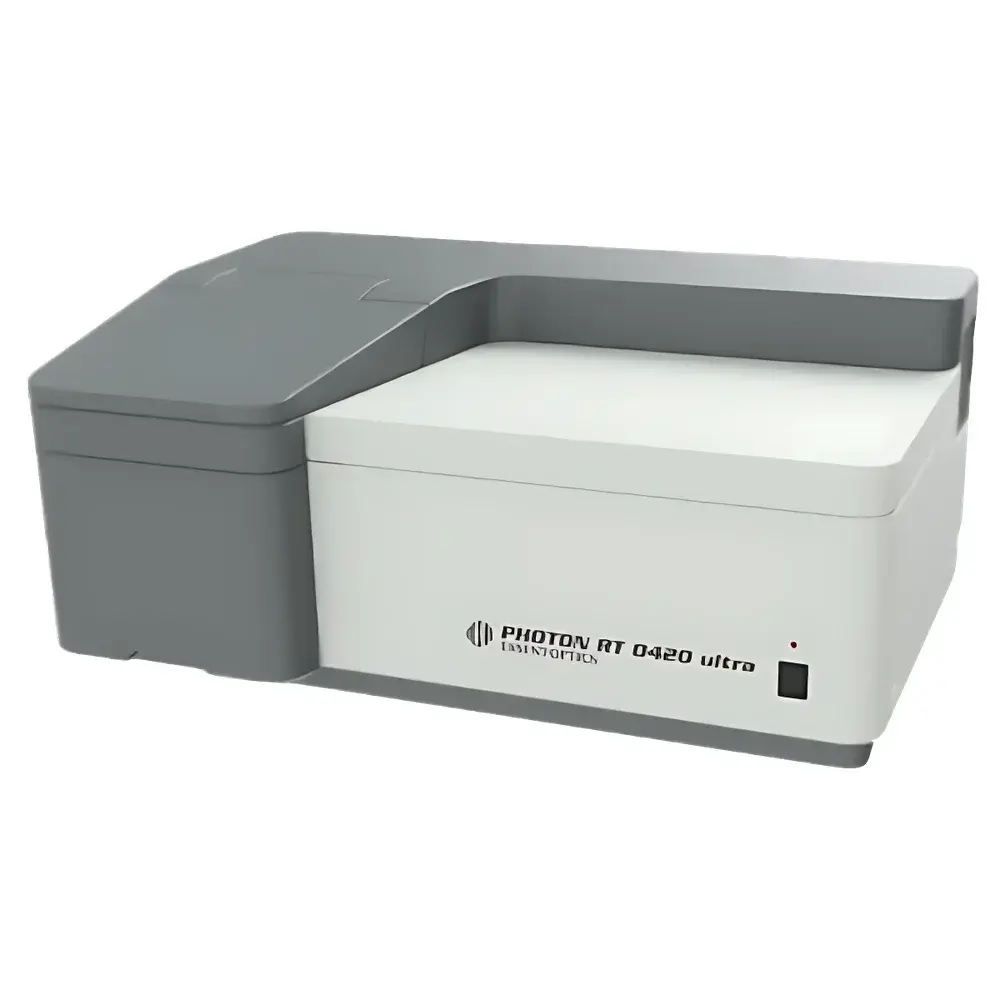
Essent Optics Photon RT UV-VIS-MWIR Scanning Spectrophotometer
| Brand | Auniontech |
|---|---|
| Origin | Shanghai, China |
| Manufacturer Type | Authorized Distributor |
| Origin Category | Domestic (China) |
| Model | Reflectance Measurement Configuration |
| Price | Upon Request |
| Spectral Range | 185–5200 nm |
| Grating Switching Speed | Rapid (automated) |
| Polarization Control | Integrated pre-calibrated broadband polarizer (220–5200 nm), user-definable S:P ratio |
| Angular Positioning | Independent rotation of sample stage, detector goniometer, and detector base |
| Detector Lateral Translation | Motorized ±30 mm (60 mm total travel), software-compensated for beam displacement in thick or prism-based samples |
| Purge Capability | Integrated N₂ purge lines for UV (<200 nm), NIR water/CO₂ absorption bands (2550–2800 nm |
Overview
The Essent Optics Photon RT UV-VIS-MWIR Scanning Spectrophotometer is an automated, high-precision optical metrology platform engineered for absolute reflectance and transmittance characterization of advanced optical components across an exceptionally broad spectral range—from deep ultraviolet (185 nm) to mid-wave infrared (5200 nm). Unlike conventional benchtop spectrophotometers, the Photon RT employs a dual-beam, goniometric architecture grounded in calibrated photometric principles, enabling angle-resolved, polarization-resolved measurements without auxiliary accessories. Its core measurement methodology integrates stabilized broadband illumination, motorized grating monochromators with rapid spectral scanning, and a dynamically positionable detection arm—allowing rigorous compliance with ISO 9050 (optical coatings), ISO 13665 (spectral reflectance), and ASTM E275 (spectrophotometer performance verification). Designed for unattended operation in R&D labs and production QA environments, it supports full spectral mapping under variable incidence angles (0°–85°) and user-defined polarization states (S, P, or arbitrary elliptical ratios), making it suitable for characterizing complex interference structures where phase and amplitude response are interdependent.
Key Features
- Rapid-scan monochromator system with automated grating exchange—achieves full 185–3500 nm spectra in ≤6 minutes at 2 nm step resolution and 20-point averaging.
- Stabilized broadband light source architecture: UV-deuterium lamp + quartz-tungsten-halogen + specialized MWIR emitter—maintains baseline stability <0.05% RMS up to 5200 nm, eliminating drift artifacts common with standard halogen sources beyond 4000 nm.
- Integrated, factory-pre-aligned broadband polarizer (220–5200 nm), enabling precise S:P control without external waveplates or rotatable mounts.
- Tri-axial angular positioning: independently motorized sample stage, detector goniometer, and detector base allow simultaneous control of incident angle, collection angle, and azimuth—critical for measuring anisotropic thin films and tilted interference filters.
- Motorized detector lateral translation (±30 mm): compensates for beam walk-off in thick substrates (e.g., fused silica windows >10 mm) or internally refracted paths in prisms, with real-time ray-trace-based position calculation driven by user-input refractive index and geometry.
- Modular sample handling: includes standard kinematic mount, high-throughput batch stage (for up to 12 wafers), precision XY-adjustable stage (±5 mm, 0.5 µm resolution), and Z-axis lift stage (±25 mm, 1 µm repeatability) for focus optimization in non-planar optics.
- Onboard nitrogen purge manifold with programmable flow control—supports four optimized purge protocols aligned to atmospheric absorption bands: O₂/H₂O suppression below 200 nm; H₂O/CO₂ attenuation at 2550–2800 nm and 4200–4300 nm; and continuous UV-optical train protection during extended 185–400 nm acquisition.
Sample Compatibility & Compliance
The Photon RT accommodates flat, curved, wedged, and prismatic optical elements up to Ø150 mm and 50 mm thickness. Verified compatibility includes anti-reflection coatings (single-layer MgF₂ to multi-band V-coats), laser mirrors (HR/R/OC designs), dichroic beamsplitters, edge filters (longpass/shortpass), multiband interference filters, and gradient-index lenses. All hardware and firmware comply with CE marking requirements and meet electromagnetic compatibility (EMC) standards per EN 61326-1. Data acquisition workflows support audit-ready traceability per FDA 21 CFR Part 11 when paired with optional secure software licensing—enabling electronic signatures, immutable metadata logging, and GLP/GMP-aligned report generation (PDF/XLSX with embedded calibration certificates).
Software & Data Management
Control and analysis are executed via PhotonRT Studio—a native Windows application built on Qt and Python 3.9, featuring scriptable automation (via Python API), real-time spectral overlay, multi-angle data fusion, and ISO-compliant uncertainty propagation. Raw data is stored in HDF5 format with embedded metadata (wavelength calibration coefficients, polarization state vectors, purge status flags, and motor encoder positions). Export options include CSV (ASCII), JDX (JCAMP-DX), and industry-standard .spc files. The software supports scheduled unattended runs, pass/fail thresholding against reference spectra, and automated report generation with configurable templates compliant with internal QA documentation standards.
Applications
- Development and validation of ultra-broadband AR coatings for EUV lithography optics.
- Angle-dependent characterization of dichroic filters used in fluorescence lifetime imaging (FLIM) and hyperspectral remote sensing.
- Quantitative reflectance mapping of laser cavity mirrors under Brewster’s angle conditions.
- Verification of spectral edge steepness and out-of-band rejection in astronomical filter sets (e.g., SDSS, LSST).
- Process monitoring of ion-assisted deposition (IAD) and magnetron sputtering systems via in-situ spectral feedback.
- Material dispersion modeling using Kramers–Kronig consistent n(λ) and k(λ) extraction from combined R/T datasets.
FAQ
What spectral calibration standards are included with the system?
NIST-traceable holmium oxide and didymium filters are supplied for wavelength verification at UV-VIS-NIR points; certified tungsten halogen and blackbody sources are available as optional accessories for radiometric calibration.
Can the system measure diffuse reflectance?
No—the Photon RT is configured for specular (directional) reflectance and transmittance only; integrating sphere accessories are not supported in this model variant.
Is remote operation supported over Ethernet or USB?
Yes—full bidirectional communication is enabled via TCP/IP (Ethernet) with optional USB-C fallback; no proprietary dongles or drivers required.
How is polarization purity verified across the full spectral range?
Each polarizer module undergoes individual spectral extinction ratio mapping (ER >10⁴:1 from 250–2000 nm; >10³:1 up to 5200 nm) and is serialized with its measured ER curve, accessible in software during measurement setup.
Does the system support custom scripting for automated test sequences?
Yes—PhotonRT Studio exposes a documented Python API (photonrt.core) enabling full instrument control, data streaming, and conditional logic for adaptive measurement strategies.





