
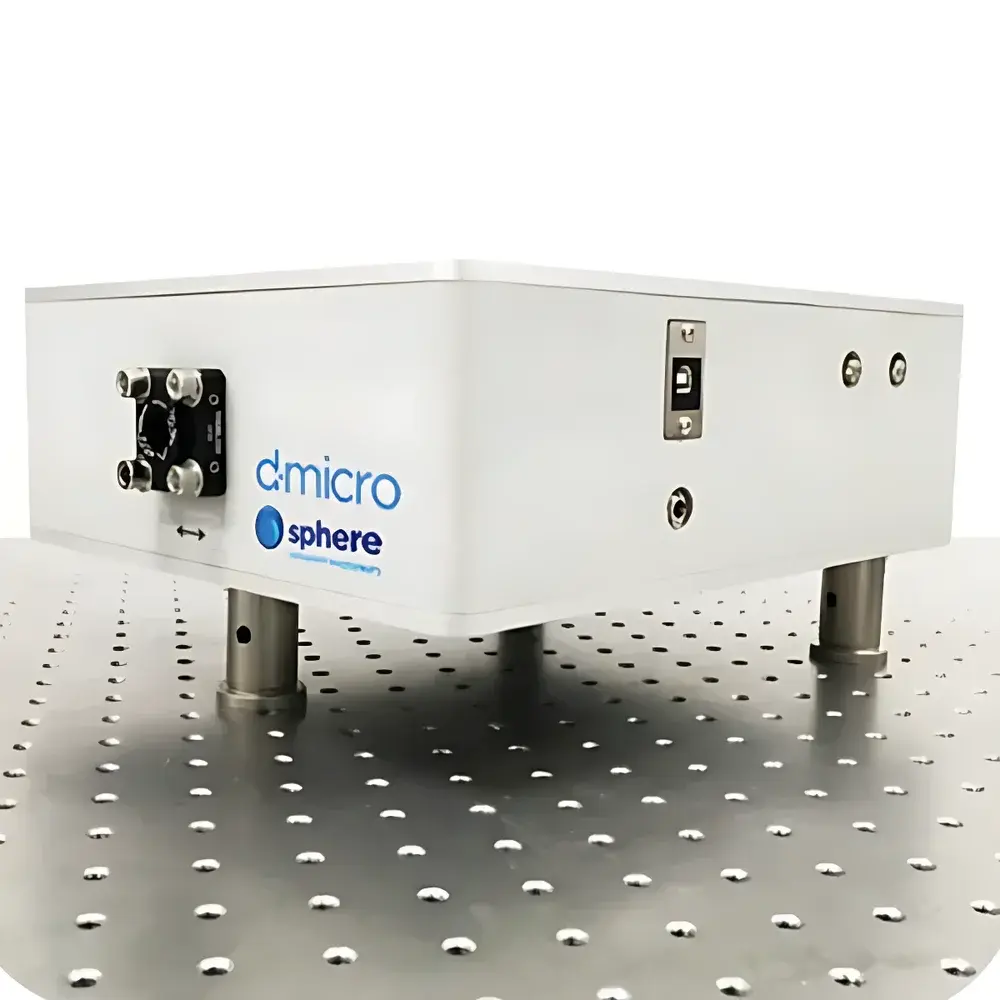
Auniontech d-micro Dual-Module Ultrafast Pulse Measurement & Compression System for Two-Photon Microscopy
| Brand | Auniontech |
|---|---|
| Origin | Shanghai, China |
| Model | d-micro Series |
| Wavelength Ranges | 600–1100 nm (USd-micro), 700–1400 nm (Sd-micro & NIRd-micro LP), 1500–1700 nm (NIRd-micro LP) |
| Pulse Duration (Fourier-Limited) | 5–20 fs (USd-micro), 2.5–60 fs (Sd-micro), 80–140 fs (Rd-micro LP), 60–200 fs (NIRd-micro LP) |
| Dispersion Compensation Range | 0 to −4000 fs (USd-micro), −20 to −8000 fs (Sd-micro), −20 to −300,000 fs (Rd-micro LP), −20 to −20,000 fs² (NIRd-micro LP) |
| Repetition Rate Support | ≥1 kHz (with external synchronization option for lower rates) |
| Input Polarization | Linear |
| Max Input Aperture | 20 mm |
| Minimum Input Pulse Energy | >100 pJ @ 80 MHz |
| Compression Module Dimensions (W×L×H) | 317 × 336 × 97 mm (USd-micro), 250 × 250 × 100 mm (Sd-micro) |
| Measuring Head Dimensions (W×L×H) | 57 × 57 × 116 mm |
Overview
The Auniontech d-micro Dual-Module Ultrafast Pulse Measurement & Compression System is an integrated, microscope-coupled instrumentation platform engineered specifically for real-time characterization and adaptive compensation of temporal dispersion in two-photon and multiphoton microscopy. It operates on the principle of second-harmonic generation frequency-resolved optical gating (SHG-FROG) combined with a reflective, prism-based pulse shaper architecture, enabling simultaneous measurement and closed-loop compression of ultrashort laser pulses directly at the sample plane. Unlike conventional pre-compensation methods that rely on theoretical dispersion models of optical paths, the d-micro system performs in situ, single-shot pulse characterization—ensuring Fourier-transform-limited (FTL) durations are achieved where photon–matter interaction occurs. This capability is critical for maintaining high peak intensities required for efficient nonlinear excitation, minimizing photodamage, and maximizing signal-to-noise ratio in deep-tissue imaging.
Key Features
- Integrated dual-module design: independent compression module and sample-plane measurement head, both optimized for alignment-free integration into commercial upright and inverted multiphoton microscopes.
- Real-time, non-invasive pulse diagnostics: SHG-FROG detection with sub-5-fs temporal resolution enables direct quantification of pulse duration, chirp, and phase distortion without beam splitting or intensity loss.
- High-dynamic-range dispersion compensation: adjustable spectral phase control via reflective grating and motorized mirror array, supporting compensation up to −300,000 fs² for broadband Ti:Sapphire and Yb-fiber sources.
- Modular wavelength coverage: four calibrated variants (USd-micro, Sd-micro, Rd-micro LP, NIRd-micro LP) cover 600–1700 nm, ensuring compatibility with standard Ti:Sa lasers, optical parametric amplifiers (OPAs), and emerging few-cycle Er/Yb fiber systems.
- Robust mechanical architecture: monolithic aluminum housing with kinematic mounts and thermal stabilization (±0.1 °C) minimizes drift during long-duration time-lapse acquisitions.
- Low-energy operation: functional down to 100 pJ pulse energy at 80 MHz repetition rate—compatible with standard femtosecond oscillators without amplification.
Sample Compatibility & Compliance
The d-micro system is designed for use in regulated life science research environments. Its measurement head interfaces directly with standard microscope side ports or scan-head couplers via C-mount or SM1-threaded adapters, requiring no modification to existing optical paths. All optical components comply with ISO 10110 surface quality standards (scratch-dig 20–10), and coated optics meet MIL-C-48497A durability requirements. The system supports GLP-compliant data logging: timestamped FROG traces, phase retrieval outputs, and compression settings are stored in HDF5 format with embedded metadata (wavelength, energy, repetition rate, user ID). Audit trails conform to FDA 21 CFR Part 11 when deployed with validated third-party laboratory information management systems (LIMS). No hazardous materials or Class 4 laser emissions are generated outside the designated optical enclosure; full IEC 60825-1:2014 compliance documentation is available upon request.
Software & Data Management
The d-micro Control Suite is a cross-platform (Windows/Linux) application built on Qt and Python 3.9, featuring a modular plugin architecture for custom analysis workflows. Core modules include: (1) Real-Time FROG Reconstruction Engine using principal component generalized projections (PCGP); (2) Adaptive Phase Optimization Algorithm that iteratively minimizes pulse duration via gradient descent on spectral phase coefficients; (3) Microscope Integration API supporting Thorlabs Kinesis, Nikon NIS-Elements, and Zeiss ZEN via TCP/IP and DLL hooks. All raw interferograms and retrieved electric fields are saved with IEEE 1596.1–2020 metadata tagging. Export options include CSV (pulse width, GDD, TOD), PNG/SVG (FROG traces), and MATLAB .mat files. Software validation reports—including IQ/OQ protocols and traceability to NIST-traceable autocorrelators—are provided with each system shipment.
Applications
- Two-photon excited fluorescence (TPEF) optimization: Demonstrated 2–3× increase in GFP signal intensity at identical average power versus uncompressed Ti:Sa pulses, with 10% higher spectral yield in blue/red channels due to improved excitation cross-section matching.
- SyncRGB-FLIM: Enables synchronous multicolor lifetime imaging using ultra-broadband <7-fs excitation, as validated in Biomed. Opt. Express 10, 1891 (2019) for concurrent detection of CFP/YFP/mCherry with sub-100-ps temporal resolution.
- Third-harmonic generation (THG) and coherent anti-Stokes Raman scattering (CARS) microscopy: Precise dispersion control ensures optimal phase-matching bandwidth across 1000–3000 cm⁻¹ vibrational windows.
- Optogenetics stimulation: Sub-10-fs pulse delivery improves temporal fidelity of ChR2 activation while reducing off-target heating effects in neural tissue slices.
- Development of adaptive optics–integrated multiphoton platforms: d-micro serves as the reference arm for wavefront-sensing–guided dispersion correction in AO-corrected deep-brain imaging.
FAQ
Can the d-micro system be retrofitted onto an existing two-photon microscope?
Yes. The measurement head mounts via standard side-port optics train interfaces (C-mount or SM1), and the compression module integrates upstream of the scan head. Mechanical and software integration kits are included for major platforms (Bruker Ultima, Leica SP8 MP, Zeiss LSM 880 NLO).
What is the minimum pulse energy required for reliable FROG reconstruction?
100 pJ at 80 MHz (1.2 nJ/pulse average) or 1 µJ at 1 kHz. Lower energies may be supported with optional high-efficiency BBO crystals and low-noise EMCCD detection.
Does the system support automatic dispersion calibration across multiple wavelengths?
Yes. The software includes a multi-wavelength calibration mode that acquires FROG traces at discrete tuning points (e.g., 750, 800, 850 nm) and builds a polynomial dispersion model for predictive compensation across the full tuning range.
Is remote operation and monitoring supported?
Full remote access is enabled via secure SSH tunneling and VNC-compatible GUI forwarding. All diagnostic logs and compression status updates can be streamed to central lab servers using MQTT protocol with TLS 1.3 encryption.
How often does the system require recalibration?
Factory calibration remains valid for 12 months under normal lab conditions (20–25 °C, <60% RH). Annual verification using the included NIST-traceable reference pulse generator is recommended for GLP/GMP environments.




