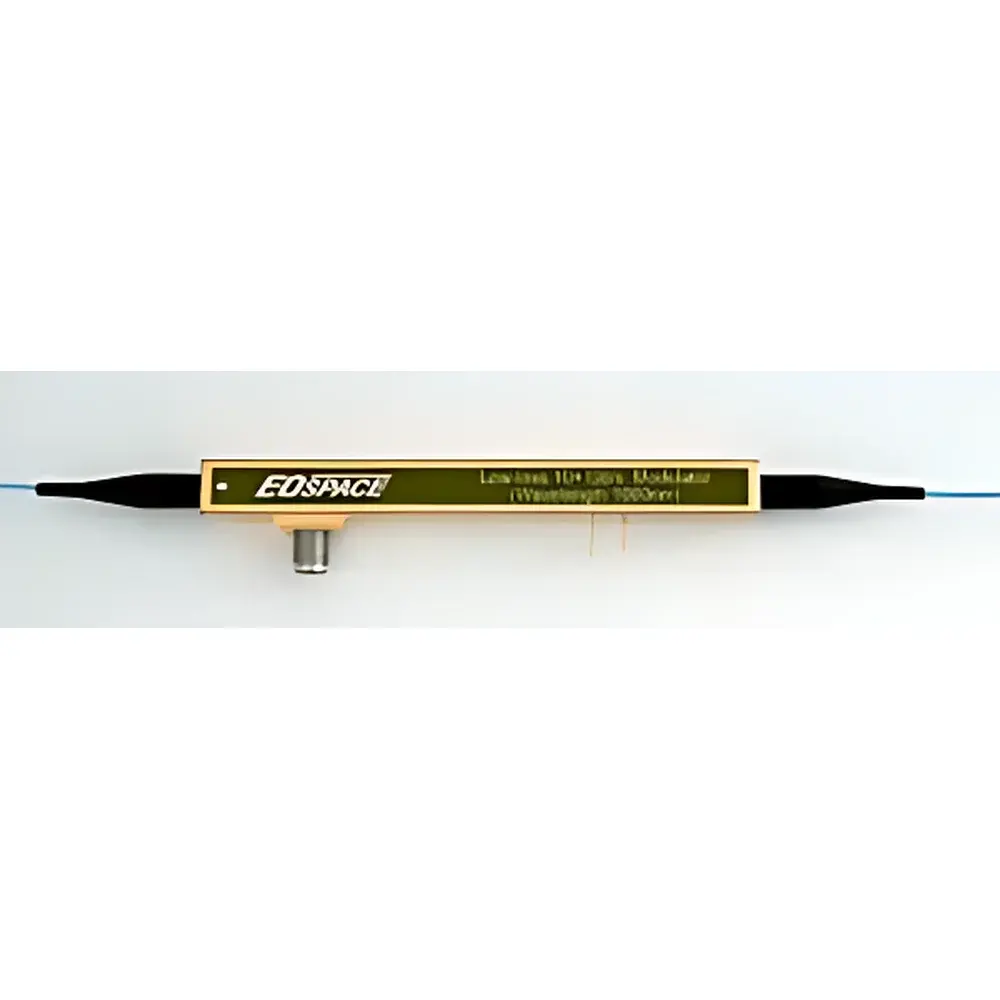
EOSPACE Short-Wavelength Lithium Niobate Modulator
| Origin | Imported |
|---|---|
| Manufacturer Type | Distributor |
| Model | Lithium Niobate Modulator |
| Wavelength Range | 700 nm – 2000 nm |
| Bandwidth | High-frequency RF-compatible |
| Insertion Loss | Low (typ. < 4 dB) |
| Extinction Ratio | Optional high-ER configuration available |
| Waveguide Technology | Titanium-diffused LiNbO₃ |
Overview
The EOSPACE Short-Wavelength Lithium Niobate Modulator is a high-performance electro-optic device engineered for precise amplitude, phase, and polarization control of optical signals in the visible to near-infrared spectrum (700 nm – 2000 nm). Built upon titanium-diffused lithium niobate (Ti:LiNbO₃) waveguide technology, it leverages the strong Pockels effect inherent to single-crystal lithium niobate to enable fast, linear, and low-distortion modulation. Unlike bulk modulators, this integrated-optic design ensures superior mode confinement, polarization stability, and compatibility with fiber-pigtailed configurations—making it ideal for demanding applications in quantum optics, ultrafast laser systems, aerospace avionics, and high-speed optical interconnects where short-wavelength operation and RF bandwidth are critical.
Key Features
- Optimized for short-wavelength operation from 700 nm through 2000 nm, supporting key spectral windows including visible (e.g., 780 nm for atomic physics), telecom O-band (1310 nm), and extended IR (up to 2000 nm)
- High modulation bandwidth—designed for RF drive frequencies up to multi-GHz range, enabling sub-nanosecond temporal resolution in pulsed laser shaping and coherent communications
- Low insertion loss (typically < 4 dB across operational bands), minimizing signal degradation and reducing downstream amplification requirements
- Available in multiple functional configurations: Mach–Zehnder intensity modulators (MZMs), single-arm phase modulators (PMs), and polarization-switching devices with integrated polarization-maintaining (PM) fiber pigtails
- Optional high-extinction-ratio variants (>30 dB) suitable for quantum state preparation, interferometric sensing, and optical switching requiring stringent contrast control
- Hermetically sealed, industry-standard butterfly or DIP packages with SMA or K-connectors for RF input; compatible with standard optical alignment and automated test platforms
Sample Compatibility & Compliance
The modulator supports single-mode fiber coupling (SMF-28, HI1060, or PM fibers depending on wavelength band) and is designed for integration into both free-space and fiber-based optical setups. Device fabrication adheres to cleanroom-controlled processes per ISO 9001-certified manufacturing protocols. While not classified as medical or safety-critical hardware, its performance characteristics align with common laboratory and industrial standards—including IEEE 802.3 for optical interconnect validation, ITU-T G.694.1 for wavelength grid compatibility, and general-purpose compliance with RoHS and REACH directives. For GLP/GMP environments, traceable calibration reports and lot-specific test data (including Vπ, EO bandwidth, and polarization extinction ratio) can be provided upon request.
Software & Data Management
As a passive electro-optic component, the modulator does not include embedded firmware or onboard software. However, it is fully interoperable with industry-standard instrumentation ecosystems: RF signal generators (Keysight, Rohde & Schwarz), optical spectrum analyzers (Yokogawa, Anritsu), and lock-in amplifiers (Stanford Research Systems). When deployed in automated test benches, it integrates seamlessly with LabVIEW, Python (via PyVISA), and MATLAB-based control frameworks. Full characterization datasets—including S-parameter sweeps, Vπ vs. wavelength curves, and thermal drift profiles—are available in CSV and HDF5 formats for traceable metrology and long-term system modeling.
Applications
- Quantum optics experiments: generation of time-bin qubits, heralded photon sources, and active feed-forward control in photonic quantum computing architectures
- Aerospace and defense: ruggedized free-space optical links, laser communication terminals (LCTs), and onboard interferometric gyroscopes operating at 780 nm or 1064 nm
- Ultrafast science: pulse picking, cavity dumping, and synchronous gating of Ti:sapphire and Yb-fiber lasers
- Biophotonics and microscopy: high-speed AOM-free beam modulation for confocal, STED, and light-sheet imaging systems requiring minimal thermal perturbation
- Coherent optical communications: pre-modulation stages in advanced modulation formats (QPSK, 16-QAM) for next-generation short-reach interconnects
FAQ
What is the typical half-wave voltage (Vπ) for this modulator at 780 nm?
Vπ varies by configuration and electrode design; standard MZMs exhibit Vπ values between 3.5–5.5 V at 780 nm under DC bias, with RF-driven variants optimized for lower Vπ·f product.
Is polarization-maintaining (PM) fiber pigtail standard or optional?
PM fiber pigtails are available as standard for all 700–1064 nm models; non-PM versions are offered for cost-sensitive OEM integration at longer wavelengths.
Can this modulator operate at cryogenic temperatures?
Titanium-diffused LiNbO₃ waveguides retain electro-optic functionality down to 77 K; however, thermal expansion mismatch requires custom packaging—consult engineering support for cryo-qualified variants.
Do you provide drive electronics or bias controllers?
EOSPACE supplies modulators only; recommended RF amplifiers, bias tees, and low-drift DC bias controllers are listed in the integration guide and supported via third-party vendor partnerships.
Is there documentation available for system-level calibration procedures?
Yes—application notes covering Vπ measurement, quadrature point stabilization, and RF impedance matching are included with each shipment and accessible via secure customer portal.