
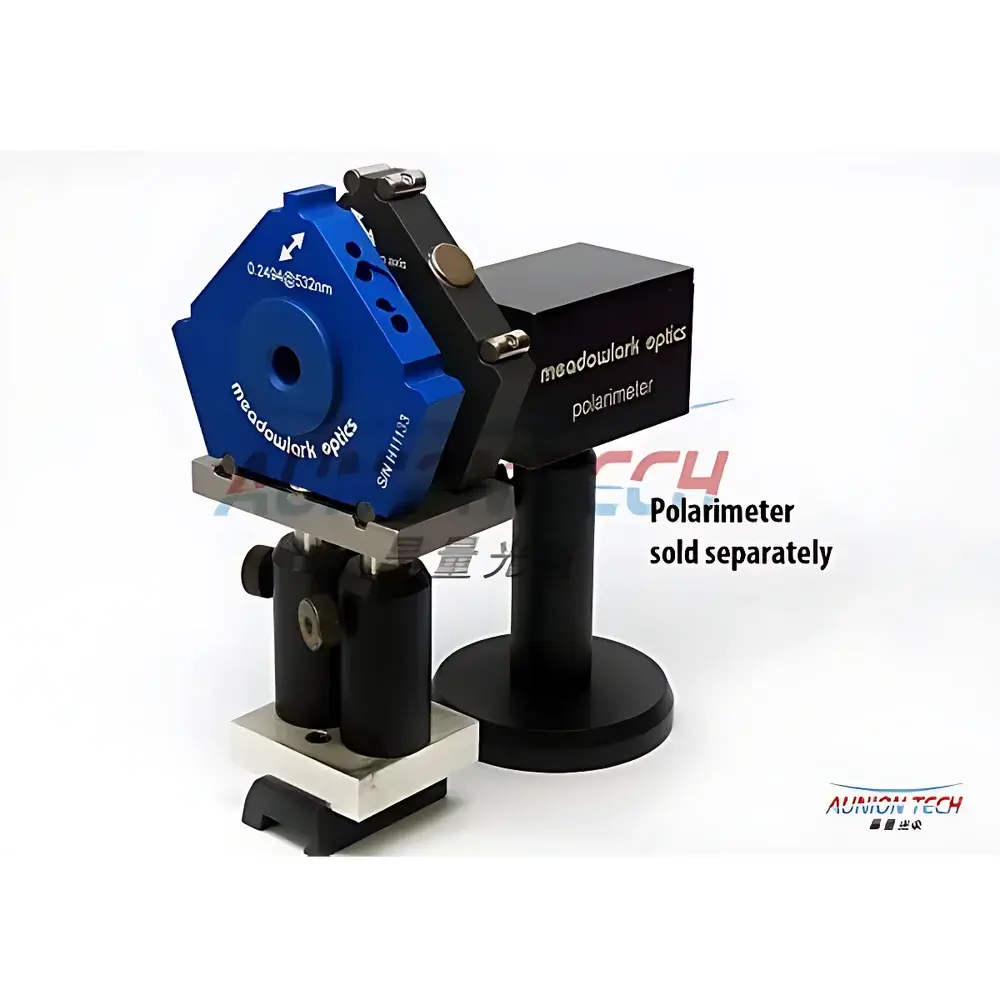
Meadowlark Optics LCPM-1000 Calibration-Grade Standard Polarization State Generator
| Brand | Meadowlark Optics |
|---|---|
| Origin | USA |
| Model | LCPM-1000 |
| Wavelength Range | 450–1700 nm |
| Calibration States | 6 intrinsic polarization states (0°, 90°, +45°, −45° linear |
| Stokes Vector Resolution | 0.001 |
| Degree of Polarization Accuracy | ≤1% |
| Measurement Rate | 10 Hz |
| Interface | USB 2.0 |
| Compliance | Compatible with ASTM E2583, ISO 15382, and NIST-traceable calibration workflows |
Overview
The Meadowlark Optics LCPM-1000 Calibration-Grade Standard Polarization State Generator is a metrology-grade optical reference instrument engineered for traceable calibration of liquid crystal-based polarimeters, Stokes parameter analyzers, and general-purpose polarization measurement systems. It operates on the principle of static, non-mechanical polarization synthesis using precision-aligned birefringent optics—specifically, high-fidelity dichroic linear polarizers and λ/4 waveplates—mounted in CNC-machined aluminum housings with angular alignment accuracy better than 1 arcminute. Unlike motorized or rotating-element calibrators, the LCPM-1000 eliminates mechanical hysteresis, wear-induced drift, and vibration coupling—critical factors in high-stability polarization metrology. Its design supports direct integration into optical test benches, fiber-pigtailed setups, or free-space alignment stations across visible and near-infrared spectral bands (450–1100 nm and 900–1700 nm). The generator produces six NIST-aligned intrinsic polarization states: horizontal (0°), vertical (90°), +45°, −45° linear, left-handed circular, and right-handed circular—each defined by rigorously characterized retardance and extinction ratios per ISO 15382 Annex B.
Key Features
- Static, solid-state architecture with zero moving parts—no motors, rotating waveplates, or stepper actuators
- CNC-machined aluminum enclosures ensuring angular repeatability < 60 arcseconds for polarizer transmission axis and waveplate fast-axis orientation
- Integrated mechanical indexing system: precision dowel pins engage V-grooves and flat-bottom slots for rapid, deterministic state selection
- Optical path length matched to minimize phase error across broadband operation (450–1700 nm)
- Thermal stabilization option available to mitigate liquid crystal and birefringent material sensitivity to ambient fluctuations
- Compatible with both free-space collimated beams and fiber-coupled inputs (FC/PC or FC/APC adapters optional)
Sample Compatibility & Compliance
The LCPM-1000 is designed for use with polarimetric systems requiring SI-traceable calibration at the instrument level—not only for research-grade polarimeters but also for QC/QA validation in photonics manufacturing, fiber optic component testing, and aerospace electro-optical subsystem verification. It meets functional requirements outlined in ASTM E2583 (Standard Practice for Polarization Characterization of Optical Components), ISO 15382:2017 (Optics and photonics — Polarization characterization of optical components), and supports GLP/GMP audit readiness when deployed with documented calibration certificates (NIST-traceable upon request). Each unit ships with individual measurement reports specifying measured extinction ratio (>35 dB at 633 nm), retardance uniformity (<±0.5° over Ø10 mm clear aperture), and spectral transmittance profiles across its operational range.
Software & Data Management
While the LCPM-1000 itself is a passive optical standard, it is fully integrated into Meadowlark Optics’ calibration ecosystem via the PolarView™ software suite (v4.2+). This application provides automated sequence control for multi-state calibration routines, generates CSV-exportable Stokes vector logs with timestamps and environmental metadata (temperature, humidity), and supports FDA 21 CFR Part 11-compliant electronic signatures when used with validated LabVIEW VI libraries (included). Audit trails record all user actions—including state selection history, calibration date stamps, and operator ID—ensuring full data integrity for regulated environments. Raw calibration data may be imported into MATLAB, Python (via PyVISA), or custom C++ applications using documented SCPI-style command sets.
Applications
- Factory-level calibration of Meadowlark LCPM-series and third-party liquid crystal polarimeters
- Validation of polarization-dependent loss (PDL) and polarization mode dispersion (PMD) test sets
- Benchtop verification of polarization-sensitive detectors in quantum optics labs
- Reference source for developing Mueller matrix reconstruction algorithms
- Education and training in polarization optics: visualizing Poincaré sphere mapping, ellipticity evolution, and depolarization metrics
- Field-deployable calibration anchor for portable spectropolarimeters in remote sensing platforms
FAQ
Is the LCPM-1000 compatible with non-Meadowlark polarimeters?
Yes—it is wavelength-agnostic and functions as a universal optical standard; compatibility depends solely on beam diameter, divergence, and input coupling method.
Can it be used for absolute calibration of degree of polarization (DOP)?
Yes—its six intrinsic states provide orthogonal anchors for DOP linearity verification and zero-offset correction per IEC 61290-10.
Does it require periodic recalibration?
No—being a passive, solid-state device with no active elements, it maintains intrinsic state fidelity indefinitely; however, annual verification against NIST-traceable references is recommended for ISO 17025 compliance.
What temperature range is supported with the thermal control option?
The optional thermoelectric module maintains ±0.1°C stability over 15–35°C ambient, minimizing birefringence drift in LC-based downstream instruments.
Are fiber-coupled versions available with APC or PC polish?
Yes—both FC/APC and FC/PC configurations are offered; custom connector types (e.g., SMA905, SC) can be accommodated under OEM agreements.




