
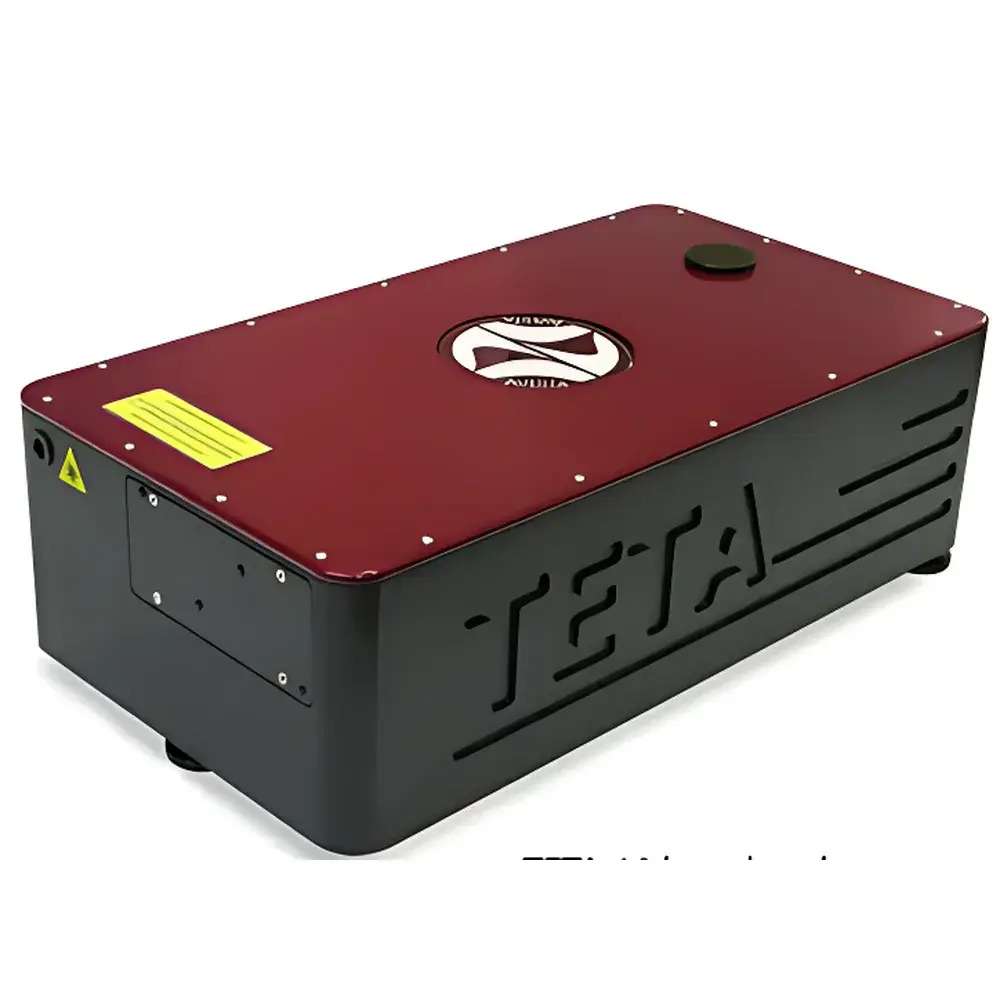
Auniontech TETA Series Yb-Doped Femtosecond Solid-State Laser System (1030 nm, 20 W, 2 mJ)
| Brand | Auniontech |
|---|---|
| Wavelength | 1030 nm |
| Average Power | up to 20 W |
| Pulse Energy | up to 2 mJ |
| Pulse Duration | adjustable from <270 fs to 10 ps |
| Repetition Rate | software-tunable via integrated Pockels cell |
| Laser Type | Diode-pumped CPA-based regenerative amplifier with fiber seed oscillator |
| Cooling | Integrated thermo-stabilized enclosure |
| Output Options | Harmonic generation modules available (515 nm, 343 nm, 248 nm) |
| Compliance | CE-marked, RoHS-compliant |
Overview
The Auniontech TETA Series is a high-performance, diode-pumped, chirped-pulse amplification (CPA)-based femtosecond laser system engineered for demanding ultrafast science and industrial applications. Operating at a fundamental wavelength of 1030 nm, the system delivers up to 20 W average power and pulse energies reaching 2 mJ, with pulse durations tunable from sub-270 fs to 10 ps. Its architecture integrates a low-noise fiber oscillator, fiber-based stretcher, Faraday isolator, regenerative amplifier pumped by high-brightness laser diodes, pulse picker, and vacuum-compatible grating compressor—all housed within a single, thermally stabilized monolithic enclosure. This design ensures long-term pointing stability (<25 µrad RMS over 8 hours), power stability (<0.5% RMS over 24 h), and minimal environmental sensitivity—enabling true turnkey operation without external water cooling or active vibration isolation.
Key Features
- High-energy femtosecond pulses: Up to 2 mJ per pulse at 1030 nm, supporting nonlinear conversion and high-intensity interaction studies.
- Flexible pulse duration control: Adjustable from <270 fs to 10 ps via compressor tuning and internal dispersion management—optimized for specific nonlinear processes or material ablation thresholds.
- Integrated electro-optic modulation: Built-in Pockels cell enables real-time repetition rate selection (1 kHz–200 kHz) and single-shot or burst-mode triggering with nanosecond-level jitter.
- Harmonic generation compatibility: Designed for seamless integration with optional harmonic modules delivering 515 nm (SHG), 343 nm (THG), and 248 nm (FHG) outputs—calibrated and collinearly aligned for maximum conversion efficiency.
- Robust thermal architecture: Monolithic, air-cooled, temperature-regulated chassis maintains optical alignment stability across ambient fluctuations (±0.5 °C control precision).
- Full remote operation: Ethernet- and USB-controlled via intuitive PC software with scripting interface (Python/LabVIEW SDK included), supporting automated parameter sweeps and synchronization with external diagnostics (e.g., delay stages, streak cameras).
Sample Compatibility & Compliance
The TETA laser is compatible with a broad range of optical components, including dielectric mirrors, fused silica and CaF2 optics, BBO/LBO/KDP crystals for parametric amplification, and vacuum-compatible beam delivery systems. Its pulse characteristics meet requirements for ISO 11146-compliant beam profiling and EN 60825-1:2014 Class 4 laser safety certification. The system complies with CE directives for electromagnetic compatibility (EMC) and low-voltage equipment, adheres to RoHS 2011/65/EU restrictions on hazardous substances, and supports GLP/GMP-aligned operation through audit-trail-enabled software logging (optional FDA 21 CFR Part 11 compliance package available).
Software & Data Management
The proprietary TETA Control Suite provides real-time monitoring of pump diode current, cavity temperature, pulse energy (via internal pyroelectric sensor), and repetition rate. All operational parameters are timestamped and exportable in CSV or HDF5 format. Software supports synchronized acquisition with external hardware triggers, multi-channel parameter logging, and customizable alarm thresholds. For regulated environments, optional firmware modules enable electronic signatures, user role-based access control, and immutable audit trails—fully traceable for quality assurance documentation in photonics R&D labs and laser processing facilities.
Applications
- Ultrafast spectroscopy: Pump-probe experiments requiring high signal-to-noise ratio and precise temporal overlap, especially in transient absorption and time-resolved photoemission setups.
- Nonlinear frequency conversion: Efficient seeding of optical parametric amplifiers (OPAs), optical parametric generators (OPGs), and high-harmonic generation (HHG) sources.
- Precision micromachining: Cold ablation of transparent dielectrics (e.g., fused silica, sapphire), polymer structuring, and bio-tissue surgery with minimized thermal damage zone.
- Advanced light source development: Front-end injection for terawatt (TW) and petawatt (PW) laser systems, free-electron laser (FEL) seeding, and ultrafast electron diffraction (UED) timing reference.
- Industrial metrology: Calibration of ultrafast photodetectors, autocorrelators, and FROG/SPIDER devices under standardized test conditions (per ISO/TR 20478).
FAQ
What is the minimum pulse duration achievable at full 2 mJ output?
At 2 mJ pulse energy, the shortest supported pulse width is ≤270 fs, limited by gain-narrowing and higher-order dispersion compensation limits.
Can the system operate in single-shot mode with external TTL triggering?
Yes—the integrated Pockels cell supports external TTL input with <5 ns jitter, enabling reliable single-pulse extraction synchronized to external events.
Is vacuum-compatible beam delivery available as an option?
Standard output is atmospheric; however, a UHV-compatible feedthrough port and kinematic mirror mount adapter kit are available upon request for integration into vacuum chambers.
Does the laser support third-party harmonic generation modules?
Yes—the 1030 nm output is optimized for standard BBO/LBO crystal phase-matching angles; full optical layout drawings and M² specifications are provided to facilitate custom SHG/THG integration.
What maintenance is required during routine operation?
No consumables or periodic alignment is required; annual calibration of internal energy monitor and thermal sensors is recommended for metrological traceability.




