
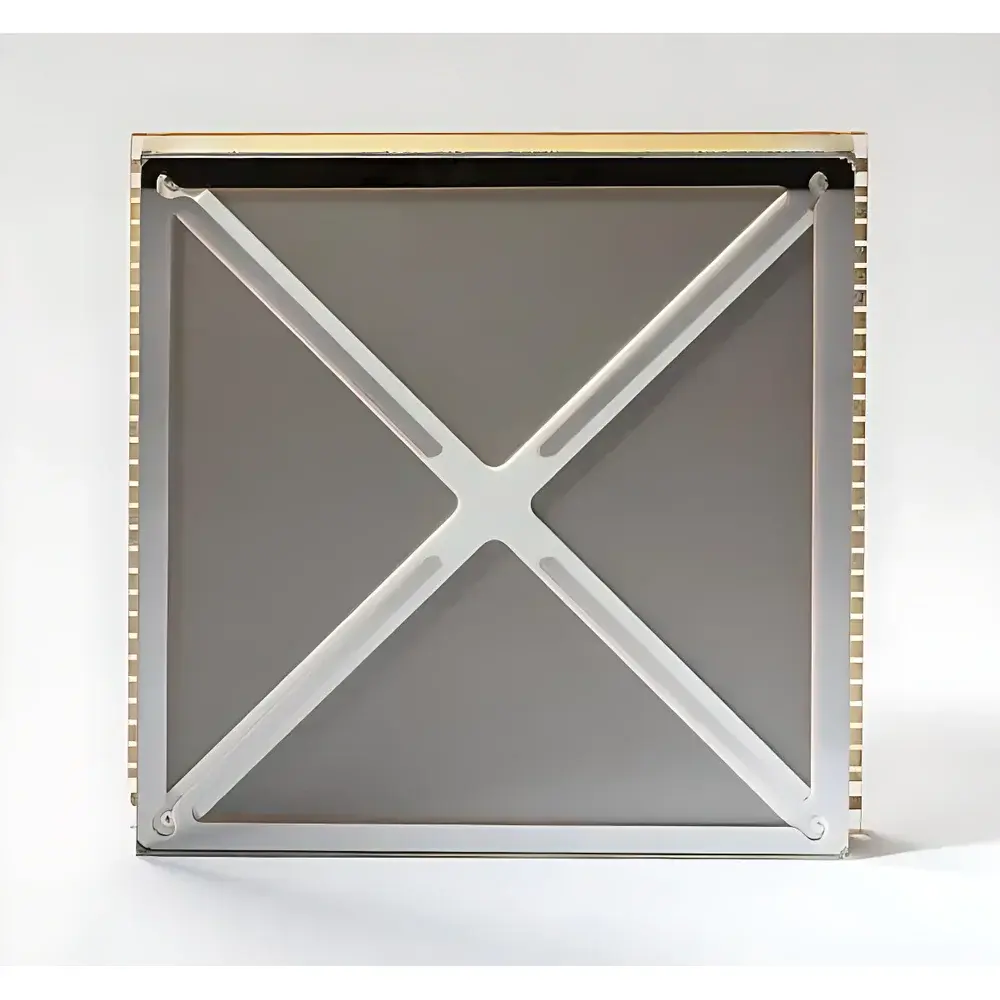
LAPPD™ Large-Area Picosecond Microchannel Plate Detector by Auniontech
| Brand | Auniontech |
|---|---|
| Model | LAPPD™ |
| Detection Principle | Microchannel Plate (MCP)-based Photon Amplification with ALD-Grown Chevron MCP Stack |
| Active Area | 200 mm × 200 mm |
| Quantum Efficiency | >20% (90% Uniformity Across Active Area) |
| Temporal Resolution | <10 ps FWHM (System-Level, With Optimized Readout) |
| Spatial Resolution | ≤1 mm RMS |
| Dark Count Rate | <150 Hz/cm² |
| MCP Configuration | Dual 203 mm × 203 mm ALD-Grown Chevron GCA-MCPs |
| Gain | >1 × 10⁷ |
| Independent Bias Control | Separate HV Supplies for Photocathode and MCP Stacks |
| Compatibility | Vacuum-Compatible (UHV-Rated, ≤1×10⁻⁹ Torr) |
Overview
The LAPPD™ (Large-Area Picosecond Photodetector) is a next-generation microchannel plate (MCP) detector engineered for ultrafast, high-fidelity single-photon imaging in demanding scientific environments. Developed in collaboration with the U.S. Department of Energy, Argonne National Laboratory, and the University of Chicago, the LAPPD™ leverages atomic-layer-deposited (ALD) chevron-configured glass capillary array (GCA) MCPs to achieve unprecedented performance across three critical dimensions: temporal resolution, spatial fidelity, and detection efficiency. Unlike conventional MCP detectors limited by pore size, stack geometry, and resistive layer uniformity, the LAPPD™ integrates monolithic 203 mm × 203 mm ALD-GCA-MCPs—fabricated with sub-nanometer thickness control—to deliver stable, high-gain amplification (>1 × 10⁷) with minimal ion feedback and exceptional pulse-height distribution uniformity. Its 200 mm × 200 mm active area supports large-solid-angle coverage required for time-of-flight (TOF) spectroscopy, neutrino interaction vertex reconstruction, and distributed PET detector arrays. The detector operates under ultra-high vacuum (UHV) conditions (≤1 × 10⁻⁹ Torr), enabling integration into synchrotron beamlines, neutron scattering instruments, and accelerator-based physics experiments where background suppression and long-term stability are non-negotiable.
Key Features
- Monolithic 200 mm × 200 mm active imaging area—largest commercially available MCP-based photodetector platform.
- Atomic-layer-deposited (ALD) chevron GCA-MCP stack (dual 203 mm × 203 mm plates) enabling gain >1 × 10⁷ with sub-10 ps timing jitter and low ion feedback.
- Quantum efficiency >20% at 400–600 nm (typical bialkali photocathode), with ≥90% spatial uniformity across full active area.
- Independent high-voltage bias control for photocathode and MCP stacks—enabling real-time optimization of signal-to-noise ratio and dynamic range.
- Sub-millimeter intrinsic spatial resolution (≤1 mm RMS) with centroid-based position reconstruction using segmented anode readout (e.g., delay-line or pixelated ASIC).
- Ultra-low dark count rate (<150 Hz/cm²) attributable to ALD surface passivation and optimized thermal management architecture.
- UHV-compatible stainless-steel flange housing with CF-150 or KF-100 port options; rated for bake-out up to 150 °C.
Sample Compatibility & Compliance
The LAPPD™ is designed for use with pulsed and continuous UV–visible light sources, scintillation photons from inorganic crystals (e.g., LYSO, LaBr₃), secondary electrons from grazing-incidence X-ray optics, and Cherenkov radiation in neutrino and cosmic-ray experiments. It complies with standard vacuum interface specifications per ISO-KF and ISO-CF standards. While not a medical device itself, its performance characteristics meet foundational requirements for research-grade PET detector module development under IEC 61675-1 (Nuclear Medicine Instrumentation – Gamma Cameras). For nuclear physics applications, it supports data acquisition protocols aligned with IEEE 11073-10201 (Medical Device Communication) and is compatible with DAQ systems certified to EN 61326-1 (EMC for laboratory equipment). No FDA 510(k) or CE-IVD certification applies, as the LAPPD™ is supplied as a component-level detector for OEM integration and fundamental research use only.
Software & Data Management
The LAPPD™ interfaces via standard high-speed digital links (e.g., 10 GbE or PCIe Gen3 x8) to host acquisition systems running Linux-based firmware (provided as open-source FPGA bitstreams and C++/Python SDKs). Time-stamped event data (TDC + ADC + XY coordinates) are formatted in HDF5-compliant binary streams, supporting direct ingestion into ROOT (CERN), SciPy, or custom HPC pipelines. Timestamp calibration includes built-in reference clock distribution and temperature-compensated delay-line skew correction. Audit trails for HV settings, gain monitoring, and environmental sensor logs (pressure, temperature) are recorded in accordance with GLP-aligned metadata schema (ISO/IEC 17025 Annex A.3), facilitating traceability in regulated research environments. Firmware updates follow secure signed-image verification protocol compliant with NIST SP 800-193 guidelines.
Applications
- High-energy and nuclear physics: Precision TOF measurements in neutrino oscillation experiments (e.g., DUNE near detector modules), proton radiography, and heavy-ion collision vertex tracking.
- Time-resolved X-ray science: Pump-probe studies at XFEL facilities requiring <10 ps photon arrival time tagging synchronized to electron bunches.
- Neutron detection: Conversion via ⁶LiF/ZnS scintillator coupling for cold/thermal neutron imaging with simultaneous spatial and temporal binning.
- Positron emission tomography (PET) R&D: Development of time-of-flight PET (TOF-PET) detector tiles with <200 ps coincidence resolving time (CRT) potential.
- Ultrafast laser diagnostics: Single-shot characterization of ultrashort pulse spatiotemporal profiles using streak-camera-free optical upconversion schemes.
- Fundamental metrology: Tests of Lorentz invariance and quantum gravity models through precision measurement of photon dispersion in vacuum over cosmological baselines.
FAQ
What vacuum level is required for optimal LAPPD™ operation?
The detector is rated for continuous operation at pressures ≤1 × 10⁻⁹ Torr; bake-out to 150 °C is supported for achieving base pressure in UHV systems.
Is the photocathode replaceable in the field?
No—the bialkali photocathode is deposited in situ during final UHV processing and is not user-replaceable. Lifetime exceeds 5 C/cm² total extracted charge under typical operating conditions.
Does the LAPPD™ support analog or digital readout?
It supports both: analog charge division (for low-cost centroiding) and digital pixelated or delay-line ASIC readouts (e.g., TORCH, TDCPix) for high-throughput event reconstruction.
Can multiple LAPPD™ units be synchronized for distributed detection?
Yes—via external 10 MHz reference clock input and PPS trigger lines, with sub-5 ps inter-unit timing skew achievable using White Rabbit protocol extensions.
What is the maximum sustainable count rate per cm²?
At full gain and with 10 ns pulse width discrimination, the linear dynamic range extends to ~10⁵ counts/s/cm² before space charge effects degrade gain stability.





