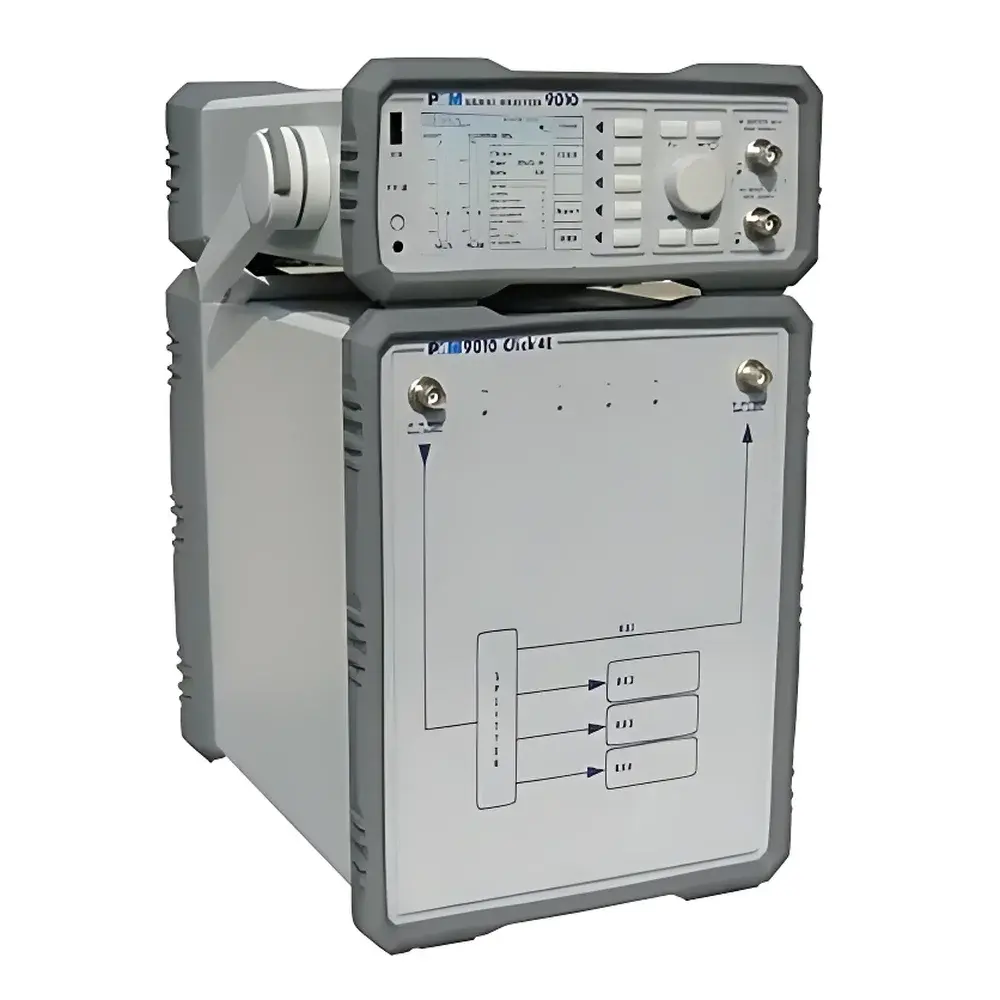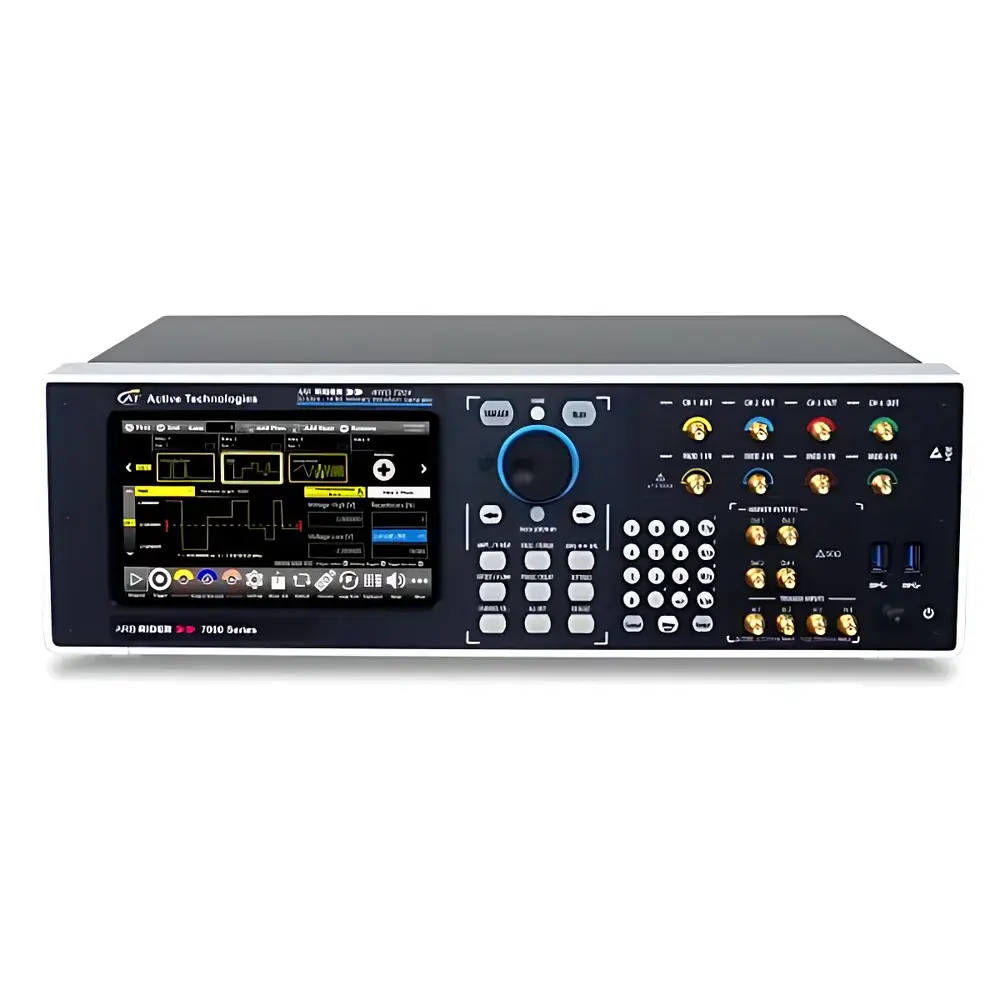
Auniontech ARB Rider AWG-7000 High-Speed Arbitrary Waveform Generator
| Brand | Auniontech |
|---|---|
| Origin | Italy |
| Model | AWG-7000 Series |
| Analog Channels | 2 or 4 |
| Digital Channels | up to 32 (optional) |
| Sampling Rate | up to 20 GS/s |
| Vertical Resolution | 14 bits |
| Analog Bandwidth | up to 10 GHz |
| Max Output Voltage | 5 Vpp (50 Ω), 10 Vpp (Hi-Z) |
| Rise/Fall Time | 50 ps |
| Minimum Pulse Width | 100 ps |
| Record Length | up to 9 Gpts per channel |
| Synchronization | internal chassis bus for multi-unit sync (up to 4 units → 16 analog + 128 digital channels) |
| Software | True-Arb & Simple Rider (PC-based, MATLAB/LabVIEW/.NET API support) |
Overview
The Auniontech ARB Rider AWG-7000 is a high-fidelity, ultra-high-speed arbitrary waveform generator engineered for demanding scientific and industrial applications requiring precise temporal control, wide instantaneous bandwidth, and deterministic signal fidelity. Operating on direct digital synthesis (DDS) and high-speed DAC architecture, the AWG-7000 delivers real-time waveform generation with sampling rates up to 20 GS/s and 14-bit vertical resolution—enabling sub-100-ps timing granularity and exceptional dynamic range. Its analog front-end features a flat frequency response extending to 10 GHz, supporting accurate reproduction of fast transients, ultra-narrow pulses, and complex modulated RF/IF/IQ waveforms without spectral distortion or group delay artifacts. Designed for reproducible laboratory-grade signal integrity, the AWG-7000 integrates low-jitter clock distribution, matched impedance paths (50 Ω), and hardware-level DC offset control (±2.5 V), making it suitable for applications where waveform fidelity directly impacts experimental validity—including quantum state manipulation, photonic device characterization, and radar cross-section simulation.
Key Features
- Ultra-high sampling rate: configurable from 1 Sa/s to 20 GS/s (model-dependent), with interpolation and decimation support for optimal Nyquist compliance.
- 14-bit DAC resolution ensures >83 dB spurious-free dynamic range (SFDR) across full bandwidth, critical for low-error quantum pulse shaping and EMI-sensitive testing.
- Dual-domain output architecture: simultaneous analog (2 or 4 channels) and digital (up to 32 LVTTL/LVDS channels) signal generation, fully time-aligned with sub-10 ps skew.
- Deep memory: up to 9 Gpts per analog channel enables long-duration, non-repeating waveform playback—essential for simulating extended radar chirps, multi-pulse QKD protocols, or stochastic optical noise profiles.
- Hardware-accelerated sequencer: supports up to 16,384 programmable entries with conditional branching, enabling deterministic state-machine-driven stimulus sequences for automated test systems.
- Multi-unit synchronization: proprietary intra-chassis synchronization bus allows phase-coherent operation of up to four AWG-7000 units—scaling to 16 synchronized analog channels and 128 digital lines with <5 ps inter-channel jitter.
Sample Compatibility & Compliance
The AWG-7000 meets stringent requirements for traceable signal generation in regulated environments. Its timing stability complies with IEEE Std 1139–2008 for time-domain uncertainty quantification, and its amplitude accuracy is validated per IEC 61000-4-3 for RF immunity test signal calibration. While not certified as a medical or safety-critical device, the instrument adheres to CE, RoHS, and EMC Directive 2014/30/EU standards. For GLP/GMP-aligned laboratories, optional audit-trail logging (via True-Arb software) records all waveform edits, parameter changes, and export actions with timestamped user attribution—supporting FDA 21 CFR Part 11 compliance when deployed with validated IT infrastructure. The system interfaces exclusively via Ethernet (TCP/IP) and PCIe (for host-embedded configurations), eliminating legacy USB/GPIB dependencies that complicate validation workflows.
Software & Data Management
True-Arb software provides native waveform design, import, and playback orchestration. It includes a graphical pulse editor with parametric shape libraries (Gaussian, exponential decay, PRBS, PAM-4), FFT-based spectral preview, and real-time distortion modeling (e.g., cable loss compensation, amplifier nonlinearities). MATLAB, LabVIEW, and .NET SDKs enable programmatic waveform synthesis and closed-loop control integration—for example, feeding real-time feedback from an oscilloscope into adaptive pulse correction routines. All waveforms are stored in HDF5 format with embedded metadata (sampling rate, trigger latency, channel mapping), ensuring interoperability with Python-based analysis pipelines (NumPy, SciPy, PyTorch). Remote operation is supported via RESTful API endpoints, allowing integration into CI/CD test automation frameworks.
Applications
- Quantum Information Science: Generation of nanosecond-scale microwave pulses for superconducting qubit control, spin manipulation in NV centers, and time-bin encoded photonic qubits.
- Photonics & Optoelectronics: Driving electro-optic and acousto-optic modulators; synthesizing chirped laser pulses; characterizing ultrafast photodetectors and integrated MZI modulators.
- Radar & EW Systems: Emulation of wideband FMCW, pulsed-Doppler, and OFDM-based radar signatures; electronic warfare scenario replay with realistic clutter and jamming signals.
- Automotive ADAS Validation: Stimulus generation for LiDAR receiver ICs, mmWave radar front-ends, and ultrasonic parking sensor evaluation under controlled SNR and multipath conditions.
- Fundamental Physics Experiments: Precision timing for pump-probe spectroscopy, particle detector readout simulation, and high-energy beam diagnostics requiring picosecond-level trigger alignment.
FAQ
What is the maximum usable analog bandwidth for the AWG-7000 series?
The analog bandwidth is model-specific: AWG-720x models deliver up to 10 GHz, AWG-717x up to 8.5 GHz, and AWG-710x up to 5 GHz—verified via -3 dB point measurement using calibrated VNA traceable to NIST standards.
Can the AWG-7000 generate true differential outputs?
Yes—selected models (e.g., AWG-7204D) provide dedicated differential analog outputs compliant with LVDS 1.2 V swing and common-mode voltage control (0.75–1.25 V), with matched propagation delay across pairs.
Is firmware update capability available over network?
Yes—secure firmware updates are delivered via signed binary packages through the True-Arb software interface, with rollback support and SHA-256 verification.
How is timing jitter specified between analog and digital channels?
Inter-channel timing skew is ≤8 ps RMS (analog-to-digital) and ≤3 ps RMS (analog-to-analog) under synchronized multi-unit operation, measured using cross-correlation on a 63 GHz real-time oscilloscope.
Does the AWG-7000 support external clock locking?
Yes—it accepts 10 MHz or 100 MHz reference inputs with phase-lock loop (PLL) bandwidth adjustable from 1 Hz to 10 kHz, enabling synchronization to atomic clocks or master timing systems in distributed labs.