
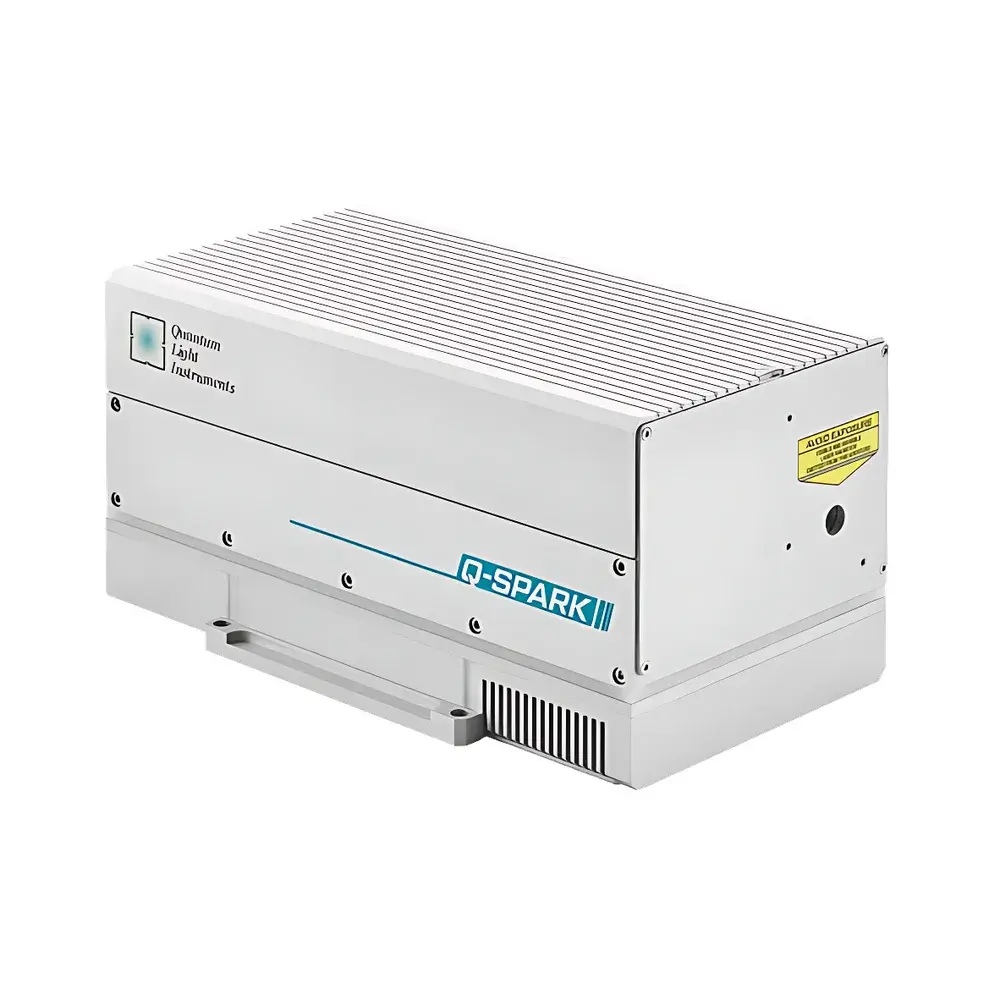
Auniontech Q-SPARK Diode-Pumped Passive/Active Q-Switched Sub-Nanosecond Laser System
| Brand | Auniontech |
|---|---|
| Model | Q-SPARK |
| Type | Solid-State Q-Switched Laser |
| Wavelength | 1064 nm (fundamental), up to 5th harmonic (266 nm) |
| Pulse Width | ≤750 ps (passive), ≤1.5 ns (active) |
| Pulse Energy | up to 10 mJ @ 1064 nm |
| Repetition Rate | 10–100 Hz |
| Cooling | Air-cooled |
| Harmonics | Optional 2ω, 3ω, 4ω, 5ω generation |
| Control Interface | Ethernet + API |
| Sync Output | TTL-compatible SYNC signal |
| Beam Profile | Near-Gaussian |
| Divergence | Low (typ. <1.5 mrad) |
| Diode Lifetime | >2 Gshots |
Overview
The Auniontech Q-SPARK is a compact, air-cooled, diode-pumped solid-state (DPSS) laser system engineered for high-precision sub-nanosecond pulse generation in demanding scientific and industrial applications. Operating at a fundamental wavelength of 1064 nm, the Q-SPARK leverages optimized end-pumping architecture with no water cooling requirement—enabling robust, turnkey deployment in laboratory, field, or OEM-integrated environments. Its core design implements either passive Q-switching via Cr:YAG saturable absorber or active electro-optic Q-switching using a Pockels cell, delivering two distinct operational regimes: one optimized for ultra-short pulses (≤750 ps, up to 5 mJ), and another for higher-energy output (up to 10 mJ, ≤1.5 ns). The laser’s near-Gaussian spatial profile, low beam divergence (<1.5 mrad), and intrinsic timing stability make it suitable for time-resolved measurements where pulse fidelity, temporal resolution, and shot-to-shot reproducibility are critical—such as time-of-flight mass spectrometry (TOF-MS), laser-induced breakdown spectroscopy (LIBS), and pump-probe transient absorption.
Key Features
- Air-cooled DPSS architecture eliminates dependency on external chillers or plumbing—reducing footprint, power consumption, and maintenance overhead.
- Sub-nanosecond pulse width (≤750 ps) in passive configuration; ≤1.5 ns in active Q-switched mode—enabling high peak power (>10 MW) without complex amplification stages.
- Adjustable repetition rate from 10 Hz to 100 Hz, programmable via Ethernet interface with microsecond-level timing resolution.
- Integrated TTL-compatible SYNC output for precise synchronization with detectors, gated cameras, or data acquisition systems.
- Optional harmonic generation modules (532 nm, 355 nm, 266 nm, 213 nm) with calibrated energy monitoring per wavelength—supporting multi-spectral excitation protocols.
- Full remote operation via standard Ethernet: real-time status monitoring (pulse energy, temperature, diode current), parameter adjustment, and fault logging.
- Software development kit (SDK) and documented API enable seamless integration into custom automation platforms, OEM instruments, or GLP/GMP-compliant manufacturing lines.
Sample Compatibility & Compliance
The Q-SPARK is designed for compatibility with standard optical tables, vacuum chambers, and open-beam experimental setups common in analytical chemistry, materials science, and plasma diagnostics laboratories. Its stable TEM00-like output supports efficient coupling into single-mode fibers (with optional fiber-coupling module), scanning galvanometers, or focusing optics down to diffraction-limited spots. All harmonic modules comply with IEC 60825-1:2014 Class 4 laser safety requirements when operated within specified energy limits. The system meets CE marking directives for electromagnetic compatibility (EMC) and low-voltage equipment (LVD). For regulated environments—including pharmaceutical process analytical technology (PAT) or ISO/IEC 17025-accredited testing labs—the Q-SPARK supports audit-trail-capable control logs and user-access-level management when integrated with compliant host software (e.g., LabVIEW, Python-based control suites).
Software & Data Management
Control is implemented through a lightweight, cross-platform web interface accessible via any modern browser or mobile device connected to the same LAN. Real-time telemetry includes diode drive current, crystal temperature, internal photodiode readings, and pulse energy estimates (with optional external energy meter integration). The provided SDK supports C/C++, Python, MATLAB, and LabVIEW bindings, allowing developers to embed laser control within larger instrument orchestration frameworks. All commands and responses adhere to RESTful principles over HTTP/TCP, enabling traceability and version-controlled script deployment. Optional pulse energy monitoring module delivers calibrated analog/digital output synchronized to each laser trigger—critical for normalization in quantitative LIBS or ablation depth profiling.
Applications
- Laser-Induced Breakdown Spectroscopy (LIBS): High peak irradiance enables efficient plasma generation on conductive and non-conductive samples—even at standoff distances—while sub-ns timing minimizes thermal diffusion artifacts.
- Time-of-Flight Mass Spectrometry (TOF-MS): Precise jitter (<100 ps RMS) and pulse-to-pulse stability support accurate ion flight time calibration and high mass resolution.
- Laser Ablation & Micromachining: Short pulse duration limits heat-affected zone (HAZ), enabling clean ablation of polymers, thin films, and brittle ceramics.
- Nonlinear Optics & Ultrafast Pump-Probe Studies: Fundamental and harmonic outputs serve as pump sources for OPOs, SHG crystals, or transient absorption setups requiring well-defined temporal profiles.
- Raman Spectroscopy (TRS): High spectral brightness at 532 nm/355 nm improves signal-to-noise ratio in resonance-enhanced configurations, particularly for biological tissue or semiconductor characterization.
FAQ
What is the typical pulse-to-pulse energy stability?
RMS stability is ≤1.5% over 1 hour under constant ambient conditions (23 ±1°C), measured with an external calibrated pyroelectric sensor.
Can the Q-SPARK be triggered externally?
Yes—both internal and external triggering modes are supported via TTL input; minimum trigger pulse width is 100 ns, with jitter <50 ps (RMS) relative to SYNC output.
Is FDA 21 CFR Part 11 compliance supported?
The laser itself does not include electronic signature or audit trail functionality—but when integrated with validated host software (e.g., certified LIMS or MES platforms), full Part 11 compliance can be achieved through proper system-level validation.
What is the maximum average power at 1064 nm?
At 100 Hz and 10 mJ/pulse, average power reaches 1 W; thermal management ensures stable operation without derating over extended duty cycles.
Are OEM integration services available?
Auniontech provides mechanical mounting drawings, electrical pinouts, firmware update protocols, and application-specific SDK extensions upon NDA execution and engineering engagement.





