
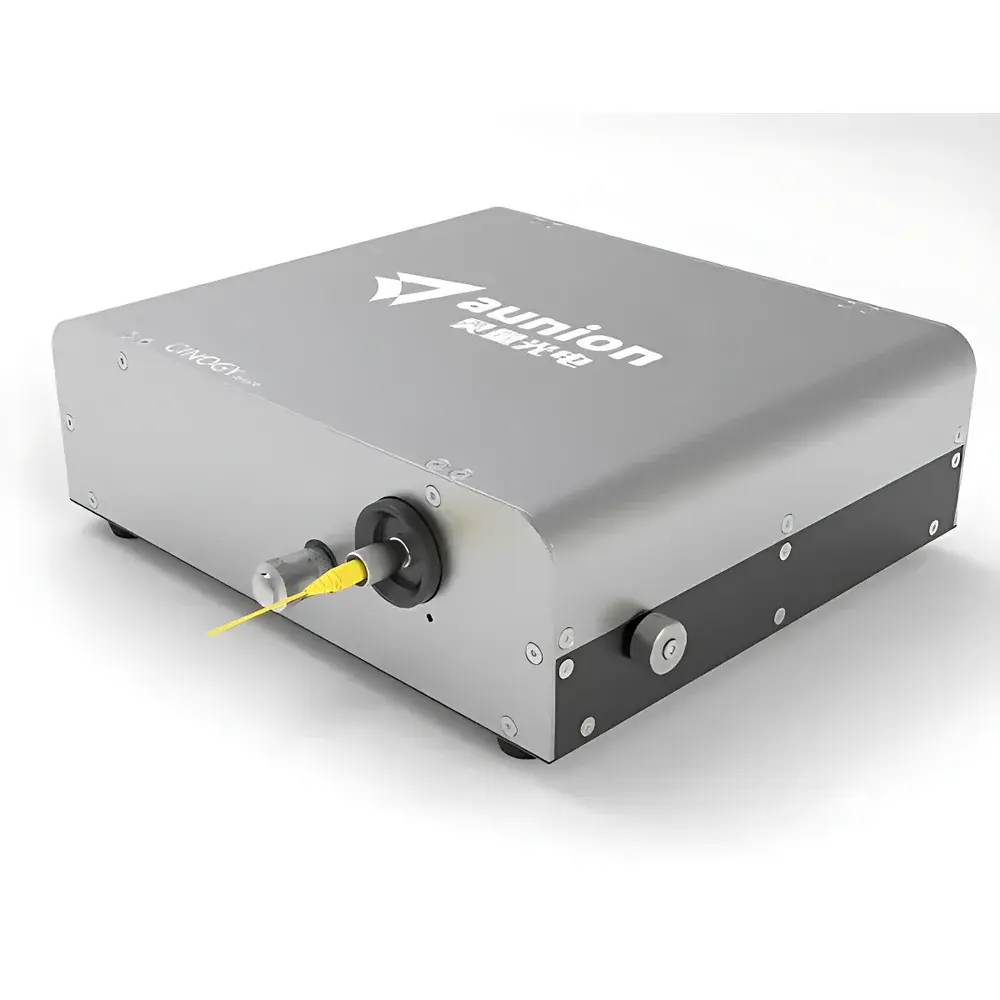
Auniontech AUT-EF Series Encircled Flux (EF) Measurement System
| Brand | Auniontech |
|---|---|
| Model | AUT-EF Series |
| Origin | Shanghai, China |
| Type | Encircled Flux (EF) Measurement Instrument for Multimode Optical Fibers |
| Compliance | IEC 61280-4-1, TIA-526-14-B, ISO/IEC 11801 |
| Interface | Gigabit Ethernet, USB 3.0 |
| Camera Compatibility | Cinogy-compatible scientific CMOS sensors (e.g., IDS UI-3370CP, Basler acA2000-50gm) |
| Software Platform | Windows 10/11 (64-bit), .NET Framework 4.8, OpenGL 4.3+ |
| Data Export | CSV, XML, HDF5 |
| Audit Trail | GLP-compliant operation logging with timestamped user actions |
| Calibration Support | NIST-traceable EF reference fibers (optional) |
Overview
The Auniontech AUT-EF Series Encircled Flux (EF) Measurement System is a precision optical metrology instrument engineered for standardized characterization of radial power distribution in multimode optical fibers. It operates on the principle of high-resolution near-field imaging combined with pixel-accurate photometric integration to quantify the fraction of total optical power enclosed within concentric circular apertures centered on the fiber core — precisely as defined in IEC 61280-4-1 and TIA-526-14-B. This measurement is critical for ensuring modal consistency across light sources (e.g., VCSELs, LEDs) used in high-speed datacom applications such as OM3/OM4/OM5 structured cabling, where launch condition variability directly impacts differential mode delay (DMD) and bandwidth performance. The system delivers traceable, repeatable EF profiles without requiring proprietary source conditioning hardware, enabling direct validation of transmitter compliance prior to system integration.
Key Features
- Optimized real-time EF computation engine leveraging IEEE 754 double-precision floating-point arithmetic for sub-0.1% radial power binning accuracy
- Intelligent pixel masking algorithm that automatically identifies and excludes saturated, clipped, or sensor-noise-dominant regions using adaptive histogram thresholding
- Modular GUI architecture supporting dynamic workspace reconfiguration — users may dock, undock, resize, and tab multiple analysis panels (image preview, radial profile plot, EF table, log console)
- Comprehensive audit logging with cryptographic timestamping, user ID tagging, and immutable operation records — fully aligned with GLP and internal quality management requirements
- Dual-buffered image acquisition pipeline ensuring zero-frame-drop throughput at up to 60 fps (dependent on camera model), maintaining temporal coherence between spatial sampling and power integration
- Open API (RESTful HTTP endpoints + native C++ SDK) for integration into factory MES, automated test benches, or LIMS environments — supports JSON/XML payload exchange and TLS 1.2 authentication
Sample Compatibility & Compliance
The AUT-EF Series is validated for use with standard 50 µm and 62.5 µm multimode fibers (MMF), including graded-index silica fibers compliant with ITU-T G.651.1 and ISO/IEC 11801. It supports both bare fiber end-face measurements (using precision V-groove fixtures) and connectorized interfaces (FC/PC, SC/PC, LC/PC) via optional alignment adapters. All EF calculations strictly follow the normalization and radial binning procedures mandated by IEC 61280-4-1 Ed. 3.0 (2021) and TIA-526-14-B (2020). Optional NIST-traceable EF reference fibers — calibrated against primary standards at national metrology institutes — are available for periodic system verification and uncertainty budgeting per ISO/IEC 17025.
Software & Data Management
The embedded EF Analysis Suite provides full lifecycle data handling: from raw sensor frame capture through calibrated radiometric conversion (via user-loaded camera responsivity curves) to final EF table generation. All intermediate datasets — including uncorrected images, flat-field normalized frames, and radial intensity integrals — are retained in HDF5 format with embedded metadata (exposure time, gain, lens magnification, fiber type, operator ID). Export modules support CSV (for spreadsheet analysis), XML (for ERP integration), and binary HDF5 (for MATLAB/Python post-processing). The software enforces role-based access control (RBAC) and maintains tamper-evident audit trails satisfying FDA 21 CFR Part 11 requirements for electronic records and signatures when deployed in regulated manufacturing environments.
Applications
- Pre-shipment validation of MMF transceivers and active optical cables against EF limits specified in IEEE 802.3ae, 802.3ba, and 802.3bm standards
- In-line EF monitoring during fiber optic patch cord assembly to detect core misalignment, contamination, or polishing defects affecting launch uniformity
- R&D characterization of novel multimode sources (e.g., photonic integrated VCSEL arrays) where modal excitation stability must be quantified under varying drive conditions
- Calibration laboratory support for accredited EF reference fiber production and inter-laboratory comparison studies
- Failure analysis of bandwidth-limiting events in datacenter links by correlating measured EF deviations with DMD test results
FAQ
What standards does the AUT-EF Series comply with for EF measurement?
It implements the full calculation methodology specified in IEC 61280-4-1 Ed. 3.0 and TIA-526-14-B, including mandatory normalization to total coupled power, radial bin width resolution (≤ 0.5 µm), and aperture centering tolerance (± 0.5 µm).
Can the system be integrated into an automated production test station?
Yes — it provides RESTful API endpoints for remote instrument control, asynchronous result retrieval, and event-driven notifications; full SDK documentation and example code (C++, Python, LabVIEW) are included.
Is camera calibration included in the base configuration?
The system ships with generic flat-field correction templates; however, full radiometric calibration — including quantum efficiency mapping and dark current profiling — requires optional NIST-traceable calibration services performed on the user’s specific camera-sensor-lens combination.
How is measurement uncertainty quantified and reported?
Uncertainty budgets follow GUM (JCGM 100:2008) principles and include contributions from pixelation error, centroid localization repeatability, photometric linearity deviation, and reference standard uncertainty — all documented in the generated measurement report.
Does the software support multi-user environments with permission levels?
Yes — administrator, operator, and viewer roles are enforced via Windows Active Directory integration or local credential database, with configurable permissions for parameter editing, report generation, and calibration access.




